
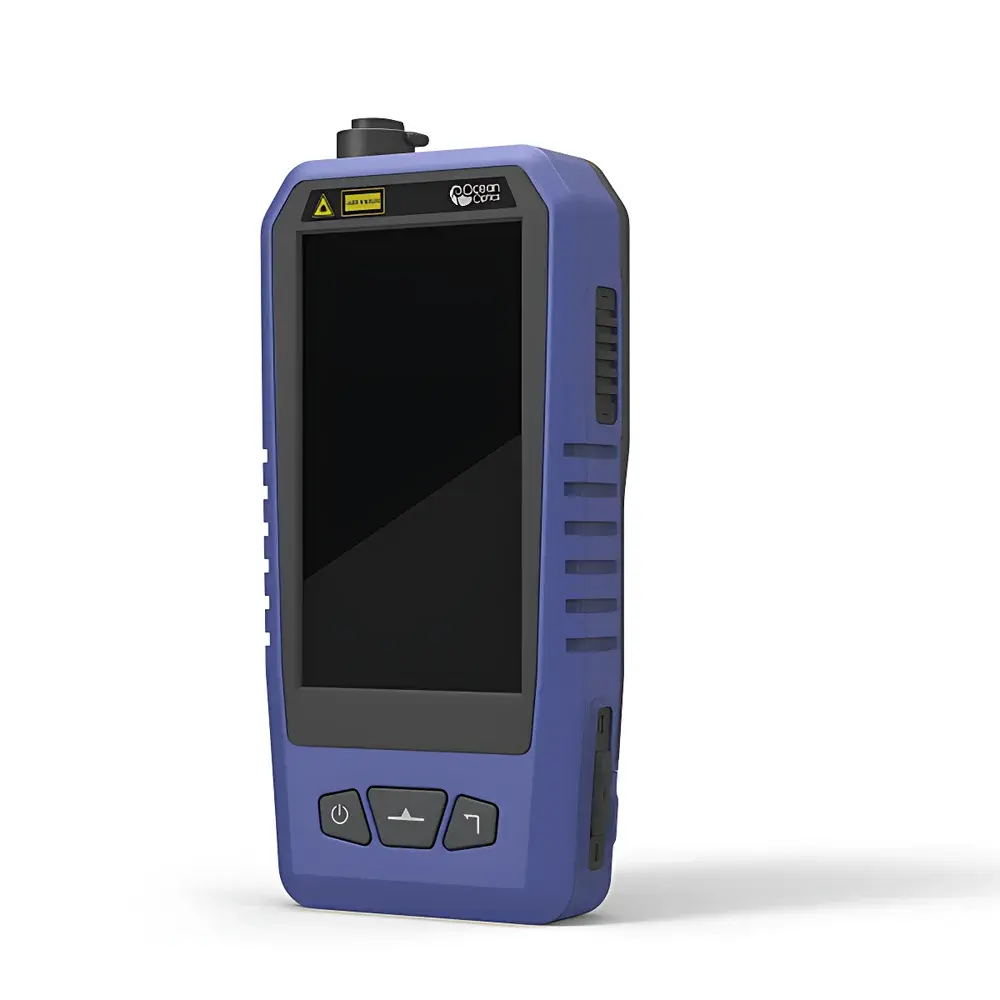
Ocean Optics HRS-5A Handheld Raman Spectrometer
| Brand | Ocean Optics |
|---|---|
| Origin | USA |
| Model | HRS-5A |
| Type | Handheld Raman Spectrometer |
| Spectral Range | 200–3200 cm⁻¹ |
| Spectral Resolution | 15 cm⁻¹ (typical) |
| Excitation Wavelength | 785 ± 0.5 nm (linewidth < 0.1 nm) |
| Laser Power | 0–500 mW (continuously adjustable) |
| Spectral Repeatability | ±0.5 nm |
| Dimensions (L×W×H) | 180 × 85 × 30 mm (excl. probe extension) |
| Weight | 550 g |
| Operating Temperature | −10 to 50 °C |
| Storage Temperature | −20 to 60 °C |
| Relative Humidity | ≤90% (non-condensing) |
| Battery Life | ≥3.5 h (standard), ≥12 h (optional extended-life battery) |
| Local Storage Capacity | >1,000,000 spectra |
| Display | 1920 × 1080 capacitive touchscreen |
| Onboard Camera | 13 MP |
| Positioning | GPS/BeiDou/GLONASS + Wi-Fi/4G triangulation |
| Connectivity | Wi-Fi, 4G (SIM-card enabled), Micro-USB |
| Operating System | Android-based embedded platform |
Overview
The Ocean Optics HRS-5A Handheld Raman Spectrometer is an engineered field-deployable instrument designed for rapid, non-destructive molecular identification across regulatory, industrial, and forensic applications. It operates on the principle of inelastic light scattering—Raman spectroscopy—where monochromatic 785 nm laser excitation induces vibrational mode shifts in chemical bonds, yielding a unique spectral fingerprint between 200 and 3200 cm⁻¹. With a typical spectral resolution of 15 cm⁻¹ and calibrated wavelength stability (±0.5 nm repeatability), the HRS-5A delivers laboratory-grade spectral fidelity in a rugged, palm-sized form factor (180 × 85 × 30 mm; 550 g). Its dual-rechargeable lithium-ion battery system supports ≥3.5 hours of continuous operation—extendable to ≥12 hours with optional high-capacity modules—enabling sustained use in mobile inspection environments including border checkpoints, pharmaceutical manufacturing floors, hazardous material response units, and customs screening lanes.
Key Features
- Field-Optimized Optical Architecture: Integrated thermally stabilized 785 nm diode laser (0–500 mW continuously adjustable) minimizes fluorescence interference while maintaining signal-to-noise integrity across diverse sample classes—from dark polymers to fluorescent pharmaceuticals.
- Adaptive Probe Interface: Motorized, continuously variable working distance (0.5–7.5 mm) accommodates opaque containers, blister packs, glass vials, and irregular surfaces without physical contact or sample preparation.
- Embedded Intelligence: On-device multilevel matching algorithms—including fluorescence background subtraction, mixture deconvolution, and spectral library correlation—enable real-time identification of pure substances and multi-component mixtures without cloud dependency.
- Secure Android Platform: Full HD 1920 × 1080 capacitive touchscreen with dedicated hardware keys (one-touch acquisition, power, back) ensures intuitive operation under gloves or adverse lighting. Role-based user permissions enforce compliance with organizational access control policies.
- Robust Environmental Rating: Certified for operation from −10 °C to 50 °C and ≤90% RH (non-condensing), with IP54-rated enclosure sealing against dust and incidental water exposure during transit or outdoor deployment.
Sample Compatibility & Compliance
The HRS-5A is validated for direct analysis of solid, liquid, and semi-solid samples through transparent or translucent packaging—including amber glass, PET, HDPE, and laminated pouches—without unpacking or sampling. Its spectral library framework supports customizable model deployment aligned with ISO/IEC 17025 method validation requirements. Preloaded reference libraries cover controlled substances (UNODC Schedule I–IV), hazardous chemicals (OSHA GHS-compliant classifications), pharmaceutical active ingredients (USP-NF monographs), gemological materials (GIA mineral database), and industrial solvents (ASTM D2622 hydrocarbon profiles). All spectral acquisitions embed geotagged metadata (GPS/BeiDou/GLONASS), timestamp, operator ID, and instrument calibration status—ensuring full traceability per FDA 21 CFR Part 11 and EU Annex 11 audit trail specifications.
Software & Data Management
The HRS-5A integrates with Ocean Insight’s secure cloud platform for centralized device lifecycle management. Administrators assign instruments to hierarchical organizational units (e.g., “Regional Customs Lab A”, “Pharma QC Site B”), enforcing logical data segregation and policy-driven firmware/model distribution. Over-the-air updates deliver algorithm enhancements, new spectral libraries, and security patches without physical intervention. Raw spectra, processed identifications, acquisition parameters, and geolocation coordinates are encrypted in transit (TLS 1.3) and at rest (AES-256), meeting HIPAA, GDPR, and NIST SP 800-53 confidentiality standards. Audit logs record all user actions—including library edits, permission changes, and report exports—with immutable timestamps for GLP/GMP compliance reporting.
Applications
- Law enforcement: Rapid identification of illicit narcotics, precursors, and explosives at ports of entry or roadside interdiction points.
- Pharmaceutical QA/QC: Verification of API identity and excipient composition in final dosage forms, supporting ICH Q5C and USP guidelines.
- Hazardous materials response: On-scene differentiation of flammable liquids, toxic industrial chemicals (TICs), and corrosive agents per NFPA 704 and DOT ERG protocols.
- Food safety surveillance: Detection of adulterants (e.g., melamine in dairy, Sudan dyes in spices) and verification of authenticity (e.g., olive oil purity, honey origin).
- Geoscience & gemology: In-field mineral phase identification and synthetic vs. natural gemstone discrimination using crystalline lattice vibration signatures.
- Research & development: High-throughput screening of catalyst formulations, polymer degradation products, and battery electrode materials under ambient conditions.
FAQ
Is the HRS-5A compliant with FDA 21 CFR Part 11 for electronic records and signatures?
Yes—the device enforces role-based authentication, audit-trail logging of all spectral acquisitions and library modifications, and cryptographic hash integrity checks for stored data, satisfying predicate rule requirements for regulated laboratories.
Can spectral libraries be customized and deployed across heterogeneous fleets?
Yes—users build, validate, and version-control proprietary models via the cloud portal; validated libraries are pushed selectively to designated device groups with configurable approval workflows.
What calibration standards are supported for routine performance verification?
The system includes NIST-traceable silicon (520.7 cm⁻¹) and cyclohexane (2901 cm⁻¹) reference caps; automated daily self-check routines verify wavelength accuracy, intensity linearity, and resolution stability.
Does the HRS-5A support offline operation when network connectivity is unavailable?
Yes—all core identification algorithms, local spectral libraries (>1 million entries), and data storage operate autonomously; synchronization with the cloud occurs automatically upon reconnection.
How is laser safety managed during field use?
The instrument complies with IEC 60825-1:2014 Class 3B laser safety standards; integrated proximity sensing disables emission if the probe-to-sample distance falls below 0.5 mm, and visible red aiming beam confirms alignment prior to Raman acquisition.





