
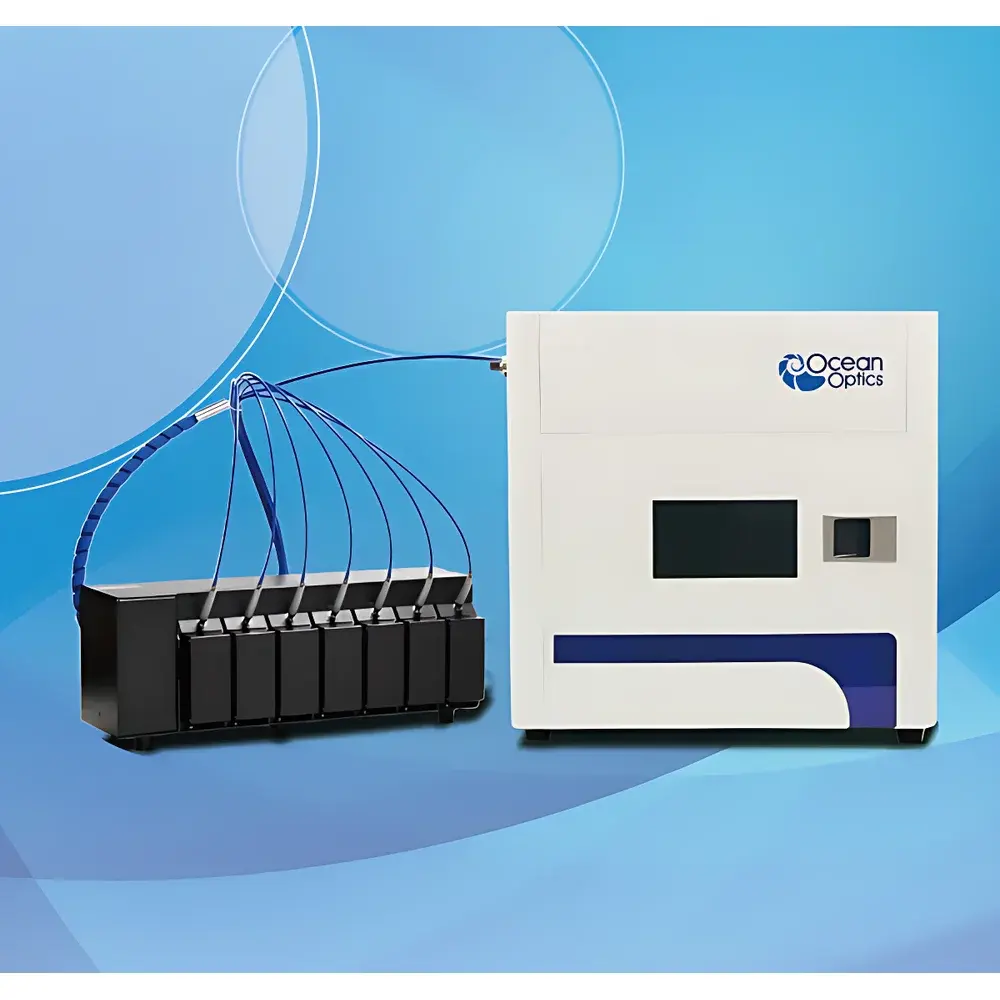
Ocean Optics LIBS-MX2500+ Laser-Induced Breakdown Spectroscopy System
| Brand | Ocean Optics |
|---|---|
| Origin | USA |
| Manufacturer Type | Authorized Distributor |
| Instrument Type | Benchtop |
| Integration | Modular |
| Laser Wavelength | 1064 nm (Nd:YAG, optional 532 nm) |
| Laser Pulse Energy | 50–200 mJ |
| Spectral Range | 180–1037 nm |
| Channels | 1–8 configurable |
| Optical Resolution | 0.1 nm (FWHM) |
| Detector | Linear or Area CCD |
| Trigger Delay Accuracy | ±450 ns |
| Trigger Jitter | ±10 ns |
| Spot Size | ≤50 µm |
| Sample Max Dimensions | 30 × 30 × 20 mm |
| Sample Max Mass | 2 kg |
| XYZ Translation Stage Range | 60 × 60 × 60 mm |
| Plasma Emission Detection Sensitivity | ≥10 ppm (element-dependent) |
| Fiber Optic Coupling | UV-Enhanced Silica Fiber |
Overview
The Ocean Optics LIBS-MX2500+ is a high-performance, modular benchtop Laser-Induced Breakdown Spectroscopy (LIBS) system engineered for rapid, minimally destructive elemental analysis of solids, powders, liquids, and gases. Based on the fundamental principle of atomic emission spectroscopy, the system employs a nanosecond-pulsed Nd:YAG laser (1064 nm primary, optionally 532 nm) to ablate a micro-volume of sample material—typically 10,000 K). As excited atoms and ions in the plasma decay to lower energy states, they emit element-specific photons across the ultraviolet–near-infrared spectrum (180–1037 nm). The MX2500+’s multi-channel spectrometer captures time-resolved spectral emissions with precise delay-gated acquisition, synchronized to plasma evolution dynamics to maximize signal-to-background ratio and spectral fidelity.
Unlike conventional techniques such as ICP-OES or XRF, LIBS requires no acid digestion, pelletization, or vacuum preparation—enabling direct, in-situ measurement with molecular-level surface perturbation. Its inherent standoff capability supports remote operation in hazardous environments (e.g., radioactive zones, toxic industrial settings), while its compact footprint and fiber-coupled architecture facilitate integration into production lines, field-deployable platforms, or regulated laboratory workflows compliant with GLP and ISO/IEC 17025 requirements.
Key Features
- Modular, multi-channel spectrometer platform (1–8 independently configurable channels) covering 180–1037 nm with 0.1 nm FWHM optical resolution
- Ultra-low jitter triggering (±10 ns) and programmable delay gating (±450 ns) for optimal plasma emission capture during peak atomic line intensity
- High-density linear or area CCD detectors supporting integration times from 1 ms to 65 s, enabling dynamic range optimization across trace and major elements
- UV-enhanced fused silica optical fiber coupling for efficient light transmission and long-term stability under repeated plasma exposure
- Integrated hardware synchronization engine enabling precise coordination of up to two external devices (e.g., dual-pulse lasers, microwave plasma enhancers)
- Benchtop design with standardized mechanical interfaces (e.g., SM1-threaded mounts, kinematic stage compatibility) for seamless integration with OEM sample chambers, robotics, or industrial process lines
Sample Compatibility & Compliance
The LIBS-MX2500+ accommodates heterogeneous samples without preprocessing: conductive and non-conductive solids (metals, ceramics, polymers), pressed pellets (soils, coal, biological tissues), thin films, and liquid surfaces (via controlled droplet or flow-cell configurations). Maximum sample dimensions are 30 × 30 × 20 mm; mass limit is 2 kg. An integrated XYZ translation stage (60 × 60 × 60 mm travel) enables automated rastering for spatially resolved mapping. The system meets ANSI Z136.1 and IEC 60825-1 Class 4 laser safety standards when used with an interlocked, NIST-traceable sample chamber (e.g., stainless-steel enclosure with purge gas port, visible/IR imaging viewport, and beam dump). Optional atmospheric control (Ar, He, N₂) enhances signal stability for low-Z elements (e.g., C, N, O, Li, Be). Data acquisition complies with FDA 21 CFR Part 11 requirements when deployed with validated software environments supporting electronic signatures, audit trails, and secure user access controls.
Software & Data Management
Control and spectral processing are implemented via OceanView™ software (v2.5+), which provides real-time visualization, wavelength calibration (Hg/Ne/Ar lamp reference), dark-current subtraction, fluorescence background modeling, and peak deconvolution using iterative least-squares fitting. The SDK includes C/C++, Python, and MATLAB APIs with full DLL support for custom algorithm development—including multivariate regression (PLS-R), principal component analysis (PCA), and machine-learning–based classification models. Raw spectral data are stored in HDF5 format with embedded metadata (laser energy, gate delay, integration time, sample ID), ensuring FAIR (Findable, Accessible, Interoperable, Reusable) data management principles. Export options include CSV, ASCII, and ASTM E131-compliant spectral data exchange files.
Applications
- Environmental Monitoring: Quantitative detection of heavy metals (Pb, Cd, As, Cr) in soils, sediments, and plant tissues—validated against EPA Method 6010D and ISO 11885 protocols
- Metallurgy & Process Control: Real-time alloy composition monitoring during steelmaking (e.g., Mn, Ni, Cr, Mo) and coal quality assurance (S, Cl, Ca, Si)—reducing batch rejection rates by >35% in pilot deployments at integrated mills
- Cultural Heritage Science: Non-invasive pigment identification in paintings, glaze analysis in ceramics, and provenance determination of gemstones—performed under museum-grade conservation guidelines (ICOM-CC)
- Biomedical Research: Elemental mapping of calcified tissues (bone, dental enamel) for Ca/P ratio, trace metal accumulation (Fe, Zn, Sr), and pathological mineral deposition studies
- Plasma Diagnostics: Time-resolved emission monitoring in ICP-OES torches, atmospheric-pressure plasma jets, and reactive ion etching reactors—supporting endpoint detection per SEMI E10 and ISO 14644 cleanroom standards
FAQ
What is the minimum detectable concentration for common elements?
Detection limits vary by element, matrix, and operating conditions; typical values range from 10–100 ppm for transition metals (Fe, Cu, Zn) in metallic matrices and 50–500 ppm for light elements (C, N, O) in insulating materials.
Can the system be upgraded to support dual-pulse LIBS?
Yes—the MX2500+’s external trigger architecture supports synchronization with two independently timed lasers (e.g., collinear or orthogonal configuration) via TTL or LVDS signals, enabling enhanced plasma lifetime and signal reproducibility.
Is spectral calibration traceable to NIST standards?
All factory calibrations use NIST-traceable Hg/Ne/Ar emission lamps; users may perform on-site recalibration using certified reference materials (CRMs) aligned with ISO Guide 35 and ASTM E2917.
What software validation documentation is provided for regulated industries?
A comprehensive IQ/OQ protocol package—including installation verification checklists, operational performance tests, and electronic record integrity reports—is available upon request for GxP environments.
How is laser-induced damage mitigated during repeated analysis?
The system employs adaptive focusing optics, automated stage repositioning, and real-time plasma luminosity feedback to minimize cumulative thermal effects—ensuring consistent ablation crater morphology over >10⁴ shots per site.
Related Products





