
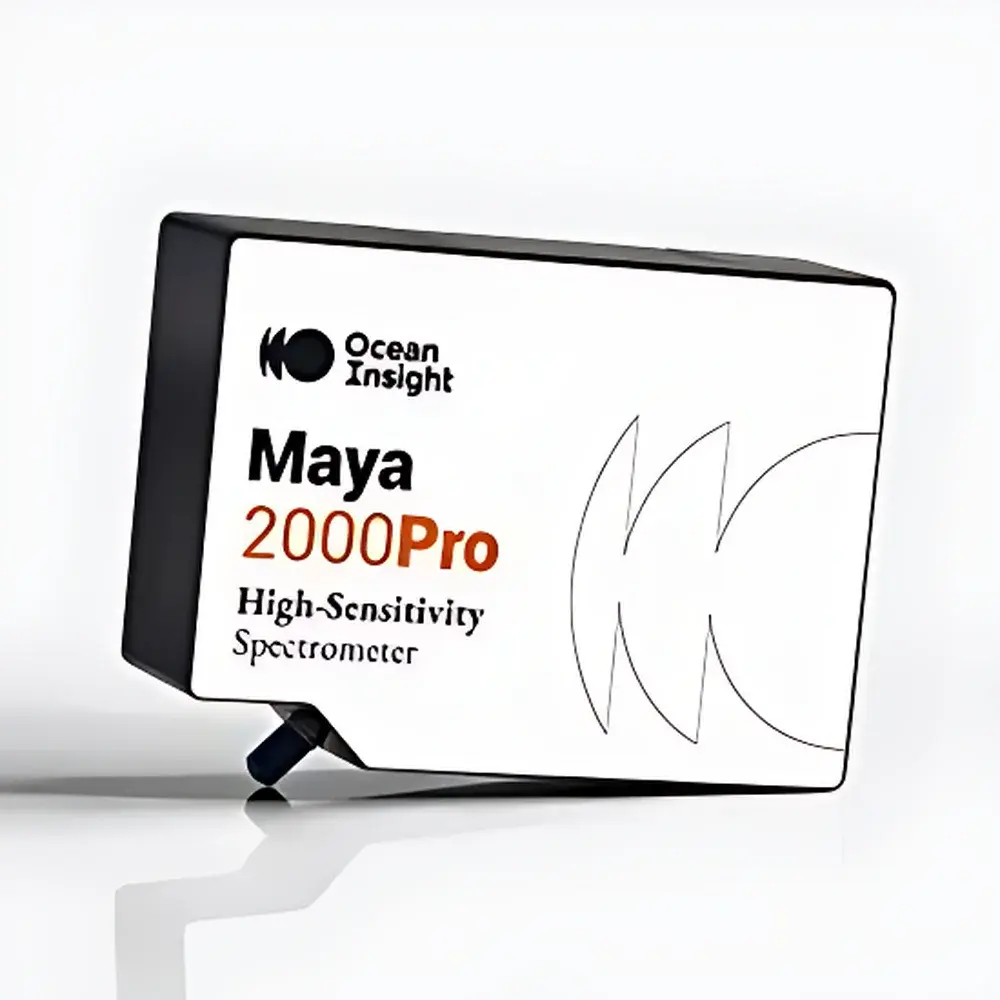
Ocean Optics Maya 2000 Fiber Optic Spectrometer
| Brand | Ocean Optics |
|---|---|
| Model | Maya 2000 |
| Spectral Range | 200–1100 nm |
| Detector Type | Back-illuminated FFT-CCD (Hamamatsu S9840) |
| Quantum Efficiency | Up to 90% @ 250 nm |
| Signal-to-Noise Ratio | 450:1 (full well, 1 s integration) |
| Dynamic Range | 15,000:1 (typical, with 16-bit A/D) |
| Stray Light | <0.05% @ 600 nm |
| Optical Resolution (FWHM) | ~0.035 nm (dependent on grating and slit selection) |
| Integration Time | 5 ms – 20 s |
| A/D Conversion | 16-bit, 500 kHz |
| Pixel Array | 2048 × 14 active pixels |
| Pixel Size | 14 µm × 14 µm |
| Slit Options | 5, 10, 25, 50, 100, 200 µm |
| Grating Options | 14 standard gratings, including HC-1 broadband grating (175–1100 nm) |
| Onboard GPIOs | 10 user-programmable digital I/O lines |
| Interface | USB 2.0 |
| Software | SpectraSuite (Windows/macOS/Linux) |
Overview
The Ocean Optics Maya 2000 is a high-performance, back-illuminated fiber optic spectrometer engineered for demanding UV-VIS-NIR spectroscopic applications where sensitivity, spectral fidelity, and reproducibility are critical. Built around a Hamamatsu S9840 back-thinned, full-frame transfer (FFT) CCD detector, the instrument leverages deep-depletion silicon architecture to deliver exceptional quantum efficiency—up to 90% at 250 nm—without requiring UV-enhancing coatings. This eliminates batch-to-batch variability associated with coated optics and ensures consistent ultraviolet response across instruments and over time. Its optical design supports resolution down to ~0.035 nm FWHM (full width at half maximum), adjustable via interchangeable slits (5–200 µm) and 14 available gratings—including the HC-1 broadband grating covering 175–1100 nm—enabling flexible configuration for absorption, fluorescence, reflectance, or Raman measurements. With a 16-bit analog-to-digital converter operating at 500 kHz and integration times spanning 5 milliseconds to 20 seconds, the Maya 2000 balances speed, dynamic range (15,000:1), and low-noise signal acquisition under variable illumination conditions.
Key Features
- Back-illuminated FFT-CCD detector (Hamamatsu S9840) with no UV coating dependency, ensuring stable and repeatable UV quantum efficiency
- High optical throughput enabled by integrated focusing lens and optional order-sorting filters to suppress second- and third-order diffraction artifacts
- Configurable spectral resolution via six slit widths (5–200 µm) and 14 grating options, including the HC-1 broadband grating for extended 175–1100 nm coverage
- Low electronic noise architecture supporting 450:1 signal-to-noise ratio (at full-well capacity, 1 s integration) and <0.05% stray light at 600 nm
- Onboard programmable logic: 10 general-purpose input/output (GPIO) lines for synchronized triggering, shutter control, or external device interfacing
- USB 2.0 interface with plug-and-play compatibility and real-time data streaming capability
Sample Compatibility & Compliance
The Maya 2000 interfaces seamlessly with standard SMA 905 optical fibers (e.g., 200 µm, 400 µm, or 600 µm core diameters), enabling non-invasive, remote sampling in liquid, gas, solid, or plasma environments. Its compact, thermally stable housing allows integration into OEM systems, process monitoring setups, or portable field instruments. While not certified for intrinsic safety or hazardous area use, the spectrometer meets CE, FCC Part 15, and RoHS compliance requirements. Its measurement traceability aligns with ISO/IEC 17025 principles when operated within validated workflows; spectral calibration files support NIST-traceable wavelength and intensity reference standards. The absence of active thermoelectric cooling means performance remains stable within ambient temperature ranges of 15–35 °C—ideal for laboratory benchtop, educational, or quality control environments where controlled thermal management is impractical.
Software & Data Management
SpectraSuite—a cross-platform application supporting Windows, macOS, and Linux—provides intuitive instrument control, real-time spectral visualization, and export-ready data formatting (CSV, TXT, XML). It includes built-in tools for dark current subtraction, pixel binning, smoothing, peak identification, and multi-curve overlay. For regulated environments, SpectraSuite can be deployed in conjunction with audit-trail-enabled data acquisition frameworks compliant with FDA 21 CFR Part 11 requirements—provided users implement appropriate system validation protocols, electronic signature controls, and secure storage policies. Raw spectral data retains full 16-bit depth and metadata (integration time, grating ID, slit width, calibration timestamp), facilitating post-acquisition reprocessing and inter-instrument comparison. API support (via COM, LabVIEW VIs, Python SDK, and MATLAB drivers) enables integration into automated test sequences, LIMS interfaces, or custom QC dashboards aligned with ISO 9001 or GLP/GMP documentation practices.
Applications
- UV-Vis absorbance quantification of nucleic acids, proteins, and small molecules in pharmaceutical development and bioprocess monitoring
- Fluorescence excitation/emission profiling of quantum dots, organic dyes, and biological fluorophores
- In-line colorimetric analysis of dyed textiles, paints, and polymer films per ASTM D2244 and ISO 11664-4
- Plasma emission diagnostics in semiconductor etch and deposition chambers
- Educational spectroscopy labs requiring robust, low-maintenance instrumentation with broad spectral coverage and intuitive software
- Environmental monitoring of nitrate, phosphate, and organic contaminants in water using calibrated multivariate regression models
FAQ
Does the Maya 2000 require external cooling for optimal performance?
No. The Hamamatsu S9840 detector operates uncooled, with thermal stability maintained through passive heat dissipation. Performance specifications assume ambient temperatures between 15 °C and 35 °C.
Can the Maya 2000 be used for Raman spectroscopy?
Yes—when paired with a suitable laser excitation source and notch or edge filter, the Maya 2000 supports basic Raman measurements in the visible to NIR range, particularly with narrow-slit and high-resolution grating configurations.
How is wavelength calibration performed and maintained?
Factory calibration uses Hg-Ne and deuterium lamp lines; users may perform recalibration using optional NIST-traceable calibration sources. SpectraSuite stores calibration coefficients per grating/slit combination and supports user-defined polynomial or spline-based corrections.
What is the difference between the Maya 2000 and Maya 2000-Pro?
The Maya 2000 prioritizes faster readout speeds, while the Maya 2000-Pro emphasizes higher dynamic range and improved SNR through optimized electronics and longer full-well integration—making it preferable for low-light, long-integration applications.
Is USB isolation supported for electrically noisy industrial environments?
While the standard USB 2.0 interface lacks galvanic isolation, third-party optically isolated USB extenders compatible with HID-class devices may be deployed to mitigate ground-loop interference in factory-floor installations.






