
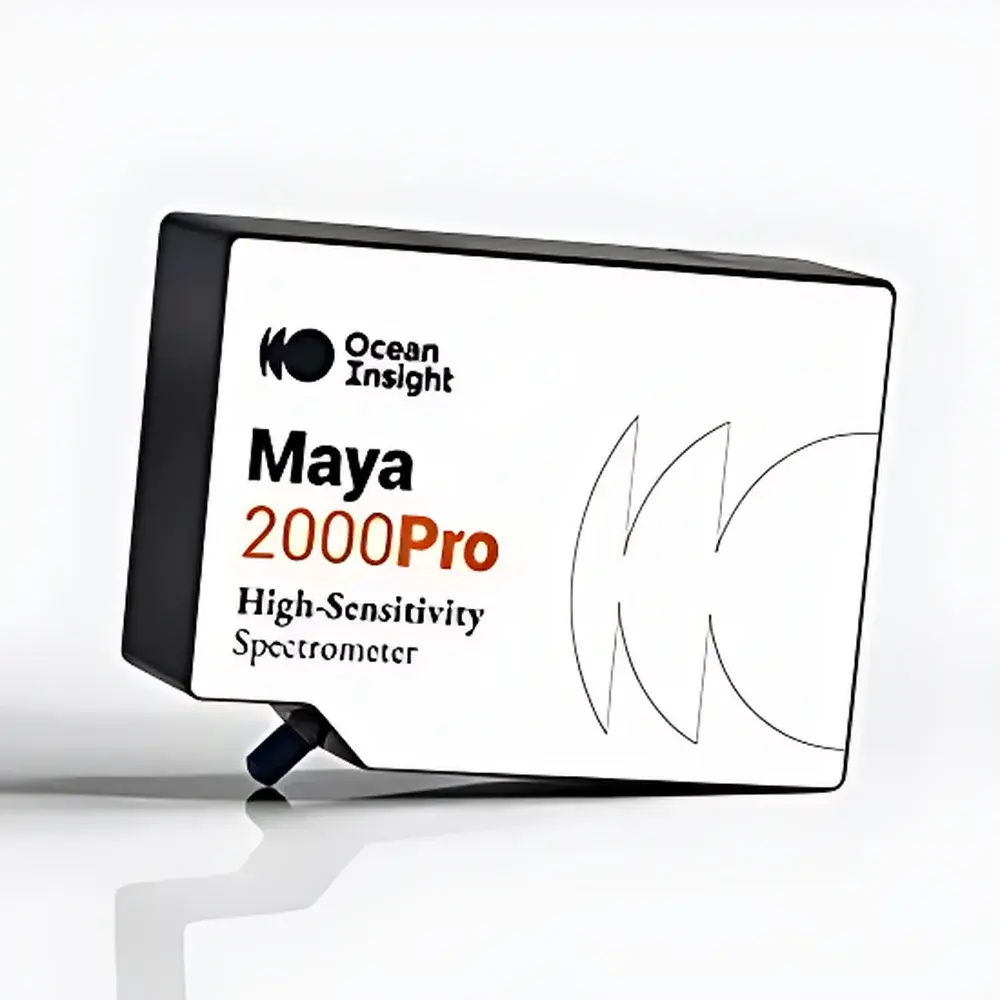
Ocean Optics Maya2000 Pro Fiber Optic Spectrometer
| Brand | Ocean Optics |
|---|---|
| Model | Maya2000 Pro |
| Spectral Range | 200–1100 nm |
| Detector Type | Back-Illuminated CCD |
| Optical Resolution | 0.07–6.7 nm (slit- and grating-dependent) |
| Signal-to-Noise Ratio | 450:1 |
| Dynamic Range | ~8000:1 |
| Stray Light | <0.05% at 600 nm, <0.10% at 435 nm |
Overview
The Ocean Optics Maya2000 Pro is a high-performance, compact fiber optic spectrometer engineered for demanding UV-Vis-NIR spectroscopic applications requiring high sensitivity, low noise, and spectral flexibility. Built around a thermoelectrically stabilized, back-illuminated, full-frame CCD detector with deep-depletion architecture, the Maya2000 Pro delivers superior quantum efficiency—particularly in the UV (down to 200 nm) and NIR (up to 1100 nm)—enabling robust detection of weak optical signals in fluorescence, Raman scattering, absorbance, and transmittance measurements. Its optical bench integrates a precision-aligned Czerny-Turner monochromator with user-selectable gratings and entrance slits, allowing configuration-specific resolution tuning from 0.07 nm to 6.7 nm. The instrument operates on a USB 2.0 interface with minimal external power requirements, supporting real-time spectral acquisition at up to 1000 spectra per second (depending on integration time and readout mode). Designed for integration into OEM systems, laboratory workstations, and field-deployable setups, the Maya2000 Pro adheres to industrial-grade mechanical and thermal stability standards, ensuring measurement reproducibility across varying ambient conditions.
Key Features
- Back-illuminated, full-frame CCD detector: Delivers peak quantum efficiency >90% in the UV and >70% at 900 nm, enabling high-sensitivity detection without cryogenic cooling.
- Thermoelectric stabilization: Integrated Peltier cooler maintains detector temperature at –10 °C ± 0.1 °C, reducing dark current by >95% compared to uncooled operation and enhancing long-integration stability.
- Configurable optical path: Supports interchangeable gratings (e.g., 300, 600, 1200, 1800, 2400 grooves/mm) and slit widths (5–200 µm), permitting optimization for resolution, throughput, or signal-to-noise trade-offs.
- Low-stray-light optical design: Optimized baffling and holographic grating options minimize stray light to <0.05% at 600 nm and <0.10% at 435 nm—critical for accurate quantitation in high-dynamic-range absorbance and fluorescence assays.
- USB-powered architecture: No external power supply required; compatible with laptop, embedded PC, or industrial controller environments via standard USB 2.0 port with software-controlled triggering and synchronization.
- Robust mechanical housing: Aluminum alloy chassis with anodized finish provides EMI shielding, thermal mass buffering, and resistance to mechanical shock—validated per IEC 60068-2 environmental test standards.
Sample Compatibility & Compliance
The Maya2000 Pro interfaces seamlessly with a wide range of sampling accessories—including cuvette holders, integrating spheres, fiber-coupled probes, collimating optics, and flow cells—enabling direct coupling to liquid chromatography, gas-phase reaction monitoring, or solid-sample reflectance setups. It supports compliance-driven workflows through native compatibility with analytical software platforms that implement audit trails, electronic signatures, and data integrity controls aligned with FDA 21 CFR Part 11, ISO/IEC 17025, and GLP/GMP documentation requirements. While the spectrometer itself is not certified as a medical device or safety-critical instrument, its firmware and SDK support deterministic timing, metadata tagging (wavelength calibration, integration time, detector temperature), and raw-data export in vendor-neutral formats (e.g., CSV, HDF5), facilitating traceability in regulated environments.
Software & Data Management
OceanView spectroscopy software provides intuitive instrument control, real-time spectral visualization, multivariate analysis (PCA, PLS), and customizable reporting templates. For integration into automated systems, the Maya2000 Pro offers a comprehensive SDK supporting Python, MATLAB, LabVIEW, C#, and C/C++. All spectral acquisitions include embedded calibration metadata (pixel-to-wavelength mapping, nonlinearity correction coefficients, dark reference timestamp), ensuring reproducible recalibration and cross-instrument comparability. Data export supports time-stamped, hierarchical storage structures compliant with FAIR (Findable, Accessible, Interoperable, Reusable) principles. Optional add-ons include chemometric modeling modules and cloud-based spectral library management tools compatible with ASTM E1421 and ISO 14253-1 metrological frameworks.
Applications
- UV-Vis quantitative analysis of pharmaceutical actives and excipients per USP & EP monographs
- In-line process monitoring of chemical synthesis and polymerization reactions
- Fluorescence lifetime screening in life science assay development
- Raman spectral fingerprinting of polymorphs and crystalline phases
- Colorimetric validation of LED lighting and display technologies
- Environmental water quality assessment (nitrate, chlorophyll-a, dissolved organic carbon)
- Plasma emission characterization in semiconductor fabrication tool monitoring
FAQ
What wavelength calibration options are available for the Maya2000 Pro?
Factory calibration uses NIST-traceable Hg-Ne and Hg-Ar emission lines; users may perform custom calibration using external sources or built-in onboard LED references.
Can the Maya2000 Pro operate in triggered or gated acquisition mode?
Yes—it supports hardware TTL triggering (rising/falling edge), external sync input, and internal programmable delay for time-resolved measurements including pump-probe and gated fluorescence.
Is the detector linear over its full dynamic range?
The CCD exhibits >99.8% linearity up to 95% of full well capacity, verified per ISO 15739:2013 methodology using neutral density step wedges.
How is spectral resolution defined and validated for this instrument?
Resolution is specified as FWHM of the instrumental line profile measured using a low-pressure mercury lamp; actual resolution depends on selected grating groove density and entrance slit width, and is documented in the instrument-specific calibration certificate.
Does OceanView software support IQ/OQ/PQ validation protocols?
Yes—software installation packages include validation documentation kits (IQ/OQ templates), and optional third-party PQ services are available through authorized partners accredited to ISO/IEC 17025.
Related Products




