
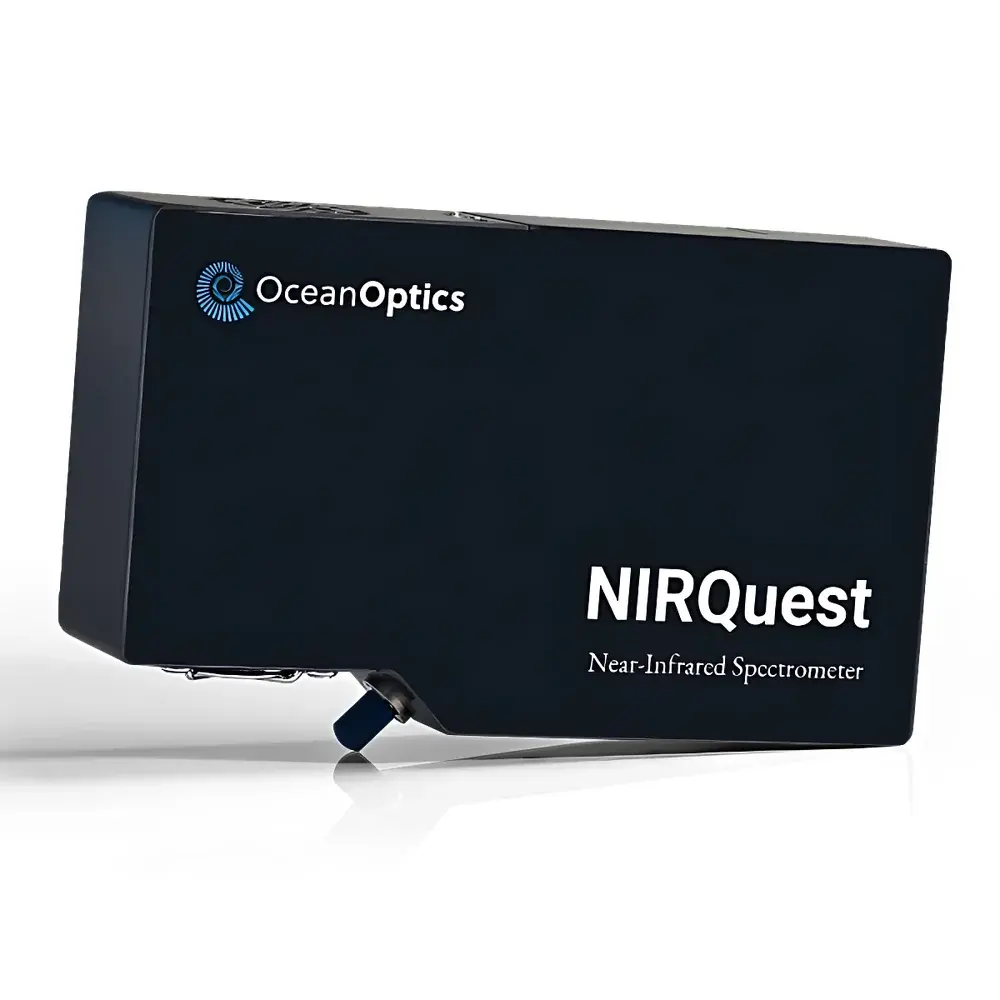
Ocean Optics NIRQuest+ Near Infrared Spectrometer
| Brand | Ocean Optics |
|---|---|
| Origin | Shanghai, China |
| Manufacturer Type | Authorized Distributor |
| Product Category | Domestic |
| Model | NIRQuest+ |
| Instrument Type | Laboratory & Process-Ready |
| Optical Principle | Fixed-grating spectrometer with linear array detector (non-scanning) |
| Wavelength Ranges | NIRQuest+1.7 (900–1700 nm), NIRQuest+2.2 (900–2200 nm), NIRQuest+2.5 (900–2500 nm) |
| Detector | InGaAs linear array (TE-cooled) |
| Optical Resolution (FWHM) | 1.7–5.0 nm (configurable by slit and grating) |
| Integration Time | 1 ms to 65 s |
| Signal-to-Noise Ratio | ≥15,000:1 (at full signal, 1 s integration, NIRQuest+2.5) |
| Dynamic Range | >25,000:1 (with 16-bit ADC) |
| Interface | USB 2.0 / USB 3.0 (via optional adapter) |
| Compliance | CE, RoHS, FCC Class B |
Overview
The Ocean Optics NIRQuest+ is a high-performance, fixed-grating near-infrared (NIR) spectrometer engineered for precision quantitative and qualitative analysis across laboratory and industrial environments. Based on non-scanning optical architecture—utilizing a thermoelectrically (TE) cooled InGaAs linear array detector and optimized Czerny-Turner optical bench—the NIRQuest+ delivers exceptional sensitivity, stability, and spectral fidelity in the 900–2500 nm range. Unlike scanning monochromator-based systems, its array-detector design enables simultaneous acquisition of the full spectrum, eliminating mechanical wear and enabling millisecond-level integration times. This architecture supports both reflectance (diffuse and specular) and transmittance measurement modalities, making it suitable for solid, semi-solid, and liquid sample analysis without reconfiguration. The instrument’s optical platform is calibrated traceably to NIST standards and designed to maintain wavelength accuracy (<0.5 nm drift over 8 hours at 25 °C) and photometric repeatability (<0.3% RSD over 100 scans) under ambient lab conditions.
Key Features
- Three standardized spectral configurations: NIRQuest+1.7 (900–1700 nm), NIRQuest+2.2 (900–2200 nm), and NIRQuest+2.5 (900–2500 nm), each optimized for detector quantum efficiency and stray light suppression.
- TE-cooled InGaAs detector (−10 °C typical operating temperature) significantly reduces dark current noise, enabling low-light performance critical for diffuse reflectance of opaque or highly scattering materials.
- Modular optical interface: Compatible with standard SMA 905 fiber-optic couplings, integrating seamlessly with reflection probes, transmission cells, flow-through cuvettes, and process dip probes.
- Ruggedized aluminum housing with passive thermal management ensures stable operation during extended acquisitions and field-deployable use cases.
- USB-powered operation (no external power supply required for most configurations) with plug-and-play compatibility across Windows, Linux, and macOS platforms via OceanView SDK and third-party API support (LabVIEW, Python, MATLAB).
Sample Compatibility & Compliance
The NIRQuest+ accommodates diverse sample forms—including powders, granules, films, slurries, and clear or turbid liquids—through configurable sampling optics and pathlength optimization. Its high signal-to-noise ratio (≥15,000:1) and extended spectral reach up to 2500 nm support robust chemometric modeling for moisture, polymer composition, protein content, and hydrocarbon ratios. The system meets electromagnetic compatibility requirements per EN 61326-1 (CE), complies with RoHS Directive 2011/65/EU and FCC Part 15 Subpart B Class B emissions limits, and supports audit-ready data integrity when used with validated software workflows compliant with FDA 21 CFR Part 11 and ISO/IEC 17025 guidelines. Optional IQ/OQ documentation packages are available for GMP/GLP-regulated laboratories.
Software & Data Management
OceanView spectroscopy software provides real-time spectral visualization, baseline correction, peak identification, and multivariate calibration tools (PLS, PCA, PCR). Raw data export is supported in CSV, TXT, and JCAMP-DX formats; spectral metadata (wavelength, integration time, detector temperature, lamp reference) is embedded per scan. The OceanInsight SDK enables programmatic control and integration into LIMS, MES, or SCADA systems. For regulated environments, optional features include electronic signatures, user access levels, and immutable audit trails—fully aligned with ALCOA+ principles (Attributable, Legible, Contemporaneous, Original, Accurate, Complete, Consistent, Enduring, Available).
Applications
- Plastics sorting and polymer identification in recycling streams using spectral fingerprinting between 1100–2300 nm.
- In-line monitoring of solvent concentration, API crystallinity, and blend uniformity in pharmaceutical manufacturing (per USP and ICH Q5E).
- Moisture and fat content quantification in agricultural commodities (grains, seeds, dairy powders) following AOAC and ASTM E1655 protocols.
- Quality control of lithium-ion battery electrode coatings via NIR reflectance mapping (900–1700 nm) to assess binder distribution and porosity.
- Process analytical technology (PAT) deployment for continuous bioreactor monitoring, including glucose and lactate trends in mammalian cell culture media.
FAQ
What is the typical optical resolution (FWHM) for the NIRQuest+2.5 configuration?
Resolution depends on slit width and grating selection; standard configurations achieve 3.1 nm FWHM (25 µm slit, 150 l/mm grating) or 1.7 nm FWHM (10 µm slit, 300 l/mm grating), measured at 1550 nm.
Can the NIRQuest+ operate in a humid or dusty industrial environment?
The spectrometer is rated IP40 and intended for controlled indoor environments; for harsh settings, it must be housed in an enclosure with filtered airflow and temperature stabilization.
Is spectral calibration traceable to NIST standards?
Yes—each unit ships with a factory calibration certificate referencing NIST-traceable tungsten-halogen and rare-earth oxide sources, with wavelength accuracy ±0.5 nm and radiometric uncertainty <5% across the specified range.
Does Ocean Insight provide chemometric model development support?
Yes—application engineers offer consulting services for PLS regression, outlier detection, and validation protocol design per ASTM E1655 and ISO 12099, including training on model transfer between instruments.
How is firmware updated, and is backward compatibility maintained?
Firmware updates are delivered via OceanView software; all revisions preserve binary data format compatibility and command syntax for existing integrations.





