
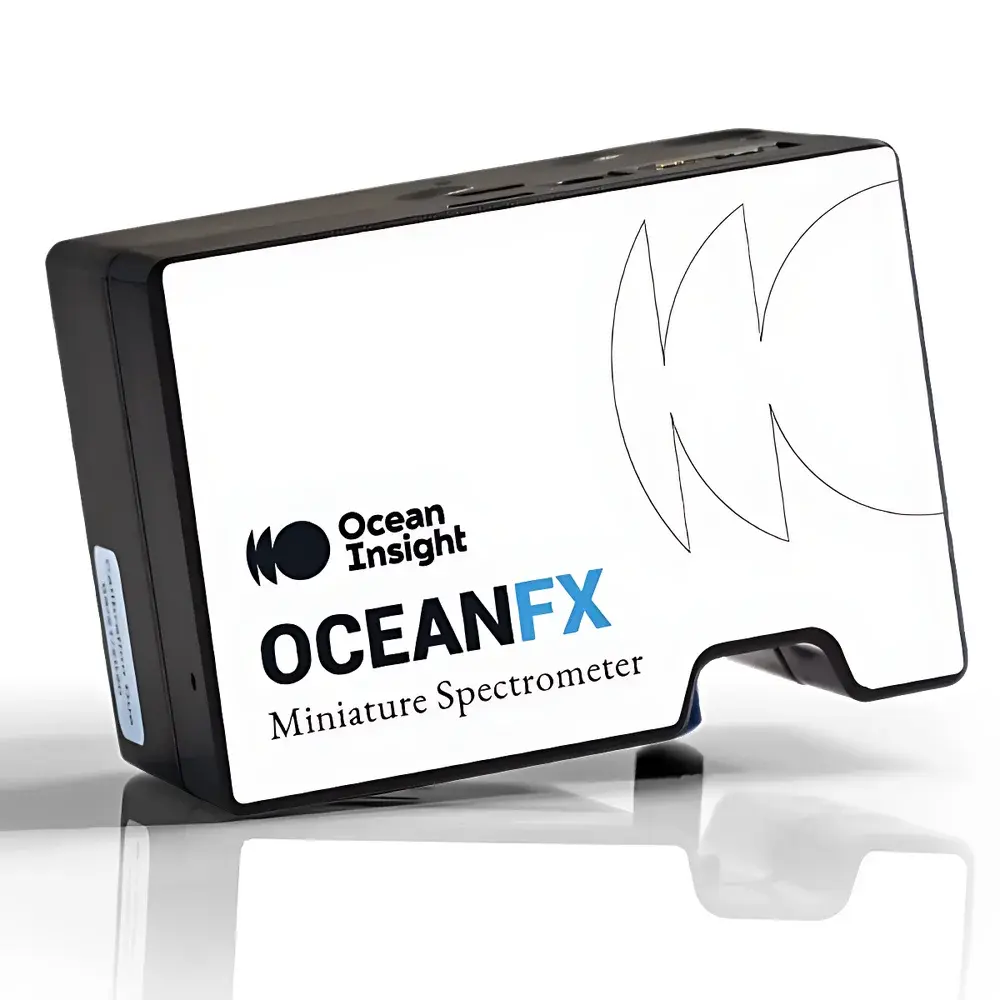
Ocean Optics Ocean-FX Fiber Optic Spectrometer
| Brand | Ocean Optics |
|---|---|
| Model | Ocean-FX |
| Spectral Range | 200–1100 nm |
| Optical Resolution (FWHM) | 0.8 nm (with 600 l/mm grating & 5 µm slit) |
| Detector | Hamamatsu S11639 CMOS |
| Slit Options | 5, 10, 50, 100, or 200 µm (SMA 905 or FC connector) |
| Sensitivity | Optimized for 200–1025 nm with 25 µm slit |
| Signal-to-Noise Ratio (single scan) | ~270:1 |
| Dynamic Range (single scan) | ~6400:1 |
| Stray Light | <0.08% at 600 nm |
| Integration Time | 10 µs to 10 s |
| Maximum Scan Rate | 3000 spectra/s (host-dependent) |
| Thermal Drift | 0.11 pixels/°C |
| Onboard Memory | 50,000 spectra with timestamping |
| Connectivity | Gigabit Ethernet, Wi-Fi 802.11ac, USB 3.0 |
Overview
The Ocean Optics Ocean-FX Fiber Optic Spectrometer is a high-performance, modular spectrometer engineered for demanding UV-VIS-NIR applications requiring speed, stability, and broad spectral coverage. Based on the Hamamatsu S11639 back-thinned CMOS detector, the Ocean-FX delivers enhanced quantum efficiency across 200–1100 nm—with particular sensitivity gains in the deep UV (200–350 nm)—enabling robust detection of low-light signals in absorption, fluorescence, reflectance, and emission measurements. Its optical architecture employs fixed-grating Czerny-Turner design with selectable slit widths and configurable gratings, achieving a nominal optical resolution of 0.8 nm FWHM (measured with 600 l/mm grating and 5 µm slit). Unlike legacy CCD-based platforms, the CMOS detector enables ultrafast readout, sub-millisecond integration control, and on-board buffering—making the Ocean-FX especially suited for time-resolved spectroscopy, process monitoring, and real-time classification tasks where spectral fidelity and temporal fidelity are co-critical.
Key Features
- High-Speed Acquisition: Capable of up to 4500 full-spectrum acquisitions per second under optimized host and firmware conditions; sustained rates of 3000 spectra/s typical in Ethernet/Wi-Fi streaming mode.
- Onboard Intelligence: Integrated 50,000-spectrum buffer with hardware timestamping ensures zero-data-loss acquisition during kinetic experiments—even when host communication latency occurs.
- Multi-Protocol Connectivity: Native support for Gigabit Ethernet (TCP/IP), dual-band Wi-Fi 802.11ac (2.4 GHz / 5 GHz), and USB 3.0 enables flexible deployment—from benchtop QC stations to wireless industrial sensors and handheld analyzers.
- Thermal Stability: Engineered thermal compensation yields drift of only 0.11 pixels/°C, minimizing wavelength calibration drift during extended unattended operation—a critical factor for GLP-compliant environmental or pharmaceutical monitoring.
- Configurable Optical Path: Interchangeable slits (5–200 µm), grating options, and fiber coupling (SMA 905 or FC) allow optimization for resolution, throughput, or signal-to-noise trade-offs per application.
Sample Compatibility & Compliance
The Ocean-FX interfaces seamlessly with standard 200–1000 µm core optical fibers and supports common sampling accessories—including cuvette holders, integrating spheres, reflection probes, and flow cells—enabling direct measurement of liquids, solids, gases, and plasmas. Its spectral response meets requirements for ASTM E308 (colorimetry), ISO 13655 (spectral measurement of printing), and USP (UV-VIS spectrophotometry). When deployed in regulated environments, the instrument supports audit-trail-capable software logging (via OceanView or third-party SDKs compliant with FDA 21 CFR Part 11), and its stable calibration traceability aligns with ISO/IEC 17025 laboratory accreditation criteria for spectroscopic instrumentation.
Software & Data Management
Ocean-FX is fully supported by OceanView v2.5+ (Windows/macOS/Linux), offering real-time spectral visualization, multichannel averaging, peak identification, chemometric modeling (PLS, PCA), and customizable reporting. Its open-source SDK (C/C++, Python, MATLAB, LabVIEW, .NET) enables integration into LIMS, MES, and SCADA systems. All firmware updates, calibration files, and spectral metadata are stored with embedded timestamps and device-unique identifiers—ensuring full data provenance. For GxP workflows, optional OceanView IQ/OQ documentation packages are available to support installation qualification, operational qualification, and performance verification per ICH Q2(R2) guidelines.
Applications
- Food & Agriculture: Real-time sorting of produce based on pigment profiles; NIR moisture/fat analysis in inline conveyor systems.
- Biomedical Research: Quantitative DNA/RNA quantification (260 nm), protein A280 assays, and time-resolved enzyme kinetics using stopped-flow or microfluidic platforms.
- Industrial Process Control: Monitoring plasma etch endpoints in semiconductor fabrication; combustion gas analysis (O2, NO, NH3) via UV absorption bands.
- Laser & Photonics QA: Pulse-resolved spectral characterization of pulsed lasers (ns–µs domain); LED binning and phosphor decay analysis.
- Environmental Monitoring: In-situ water quality assessment (COD, nitrate, chlorophyll-a) using submerged fiber probes in wastewater or aquaculture systems.
FAQ
What spectral configurations are available for the Ocean-FX?
Standard configurations include UV-Vis (200–850 nm), Vis-NIR (350–1000 nm), and wide-range (200–1025 nm), all with 25 µm slit as default. Custom grating/slit combinations can be specified at order entry.
Is the Ocean-FX compatible with existing Ocean Optics accessories?
Yes—the Ocean-FX uses the same SMA 905 or FC fiber interface and mechanical footprint as previous generations, ensuring backward compatibility with halogen/deuterium light sources, collimating optics, and sampling probes.
How is calibration maintained over temperature fluctuations?
The Ocean-FX includes factory-applied wavelength and intensity calibration with thermal correction coefficients embedded in firmware; users may perform optional dark/white reference updates at operating temperature to maintain ±0.2 nm wavelength accuracy.
Can the Ocean-FX operate in standalone mode without a PC?
While it requires a host for initial configuration and data retrieval, its onboard memory and timestamping enable autonomous buffered acquisition for up to 50,000 spectra—ideal for edge-deployed or battery-powered field instruments.
Does the Ocean-FX support compliance with FDA 21 CFR Part 11?
Yes—when used with validated OceanView IQ/OQ protocols and audit-trail-enabled software configurations, the system satisfies electronic record and signature requirements for pharmaceutical and clinical laboratory use.





