
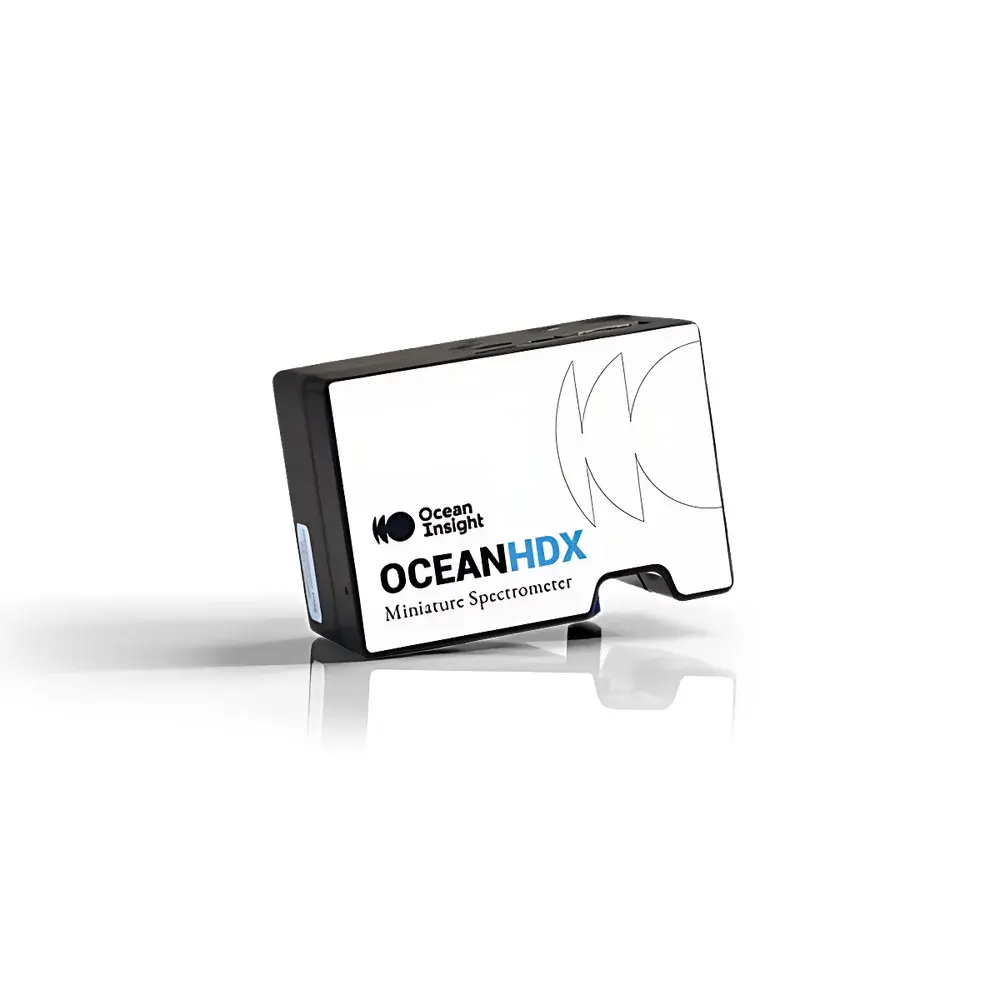
Ocean Optics Ocean HDX Miniature Fiber Optic Spectrometer
| Brand | Ocean Optics |
|---|---|
| Origin | Imported |
| Model | Ocean HDX |
| Spectral Range | 200–925 nm |
| Detector Type | CCD |
| Optical Resolution (FWHM) | 0.61–0.72 nm (with 10 µm slit) |
| Signal-to-Noise Ratio | 400:1 |
| Dynamic Range | 12,000:1 |
| Stray Light | < 0.3% (typical, at 600 nm with 400 nm cutoff filter) |
| Onboard Storage Capacity | Up to 50,000 spectra |
| Interface Options | USB 3.0, Gigabit Ethernet, Wi-Fi (802.11ac), RS-232 |
| Operating Temperature Stability | ±0.05 nm/°C (wavelength drift) |
Overview
The Ocean Optics Ocean HDX Miniature Fiber Optic Spectrometer is a high-performance, compact spectroscopic instrument engineered for precision spectral acquisition in demanding laboratory, industrial process, and field-deployable applications. Based on a Czerny-Turner optical architecture with optimized high-efficiency gratings and thermally stabilized optics, the HDX delivers exceptional wavelength fidelity, minimal thermal drift, and robust signal integrity across its full 200–925 nm spectral range. Its core design principle centers on maximizing photon throughput while minimizing stray light—achieved through precision-machined baffling, black-anodized internal surfaces, and rigorously aligned optical pathways. Unlike conventional miniature spectrometers, the HDX integrates an X-Platform electronics architecture featuring a dual-core ARM processor, FPGA-accelerated spectral preprocessing, and embedded non-volatile memory capable of storing up to 50,000 full-resolution spectra without host dependency. This enables autonomous operation in embedded OEM systems, real-time process monitoring loops, and remote sensing deployments where latency or connectivity constraints preclude continuous PC tethering.
Key Features
- High-Definition Optical Design: Utilizes ultra-low aberration optics and holographic or ruled gratings matched to detector response, delivering peak symmetry > 0.98 and resolution consistently maintained between 0.61–0.72 nm FWHM (measured with 10 µm entrance slit).
- Low Stray Light Performance: Achieves < 0.3% stray light (typical, measured at 600 nm using a 400 nm longpass blocking filter), critical for accurate quantitation of dilute analytes in highly absorbing matrices (e.g., dye solutions, ink formulations, pharmaceutical suspensions).
- Thermal Stability Architecture: Incorporates passive thermal compensation via matched expansion coefficients in the optical bench and detector mount; wavelength drift is limited to ±0.05 nm/°C over 15–35 °C ambient range—enabling unattended multi-hour measurements without recalibration.
- High Throughput Efficiency: Optimized f/2.0 optical train and high-quantum-efficiency back-thinned CCD deliver superior sensitivity in low-light scenarios including fluorescence lifetime decay profiling, bioluminescent assay readouts, and weak Raman signal capture.
- Multi-Protocol Connectivity: Supports synchronous triggering and streaming via USB 3.0 (up to 4 kHz full-spectrum rate), Gigabit Ethernet (for deterministic timing in distributed sensor networks), IEEE 802.11ac Wi-Fi (WPA2-Enterprise compatible), and legacy RS-232 for PLC integration.
Sample Compatibility & Compliance
The Ocean HDX is compatible with standard SMA 905 fiber optic interfaces (200 µm, 400 µm, or 600 µm core diameters) and supports interchangeable slit widths (5–200 µm) and order-sorting filters. It operates reliably with liquid cuvettes (10 mm pathlength), integrating spheres (e.g., ISP-REF for reflectance), flow cells, and gas-phase absorption cells. The device complies with IEC 61326-1 (EMC for laboratory equipment), RoHS 2015/863/EU, and meets essential requirements of the EU Machinery Directive 2006/42/EC when integrated into automated systems. Firmware supports audit-trail logging per FDA 21 CFR Part 11 requirements when used in regulated environments (e.g., QC labs under GLP/GMP), with optional password-protected configuration locks and timestamped spectral metadata export.
Software & Data Management
Ocean HDX is fully supported by OceanView v3.x (Windows/macOS/Linux), offering real-time spectral visualization, multivariate calibration (PLS, PCA), kinetic trace analysis, and ASTM E308-compliant color space conversion (CIE XYZ, L*a*b*). The onboard firmware implements HDF5-based spectral storage with embedded metadata (exposure time, temperature, calibration ID, GPS timestamp if Wi-Fi geolocation enabled). Raw data export supports .jdx (JCAMP-DX), .csv, and .spc formats. API access is available via Python SDK (oceanoptics-python), LabVIEW VIs, MATLAB Instrument Control Toolbox drivers, and RESTful HTTP endpoints for cloud ingestion (e.g., AWS IoT Core, Azure IoT Hub).
Applications
- Real-time endpoint detection in plasma etching and thin-film deposition (monitoring emission lines at 393.4 nm Ca II, 486.1 nm Hβ, 656.3 nm Hα)
- Quantitative color measurement of coatings, textiles, and printed materials per ISO 11664 and ASTM D2244
- In-line concentration monitoring of aqueous dyes and pharmaceutical actives using UV-Vis absorbance ratios
- Fluorescence fingerprinting of crude oil fractions and environmental water samples
- OEM integration into handheld LIBS analyzers, portable NIR moisture sensors, and UV disinfection dose meters
FAQ
What calibration options are available for the Ocean HDX?
NIST-traceable radiometric and wavelength calibrations are provided with each unit; optional factory-installed irradiance calibration (200–925 nm) and reflectance standards (BaSO₄, Spectralon) are available.
Can the Ocean HDX operate autonomously without a host computer?
Yes—the X-Platform electronics support scheduled acquisitions, threshold-triggered capture, and local data logging independent of external control; all parameters are configurable via serial command set or web interface.
Is the HDX suitable for use in humid or vibration-prone industrial environments?
The spectrometer housing meets IP54 ingress protection specifications; optional conformal coating and shock-mounted OEM enclosures are available for extended deployment in manufacturing floors or marine platforms.
How does the HDX handle spectral artifacts from ambient light interference?
Hardware-level dark current subtraction, synchronized electronic shuttering, and user-configurable integration times (1 ms to 10 s) minimize ambient contribution; optional mechanical shutter kits provide additional suppression for pulsed-light applications.
Does Ocean Optics provide application-specific firmware updates?
Yes—custom firmware builds (e.g., for dedicated LED binning, laser-induced breakdown spectroscopy pulse gating, or chemometric model embedding) are available under NDA for qualified OEM partners.





