
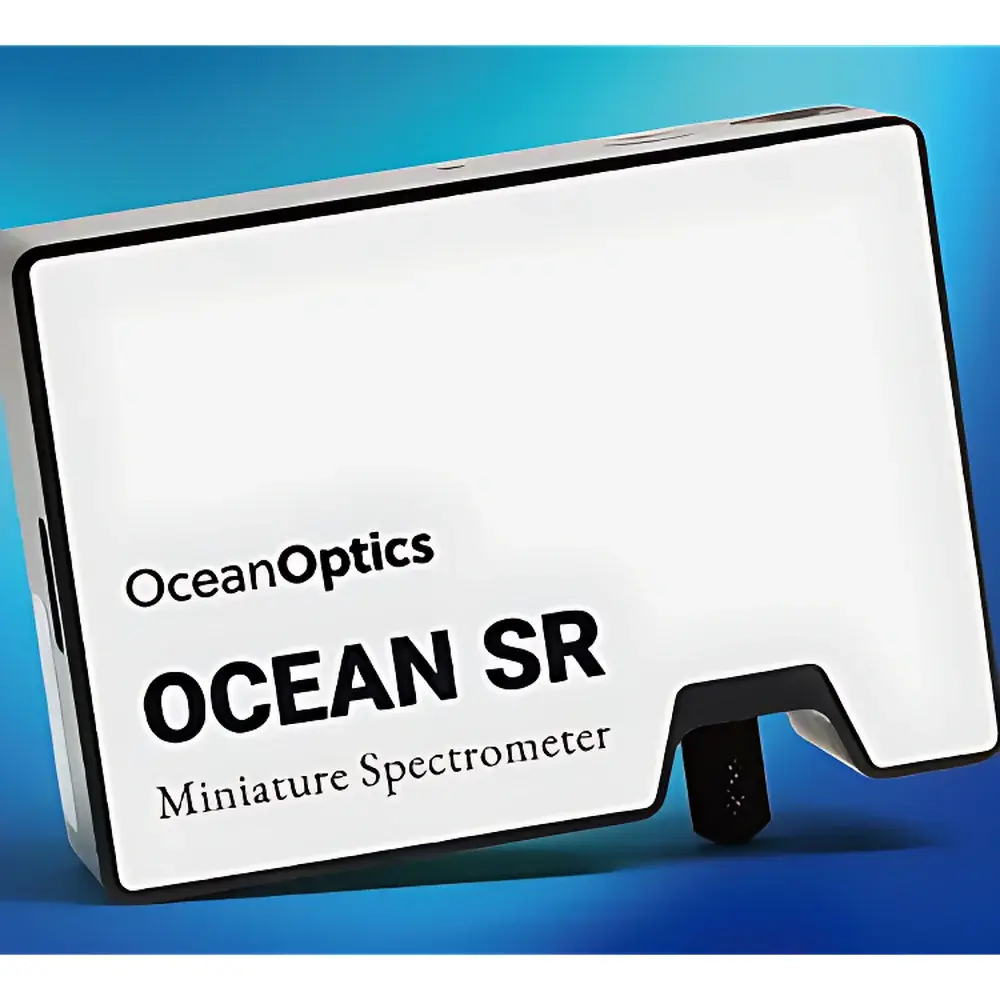
Ocean Optics Ocean SR4 Fiber Optic Spectrometer
| Brand | Ocean Optics |
|---|---|
| Origin | USA |
| Detector Type | CCD |
| Model | Ocean SR4 |
| Spectral Range | 190–1100 nm (configurable) |
| Optical Resolution (25 µm slit) | 1.36–1.65 nm (FWHM) |
| Signal-to-Noise Ratio | 3000:1 (per second, High-Speed Averaging Mode) |
| Dynamic Range | 1370:1 (single scan) |
| Integration Time | 3.8 ms – 10 s |
| Stray Light | 2.3 AU |
| Scan Rate | 74 scans/s |
| Thermal Wavelength Stability | 0.05 pixels/°C |
| A/D Conversion | 16-bit |
| Trigger Modes | External, Internal, Software, Level, Edge |
| Interface | USB-C (USB 2.0 compliant) |
| Dimensions | 88.1 × 63.5 × 31.4 mm |
| Weight | 254 g |
Overview
The Ocean Optics Ocean SR4 Fiber Optic Spectrometer is a high-resolution, thermally stabilized benchtop spectrometer engineered for precision spectral measurement across the ultraviolet, visible, and near-infrared (UV-VIS-NIR) spectrum (190–1100 nm). Built upon a robust Czerny-Turner optical architecture with optimized aberration correction, the SR4 leverages a 3648-pixel linear CCD array detector to deliver consistent wavelength fidelity and low-noise spectral acquisition. Its core design emphasizes operational reliability in both laboratory and industrial environments—featuring active thermal stabilization that limits wavelength drift to ≤0.05 pixels per °C and stray light suppression to 2.3 AU (optical density ~200), critical for quantitative absorbance and emission measurements where spectral purity directly impacts analytical accuracy.
Key Features
- High-resolution spectral acquisition with configurable resolution of 1.36–1.65 nm FWHM (using 25 µm slit); optional slit widths from 5–200 µm enable trade-off optimization between resolution and throughput
- Thermally compensated optical bench ensures long-term wavelength stability—validated under ambient temperature fluctuations typical of production floor or field-deployed setups
- Hardware-accelerated High-Speed Averaging Mode (HSAM) delivers real-time signal averaging at up to 74 full-spectrum scans per second, achieving an effective SNR of 3000:1 per second without software post-processing overhead
- 16-bit analog-to-digital conversion provides >96 dB dynamic range per acquisition, supporting both weak-emission detection and high-intensity broadband sources within a single scan
- Multi-trigger capability—including edge, level, external TTL, and timed triggers—enables precise synchronization with pulsed light sources (e.g., flash lamps, lasers) or automated sample handling systems
- Compact footprint (88.1 × 63.5 × 31.4 mm) and lightweight construction (254 g) facilitate integration into OEM instrumentation, portable analyzers, and space-constrained optical benches
Sample Compatibility & Compliance
The Ocean SR4 is compatible with standard SMA 905 fiber optic interfaces and integrates seamlessly with Ocean Insight’s full ecosystem of calibrated light sources (deuterium-halogen, LED, laser), cuvette holders, integrating spheres, and reflection probes. Its spectral response supports common photometric and radiometric applications compliant with ISO/CIE standards for colorimetry and illuminant characterization. While not certified as a medical device, the instrument meets general-purpose laboratory equipment requirements under IEC 61326-1 (EMC) and IEC 61010-1 (safety). Data integrity workflows—when used with OceanDirect SDK and OceanView software—support audit-ready traceability aligned with GLP and GMP documentation practices, including timestamped metadata, detector gain settings, integration time, and calibration file versioning.
Software & Data Management
The SR4 ships with OceanView spectroscopy software (Windows/macOS/Linux), offering intuitive spectral visualization, real-time peak identification, multi-curve overlay, and export to CSV, HDF5, or industry-standard JCAMP-DX formats. For embedded or automated deployments, the OceanDirect SDK provides a documented, cross-platform C/C++, Python, .NET, and LabVIEW API. All communication occurs over USB-C (USB 2.0 protocol), ensuring deterministic latency and plug-and-play enumeration without proprietary drivers. The SDK supports full control of hardware parameters—including trigger configuration, dark correction, nonlinearity compensation, and real-time HSAM activation—enabling reproducible method transfer across instruments and platforms. Raw spectral data includes embedded calibration coefficients and pixel-to-wavelength mapping, facilitating third-party analysis in MATLAB, Python (NumPy/SciPy), or custom chemometric pipelines.
Applications
- UV-VIS absorbance quantification of biomolecules (DNA, proteins, enzymes) in microvolume cuvettes or flow cells, adhering to Beer-Lambert law validation protocols
- In-line monitoring of plasma emission lines (e.g., Ar I at 750.4 nm, N II at 500.5 nm) for semiconductor process control and thin-film deposition endpoint detection
- Color measurement and spectral reflectance analysis of coatings, textiles, and display panels per ISO 11664 and ASTM E308
- Fluorescence excitation/emission profiling of quantum dots, organic dyes, and fluorescent proteins under controlled illumination conditions
- Environmental sensing—e.g., nitrate/nitrite detection in water via UV absorption at 220 nm and 275 nm, with baseline correction enabled by high SNR and low stray light
- OEM integration into handheld Raman spectrometers, LIBS systems, or portable gas analyzers requiring compact, high-stability spectral engines
FAQ
What spectral calibration options are available for the Ocean SR4?
Factory-calibrated units include NIST-traceable wavelength and radiometric (irradiance) calibrations. Custom calibrations—including deuterium/halogen source-based irradiance, LED-based relative intensity, or user-provided reference standards—can be performed pre-shipment or in-field using OceanView’s Calibration Wizard.
Is the SR4 suitable for time-resolved fluorescence measurements?
While not a gated or TCSPC-capable spectrometer, its 3.8 ms minimum integration time and external trigger support allow synchronized acquisition with pulsed excitation sources (e.g., nanosecond LEDs or Q-switched lasers) for decay curve sampling at discrete delay points.
Can the SR4 operate in continuous scanning mode without host PC intervention?
No standalone operation is supported; the SR4 requires continuous USB connection and host-initiated commands. However, its low-latency USB interface and OceanDirect SDK enable reliable headless operation when embedded in Linux-based industrial controllers or Raspberry Pi–based edge devices.
How does the HSAM mode differ from software-based averaging?
HSAM performs on-device accumulation of raw ADC values prior to digitization and transmission, eliminating USB bandwidth bottlenecks and reducing host CPU load. This yields higher effective SNR per unit time compared to post-acquisition software averaging of individual scans.
What accessories are recommended for absorbance measurements in liquid samples?
A matched pair of Ocean Insight’s 10-mm pathlength quartz cuvette holders (CUV-UV) with integrated fiber couplers, combined with a DH-mini deuterium-halogen light source and optional OD-filter wheel for high-absorbance ranges (>3 AU), constitutes a validated configuration for quantitative UV-VIS spectroscopy.
Related Products




