
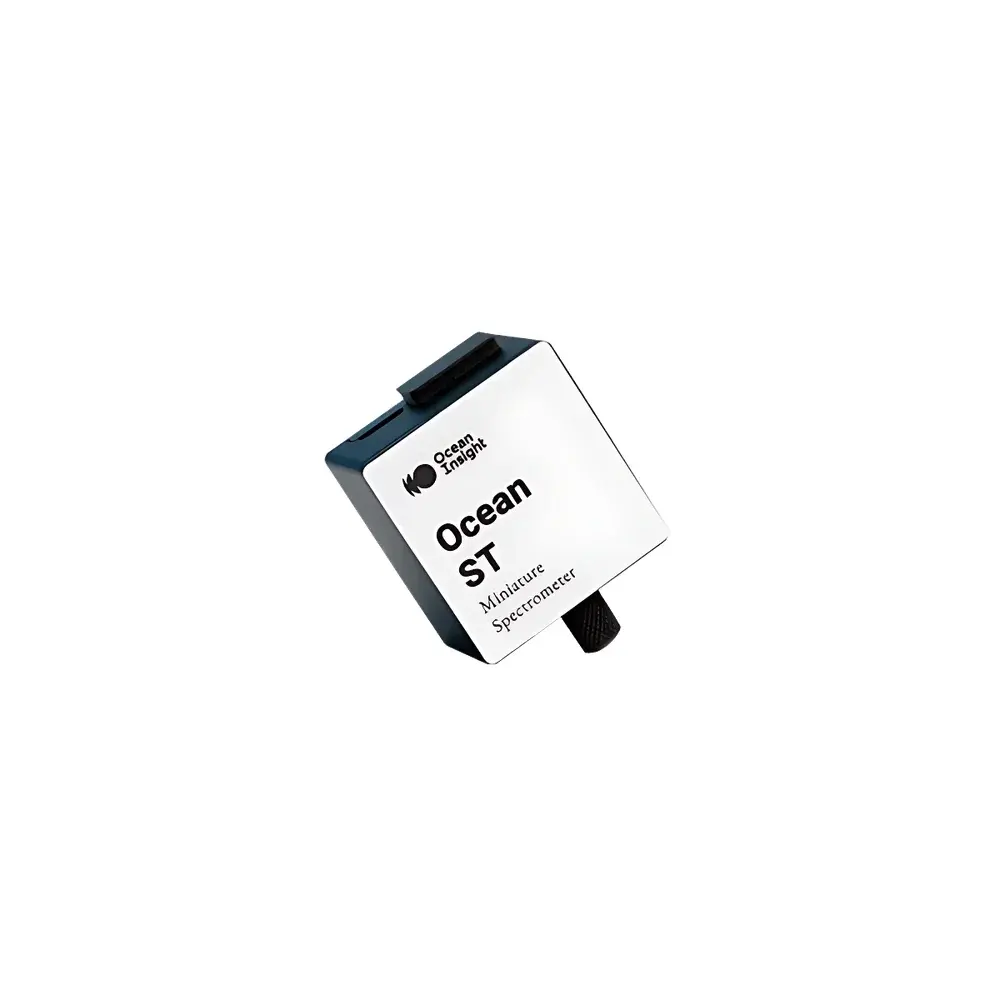
Ocean Optics Ocean ST Fiber Optic Spectrometer
| Brand | Ocean Optics |
|---|---|
| Origin | USA |
| Model | Ocean ST |
| Spectral Range | 185–650 nm (UV-VIS), 350–810 nm (VIS-NIR), 645–1085 nm (NIR) |
| Optical Resolution (FWHM, 25 µm slit) | 2.2 nm |
| Signal-to-Noise Ratio | 190:1 (single scan @ 10 ms), 2250:1 (1 s averaging, no buffer) |
| Dynamic Range | 1000:1 (single scan) |
| Stray Light | < 2.0 AU |
| Integration Time | 3.8 ms – 6 s |
| Scan Rate | 160 Hz (no buffer) |
| A/D Resolution | 14-bit |
| Thermal Stability | 0.05 pixel/°C |
| Interface | USB-C + 16-pin Samtec TFM-108-02-L-DH connector |
| Dimensions | 42.1 × 40.3 × 26.6 mm |
| Weight | 70.4 g |
Overview
The Ocean Optics Ocean ST Fiber Optic Spectrometer is a high-performance, miniature spectrometer engineered for precision UV-VIS and VIS-NIR spectral analysis in space-constrained and integration-critical environments. Based on a fixed-grating Czerny-Turner optical architecture with back-thinned CMOS detector technology, the Ocean ST delivers laboratory-grade spectral fidelity in a footprint measuring just 42.1 × 40.3 × 26.6 mm and weighing 70.4 g. Its three interchangeable spectral configurations—covering 185–650 nm (deep UV to visible), 350–810 nm (visible to near-infrared), and 645–1085 nm (near-infrared)—enable application-specific optimization without hardware redesign. The instrument operates on the principle of wavelength-dispersive detection via diffraction grating and linear array photodetection, supporting quantitative absorbance, reflectance, fluorescence, and radiometric measurements with calibrated traceability to NIST-traceable standards.
Key Features
- Compact form factor (70.4 g, <11 cm³ volume) optimized for OEM integration, portable instrumentation, and embedded process monitoring
- Three pre-aligned spectral bands with factory-calibrated wavelength and intensity response across each range
- Interchangeable slit assembly (standard 25 µm; optional 10–200 µm) enabling user-tunable trade-off between optical resolution (FWHM ≤ 2.2 nm) and throughput
- High thermal stability (0.05 pixel/°C drift) ensuring minimal wavelength shift over ambient temperature fluctuations (15–35 °C operating range)
- USB-C interface with low-latency communication and integrated 16-pin Samtec connector for synchronized triggering, external illumination control, and analog I/O
- 14-bit analog-to-digital conversion with 160 Hz maximum unbuffered scan rate and configurable integration time (3.8 ms – 6 s)
- Ruggedized aluminum housing with anodized finish, qualified for continuous operation in industrial environments with vibration and EMI resilience
Sample Compatibility & Compliance
The Ocean ST supports fiber-coupled measurement configurations using standard SMA 905 connectors, compatible with Ocean Insight’s full portfolio of deuterium-halogen, LED, and pulsed xenon light sources, as well as cuvette holders, integrating spheres, and probe-based sampling accessories. It meets electromagnetic compatibility requirements per FCC Part 15 Class B and CE EN 61326-1:2013 for laboratory and industrial use. While not certified for intrinsic safety or explosion-proof operation, its low-power design (<1.5 W typical) and absence of moving parts support deployment in GLP-compliant analytical workflows. Data acquisition and calibration metadata are stored internally with timestamping, supporting audit-ready documentation under ISO/IEC 17025 and FDA 21 CFR Part 11 when used with validated software protocols.
Software & Data Management
Every Ocean ST ships with OceanDirect—a cross-platform SDK supporting Windows, macOS, and Linux. The API provides full programmatic control over integration time, boxcar averaging, dark correction, nonlinearity compensation, and spectral smoothing. Developers can embed OceanDirect into custom applications written in Python, C/C++, MATLAB, LabVIEW, or .NET, enabling deterministic synchronization with PLCs, motion controllers, or inline production systems. Raw spectral data is output in IEEE 754-compliant floating-point format with associated wavelength arrays, facilitating direct import into chemometric platforms (e.g., Unscrambler, Pirouette) or statistical analysis tools. Firmware updates, spectral recalibration files, and device identification parameters are managed through the SDK’s built-in utilities, ensuring version-controlled reproducibility across multi-unit deployments.
Applications
- Real-time colorimetric quality control in paint, textile, and display manufacturing (CIE L*a*b*, ΔE calculations)
- UV-Vis quantification of nucleic acid concentration (A260/A280 ratio analysis) and protein purity in benchtop and microfluidic platforms
- In-line monitoring of chemical reaction kinetics via absorbance peak tracking (e.g., dye degradation, enzymatic assays)
- NIR-based moisture and organic content analysis in pharmaceutical granules and agricultural feedstock
- Portable field spectroscopy for environmental water quality assessment (nitrate, chlorophyll-a, dissolved organic carbon)
- Integration into handheld Raman or LIBS systems as a secondary broadband reference channel
FAQ
What spectral calibration options are available for the Ocean ST?
Factory-installed NIST-traceable wavelength and irradiance calibrations are provided for each configured range. Optional re-calibration services are available through Ocean Insight’s ISO/IEC 17025-accredited lab.
Can the Ocean ST operate in triggered or gated acquisition mode?
Yes—via the 16-pin Samtec interface, users can configure external TTL triggering, hardware gating, and synchronous strobe control for time-resolved measurements.
Is the Ocean ST suitable for long-term unattended operation?
With its passive thermal management, low power draw, and firmware watchdog timer, the Ocean ST is rated for continuous operation up to 10,000 hours under controlled ambient conditions (25 ± 5 °C, <60% RH).
How does slit selection affect performance metrics?
Narrower slits improve resolution but reduce signal intensity; wider slits increase throughput at the expense of resolution. Recommended slit widths are selected based on required FWHM and minimum detectable absorbance (e.g., 10 µm for high-resolution UV protein assays, 100 µm for low-light NIR moisture sensing).
Does OceanDirect support compliance with FDA 21 CFR Part 11?
OceanDirect itself is not a regulated application, but it provides the foundational audit trail capabilities (user authentication hooks, electronic signatures, immutable data logging) required to build a Part 11-compliant system when implemented within a validated environment.





