
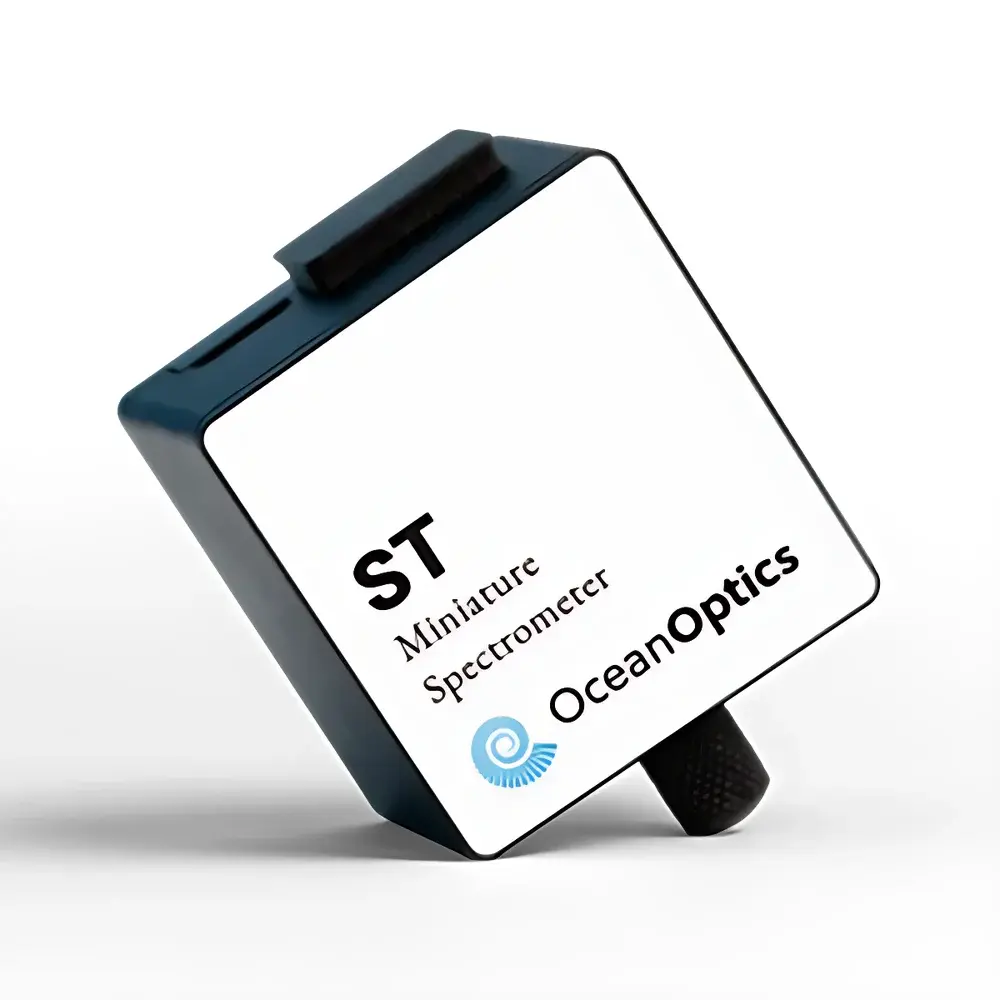
Ocean Optics ST Ultra-Compact Spectrometer
| Brand | Ocean Optics |
|---|---|
| Origin | USA |
| Model | ST UV / ST VIS / ST NIR |
| Wavelength Range | 185–650 nm (UV), 350–810 nm (VIS), 645–1085 nm (NIR) |
| Optical Resolution (FWHM, 25 µm slit) | 2.2 nm |
| Signal-to-Noise Ratio | 190:1 (single scan @ 10 ms), 2250:1 (1 s average, non-binned) |
| Dynamic Range | 1000:1 (single scan) |
| Integration Time | 3.8 ms – 6 s |
| Stray Light | < 2.0 AU |
| A/D Resolution | 14-bit |
| Scan Rate | 160 Hz (non-binned) |
| Thermal Stability | 0.05 pixel/°C |
| Detector | 1516-pixel linear CMOS |
| Input Connector | SMA 905 |
| Interface | USB-C + Samtec TFM-108-02-L-DH accessory header |
| Dimensions | 42.1 × 40.3 × 26.6 mm |
| Weight | 70.4 g |
| Environmental Compliance | EN 61326-1:2013, EN 55011:2009+A1:2010, IEC 60068-2-64 & -2-32 |
Overview
The Ocean Optics ST Ultra-Compact Spectrometer is a high-performance, field-deployable miniature spectrometer engineered for precision spectral analysis across ultraviolet (UV), visible (VIS), and near-infrared (NIR) regions. Based on fixed-grating, linear CMOS detector architecture, the ST series employs aberration-corrected optical design and thermally stabilized mechanics to deliver laboratory-grade spectral fidelity in a footprint smaller than a standard credit card. Its core measurement principle relies on dispersed light detection via diffraction grating and pixel-resolved intensity quantification—enabling accurate absorbance, reflectance, transmittance, irradiance, fluorescence, and colorimetric analysis. Designed from inception for embedded integration and portable operation, the ST platform supports real-time, full-spectrum acquisition at up to 160 Hz without onboard buffering, making it suitable for inline process monitoring, handheld diagnostics, educational instrumentation, and OEM system integration where size, power efficiency, and thermal robustness are critical constraints.
Key Features
- Ultra-compact form factor: 42.1 × 40.3 × 26.6 mm and 70.4 g—optimized for space-constrained environments including portable analyzers, drone-mounted sensors, and embedded industrial control systems.
- Three spectral configurations: ST UV (185–650 nm), ST VIS (350–810 nm), and ST NIR (645–1085 nm), each calibrated for optimal quantum efficiency and stray-light suppression in its designated band.
- Interchangeable slit options: User-replaceable 25 µm, 50 µm, 100 µm, and 200 µm SMA 905 input slits enable deliberate trade-off between optical resolution (down to 2.2 nm FWHM) and throughput—critical for low-light or high-resolution applications.
- Thermal and mechanical stability: Aluminum housing with anodized finish ensures consistent spectral registration (<0.05 pixel/°C drift), minimal inter-unit variation, and resistance to vibration per IEC 60068-2-64.
- Flexible triggering and I/O: Integrated 4-channel GPIO, RS232 serial interface, dual strobe outputs, external trigger input, and power input support synchronized multi-device operation and hardware-level automation.
- High-fidelity data acquisition: 14-bit A/D conversion, >99.4% corrected linearity, and dynamic range of 1000:1 (single scan) ensure quantitative repeatability across diverse sample types and illumination conditions.
Sample Compatibility & Compliance
The ST spectrometer accommodates fiber-optic coupled sampling via standardized SMA 905 connectors, enabling compatibility with Ocean Insight’s full suite of broadband and monochromatic light sources, cuvette holders, integrating spheres, and probe accessories. It supports absorbance measurements down to sub-millimeter path lengths, reflectance analysis of opaque and translucent surfaces, and irradiance quantification traceable to NIST-calibrated standards. The instrument complies with EN 61326-1:2013 (EMC for laboratory equipment), EN 55011:2009+A1:2010 (industrial emission limits), and environmental durability standards IEC 60068-2-32 (free fall) and IEC 60068-2-64 (vibration). While not pre-certified for FDA 21 CFR Part 11 or ISO/IEC 17025, its deterministic firmware behavior, stable calibration retention, and audit-ready metadata logging via OceanDirect SDK facilitate validation in GLP/GMP-regulated workflows when implemented with documented procedures.
Software & Data Management
OceanDirect is the official cross-platform SDK provided with every ST spectrometer—supporting Windows, macOS, and Linux. It delivers a comprehensive API for low-level spectrometer control, including real-time adjustment of integration time (3.8 ms–6 s), gain, boxcar averaging, dark correction, and nonlinearity compensation. Raw spectral data (intensity vs. wavelength) is accessible in IEEE 754 double-precision format, with optional timestamping, temperature logging, and hardware-trigger synchronization. OceanDirect includes native bindings for Python, MATLAB, LabVIEW, C#, and C++, enabling seamless integration into custom analytical pipelines, automated test benches, or cloud-connected IoT architectures. All calibrations—including wavelength, intensity, and linearity—are stored in non-volatile memory and persist across power cycles. No proprietary runtime or subscription licensing is required for deployment.
Applications
- Life sciences: Quantitative DNA/RNA concentration assays (260 nm absorbance), protein purity assessment (A260/A280), and microplate-based kinetic assays.
- Industrial QA/QC: Real-time color measurement (CIE L*a*b*, ΔE), coating thickness verification via interference fringe analysis, and LED spectral binning during manufacturing.
- Environmental monitoring: In-situ water quality assessment (nitrate, chlorophyll-a, dissolved organic carbon), soil nutrient spectroscopy, and atmospheric gas detection using differential optical absorption spectroscopy (DOAS) principles.
- Academic research & teaching: Undergraduate optics labs, spectroscopic sensor development, and low-cost hyperspectral imaging prototypes.
- OEM integration: Embedded spectral engines for medical point-of-care devices, agricultural phenotyping tools, and aerospace payload subsystems requiring radiation-tolerant, low-SWaP-C performance.
FAQ
What spectral resolution options are available, and how do they relate to slit width?
The ST offers configurable optical resolution (FWHM) ranging from 2.2 nm to 13 nm, determined by the installed entrance slit (25 µm to 200 µm) and grating selection. Narrower slits increase resolution at the expense of signal-to-noise ratio; wider slits improve sensitivity for weak-light applications.
Is the ST spectrometer compatible with third-party optical fibers?
Yes—it accepts industry-standard SMA 905-terminated fibers. Core diameter, NA, and jacket type must be matched to the selected slit to avoid vignetting or coupling loss.
Can the ST operate in continuous streaming mode without host buffering?
Yes. At maximum scan rate (160 Hz), spectra are transferred directly over USB-C in real time. Host-side buffering is optional and application-dependent.
Does the ST require periodic recalibration?
Factory wavelength and intensity calibrations remain stable under normal operating conditions (–30 °C to +70 °C storage, <85% RH). Recalibration is recommended only after mechanical shock, extreme thermal cycling, or when traceability to primary standards is mandated by quality protocols.
What is the typical warm-up time to achieve thermal equilibrium?
Less than 60 seconds from cold start; spectral pixel shift stabilizes to within ±0.1 pixel after ambient temperature equilibration.
Related Products





