
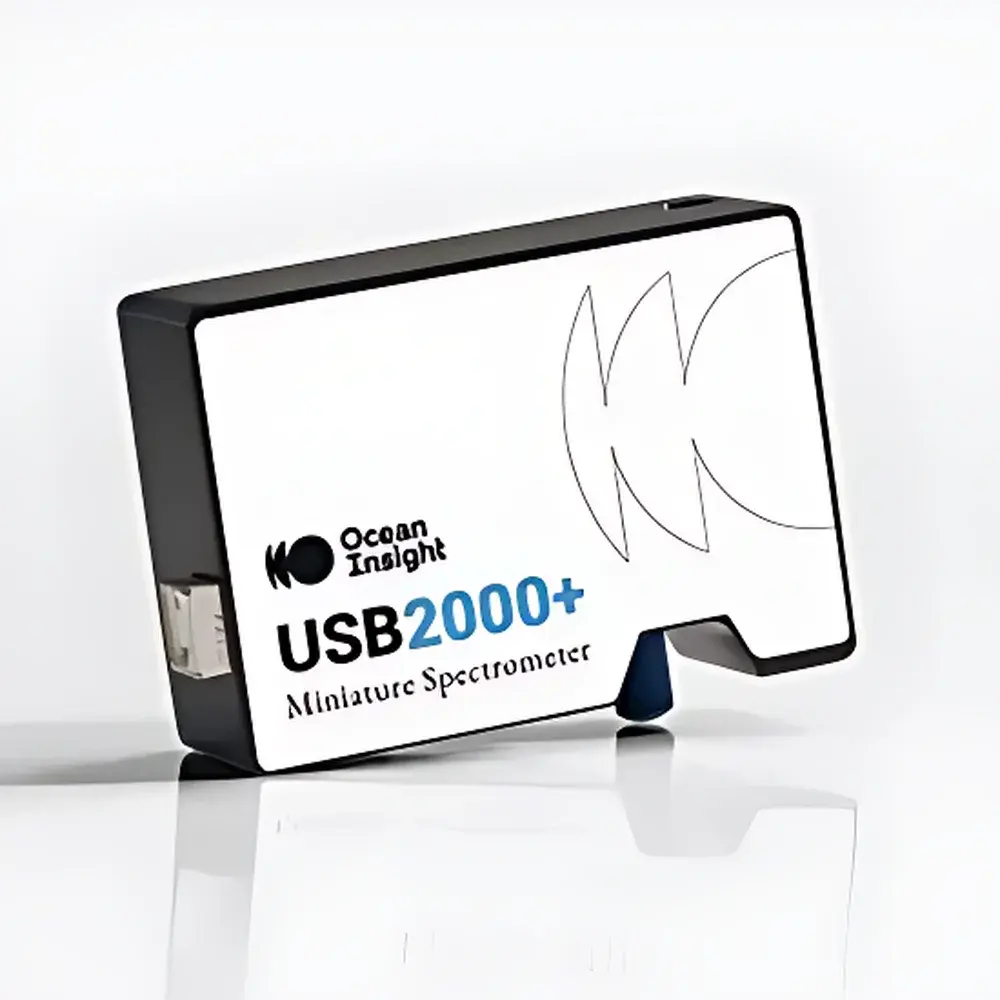
Ocean Optics USB4000 Miniature Fiber Optic Spectrometer
| Brand | Ocean Optics |
|---|---|
| Origin | USA |
| Model | USB4000 |
| Spectral Range | 190–1100 nm |
| Detector | Toshiba TCD1304AP Linear CCD Array (3648 pixels, 8 µm × 200 µm) |
| Optical Resolution (FWHM) | 0.02–8.4 nm (configurable via grating & slit selection) |
| Sensitivity | 130 photons/count @ 400 nm |
| Signal-to-Noise Ratio | 300:1 (full signal) |
| Dynamic Range | 3.4 × 10⁶ (single acquisition) |
| Stray Light | <0.05% @ 600 nm |
| A/D Conversion | 16-bit with auto-zero and temperature-compensated dark correction |
| Integration Time | 3.8 ms – 10 min |
| Interface | USB 2.0 (480 Mbps), RS-232, SPI, I²C |
| GPIO | 8 programmable digital I/O pins |
| Dimensions | 89.1 × 63.3 × 34.4 mm |
| Weight | 190 g |
| Operating Systems | Windows, macOS, Linux |
Overview
The Ocean Optics USB4000 is a compact, high-performance fiber optic spectrometer engineered for precision spectral measurement across the deep ultraviolet to near-infrared spectrum (190–1100 nm). Built upon a robust asymmetric crossed Czerny-Turner optical design (f/4, 42 mm input / 68 mm output focal length), it delivers stable wavelength calibration and minimal optical aberration under variable thermal and mechanical conditions. Its core detector — the Toshiba TCD1304AP linear CCD array — features 3648 pixels with 8 µm pitch and a full-well capacity of ~100,000 electrons, enabling high dynamic range and low-noise operation. The spectrometer integrates a 16-bit analog-to-digital converter with real-time dark current compensation, automatic zero-offset correction, and EEPROM-stored wavelength and intensity calibration coefficients — ensuring traceable, repeatable measurements without external recalibration. Designed for embedded OEM integration and field-deployable laboratory use, the USB4000 draws power solely from its USB 2.0 host connection and supports hot-plug operation across all major desktop operating systems.
Key Features
- Modular optical configuration: Select from 14 standard gratings and slit widths (5–200 µm) to optimize resolution (0.02–8.4 nm FWHM) and throughput for specific applications.
- High-speed data acquisition: Full-spectrum readout in ≤5 ms over USB 2.0; up to 250 spectra per second in burst mode with hardware triggering.
- Programmable electronics: Eight general-purpose digital I/O pins support synchronized control of external light sources, shutters, or sample stages; integrated electronic shutter enables minimum integration time of 3.8 ms.
- Thermal stability: Onboard temperature sensor enables real-time dark signal correction, critical for long-integration or ambient-variable measurements.
- Plug-and-play interoperability: Native drivers and SDKs for Python, MATLAB, LabVIEW, C/C++, and .NET; compliant with USB Device Class Definition for Human Interface Devices (HID), eliminating need for custom drivers.
- Compact, rugged form factor: Aluminum housing (89.1 × 63.3 × 34.4 mm, 190 g) rated for operation in non-condensing environments (15–35 °C, <80% RH).
Sample Compatibility & Compliance
The USB4000 interfaces seamlessly with Ocean Insight’s ecosystem of SMA905-coupled accessories, including deuterium-halogen broadband sources, pulsed LEDs, laser diodes, cuvette holders, integrating spheres, and reflection probes. Its broad spectral response supports quantitative absorbance (ASTM E308, ISO 11664-3), reflectance (ASTM E259, ISO 11664-4), and emission (ASTM E131, ISO 11664-5) measurements. While not certified for GMP/GLP-regulated environments out-of-the-box, the device supports audit-ready workflows when paired with SpectraSuite software configured for 21 CFR Part 11 compliance (electronic signatures, user access controls, immutable audit trails). Calibration certificates traceable to NIST standards are available upon request for ISO/IEC 17025-accredited laboratories.
Software & Data Management
SpectraSuite — Ocean Insight’s cross-platform spectral analysis application — provides real-time visualization, baseline correction, peak identification, multivariate fitting, and export to CSV, TXT, or HDF5 formats. The SDK includes low-level firmware access for custom timing sequences, GPIO state manipulation, and multi-device synchronization. All calibration metadata (wavelength polynomial, pixel sensitivity, nonlinearity correction) are stored in on-board EEPROM and automatically loaded at initialization. Data files embed EXIF-like headers containing instrument ID, grating ID, slit width, integration time, and temperature — enabling full experimental provenance tracking required for method validation and regulatory submissions.
Applications
- Laser characterization: Wavelength stability, mode structure, and pulse-to-pulse spectral consistency in DPSS, diode, and ultrafast lasers.
- Gas-phase absorption spectroscopy: Quantitative detection of O₃, NO₂, SO₂, and CH₄ using differential optical absorption spectroscopy (DOAS) protocols.
- Atomic emission line profiling: High-resolution mapping of Hg, Na, and H lines for plasma diagnostics and elemental analysis.
- Colorimetry and LED binning: CIE 1931 xy chromaticity, CCT, and spectral power distribution (SPD) evaluation per IES LM-79 and ENERGY STAR requirements.
- Field-deployable environmental monitoring: In-situ water quality (COD, nitrate, chlorophyll-a) and atmospheric aerosol extinction profiling using portable probe assemblies.
- OEM integration: Embedded spectral engine in medical devices (pulse oximetry), industrial process analyzers (pharmaceutical blend uniformity), and educational instrumentation platforms.
FAQ
What spectral resolution can I achieve with the USB4000?
Resolution depends on selected grating and entrance slit: typical configurations yield 0.02–8.4 nm FWHM. For example, a 2400 l/mm grating with 5 µm slit achieves ~0.02 nm resolution at 400 nm; a 300 l/mm grating with 100 µm slit yields ~8.4 nm at 600 nm.
Is the USB4000 compatible with Linux or macOS?
Yes — native support is provided via libusb-based drivers and the OceanInsight SDK, with documented API bindings for Python, C, and MATLAB on all three platforms.
Can I trigger the USB4000 externally to synchronize with other instruments?
Yes — four hardware trigger modes (edge, level, synchronous, and software-gated) are supported via dedicated TTL inputs and the 8-pin GPIO interface.
Does the USB4000 require an external power supply?
No — it operates entirely from USB 5 VDC bus power (max 250 mA), eliminating need for auxiliary power in portable or embedded deployments.
How is wavelength calibration maintained over time and temperature?
Each unit stores a third-order polynomial calibration in EEPROM; onboard temperature sensing enables real-time dark and sensitivity correction, preserving accuracy across 15–35 °C ambient ranges.






