
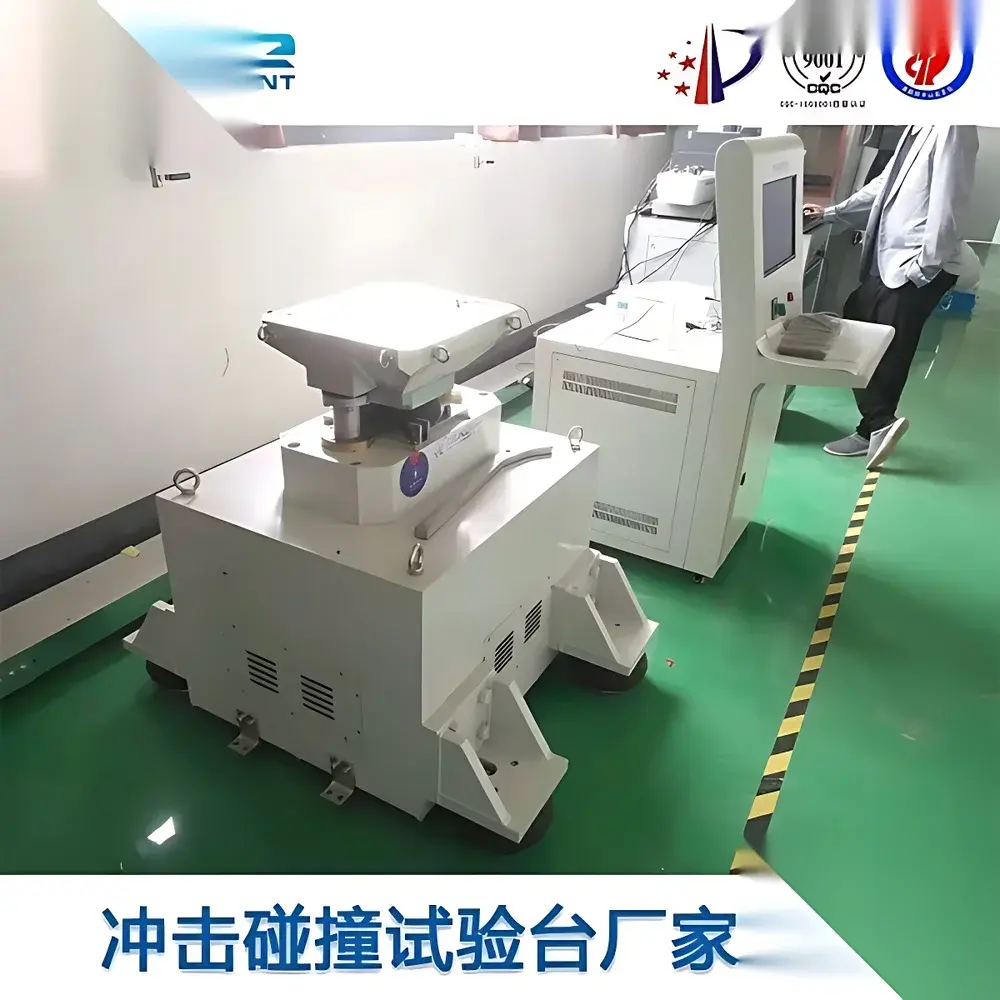
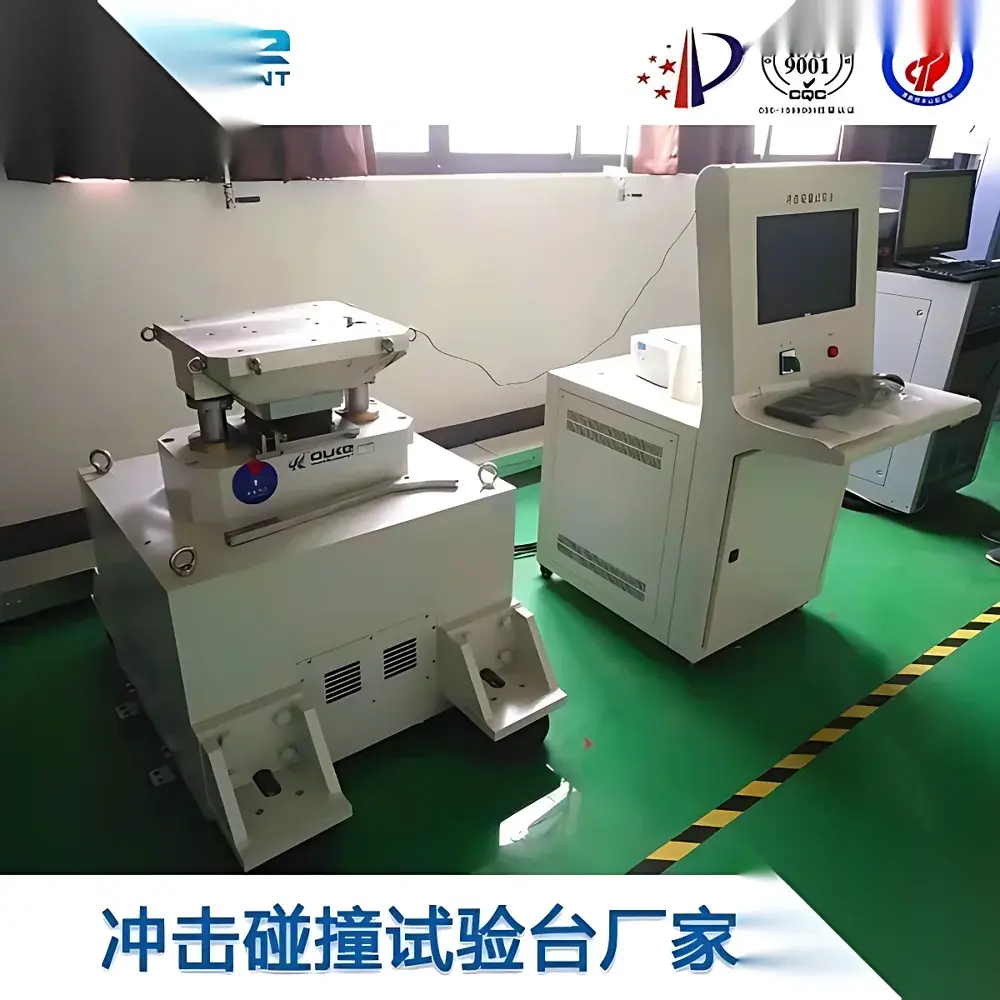
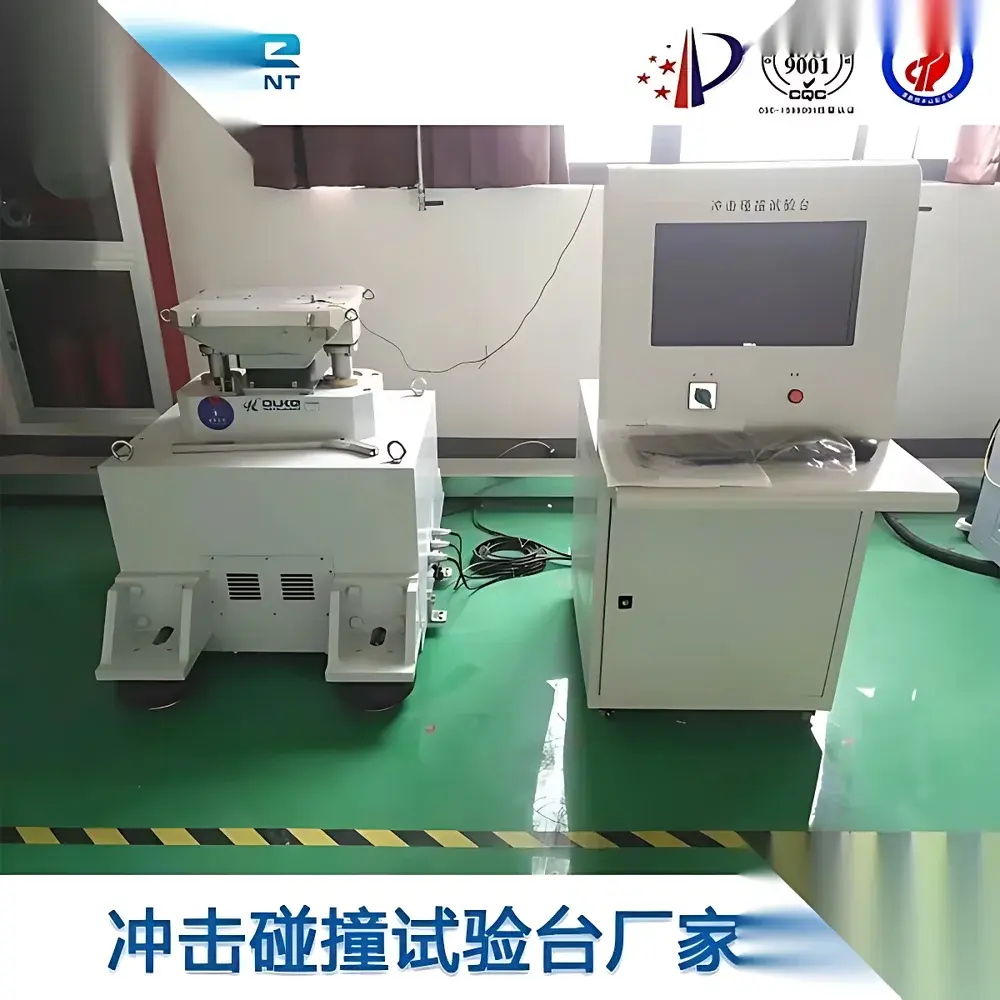
OEKO Shock and Collision Test Table
| Table Top Dimensions | 200 × 200 mm |
|---|---|
| Maximum Load Capacity | 10 kg |
| Pulse Duration Range | 0.6–20 ms (programmable, automatic) |
| Peak Acceleration Range | 150–20,000 m/s² |
| Pulse Waveform | Half-sine |
| Impact Direction | Vertical |
| Secondary Impact Prevention | Hydraulic–friction braking system |
| Height Adjustment | Digital preset + hydraulic lifting |
| Control & Measurement System | Integrated shock analysis unit |
| Table Mass | 2800 kg |
| Overall Dimensions | 750 × 2600 × 1000 mm |
| Power Supply | AC 380 V ±10%, 50 Hz, 3 kVA |
Overview
The OEKO Shock and Collision Test Table is a precision-engineered electro-hydraulic test platform designed for standardized mechanical shock and collision simulation in compliance with international testing protocols including ISO 2041, IEC 60068-2-27, MIL-STD-810H Method 516.8, and GB/T 2423.5. It operates on the principle of controlled free-fall impact combined with adjustable energy input via programmable drop height and tunable cushioning characteristics. The system generates repeatable half-sine acceleration pulses by releasing a rigid test table onto calibrated elastomeric or pneumatic buffers—enabling accurate reproduction of transient mechanical stress profiles encountered during transportation, handling, or operational shock events. Its vertical-axis configuration ensures uniaxial loading alignment critical for deterministic failure mode analysis in electronics, automotive components, aerospace subsystems, and medical devices.
Key Features
- High-rigidity monolithic table structure ensuring uniform peak acceleration distribution across the 200 × 200 mm active surface (±3% spatial variation under full 10 kg load)
- Dual-mode operation: programmable shock testing (via spring-compression or drop-height modulation) and regulated collision testing (with closed-loop acceleration control)
- Hydraulic–friction dual-stage braking mechanism eliminates secondary rebound, maintaining pulse fidelity and enabling strict adherence to waveform tolerance bands per ISO 18431-4
- Digital height presetting with hydraulic lifting actuation ensures sub-millimeter repeatability in drop height positioning (±0.2 mm)
- Integrated shock control and measurement system featuring real-time analog-to-digital acquisition at ≥1 MS/s, onboard FFT processing, and IEEE 1451.4-compliant TEDS sensor support
- Expandable waveform library supporting post-processing generation of trapezoidal and rear-peak sawtooth pulses through software-defined signal synthesis
- Optical position feedback loop synchronizes lift motion with trigger timing, reducing jitter to <10 µs RMS
Sample Compatibility & Compliance
The test table accommodates specimens up to 10 kg with mounting interface compatibility for standard ISO 13372 fixture plates and MIL-STD-1377 compliant clamping systems. Its mechanical architecture meets structural integrity requirements for Class II laboratory environments per EN 61000-6-4 (EMC immunity) and ISO 14001-aligned manufacturing traceability. All control firmware implements audit-ready event logging aligned with GLP/GMP documentation standards, including timestamped parameter changes, calibration history, and operator authentication logs. Optional FDA 21 CFR Part 11–compliant electronic signature modules are available for regulated pharmaceutical and diagnostic device validation workflows.
Software & Data Management
The OEKO Shock Analysis Suite (v4.2+) provides intuitive graphical setup of test profiles—including multi-step sequences, dwell times, and pass/fail threshold mapping against ISO 2247-2 acceptance criteria. Raw acceleration time histories are stored in HDF5 format with embedded metadata (test ID, operator, environmental conditions, calibration certificate ID). Export options include CSV, MATLAB .mat, and universal ASAM MDF4 containers for interoperability with third-party FEA post-processing tools such as ANSYS Mechanical and LS-DYNA. Remote monitoring via TLS-secured REST API enables integration into enterprise LIMS and MES platforms.
Applications
- Qualification testing of printed circuit board assemblies (PCBAs) per IPC-9592B vibration and shock thresholds
- Drop-test validation of handheld consumer electronics under IEC 60068-2-32
- Mechanical robustness assessment of avionics enclosures subjected to runway-induced shock loads
- Package integrity verification for sterile medical device shipping per ASTM D4169
- Material fatigue characterization of polymer composites under repeated low-velocity impact
- Calibration reference source for piezoelectric accelerometers per ISO 16063-21
FAQ
What safety interlocks are integrated into the system?
The table features dual-channel E-stop circuitry compliant with ISO 13850, light-curtain guarded access zones (Type 4, SIL 3), and real-time hydraulic pressure monitoring with automatic shutdown if buffer chamber integrity falls below 95% nominal setpoint.
Can the system perform sequential shock profiles with variable pulse parameters?
Yes—up to 99 programmable steps per test sequence, each with independent settings for height, pulse shape, repetition interval, and pass/fail criteria; all editable via drag-and-drop timeline interface.
Is calibration certification included with delivery?
A NIST-traceable factory calibration report covering acceleration amplitude linearity (±1.5% FS), pulse duration accuracy (±2%), and timing jitter (<10 µs) is supplied with each unit; annual recalibration services are available under ISO/IEC 17025-accredited procedures.
Related Products



