
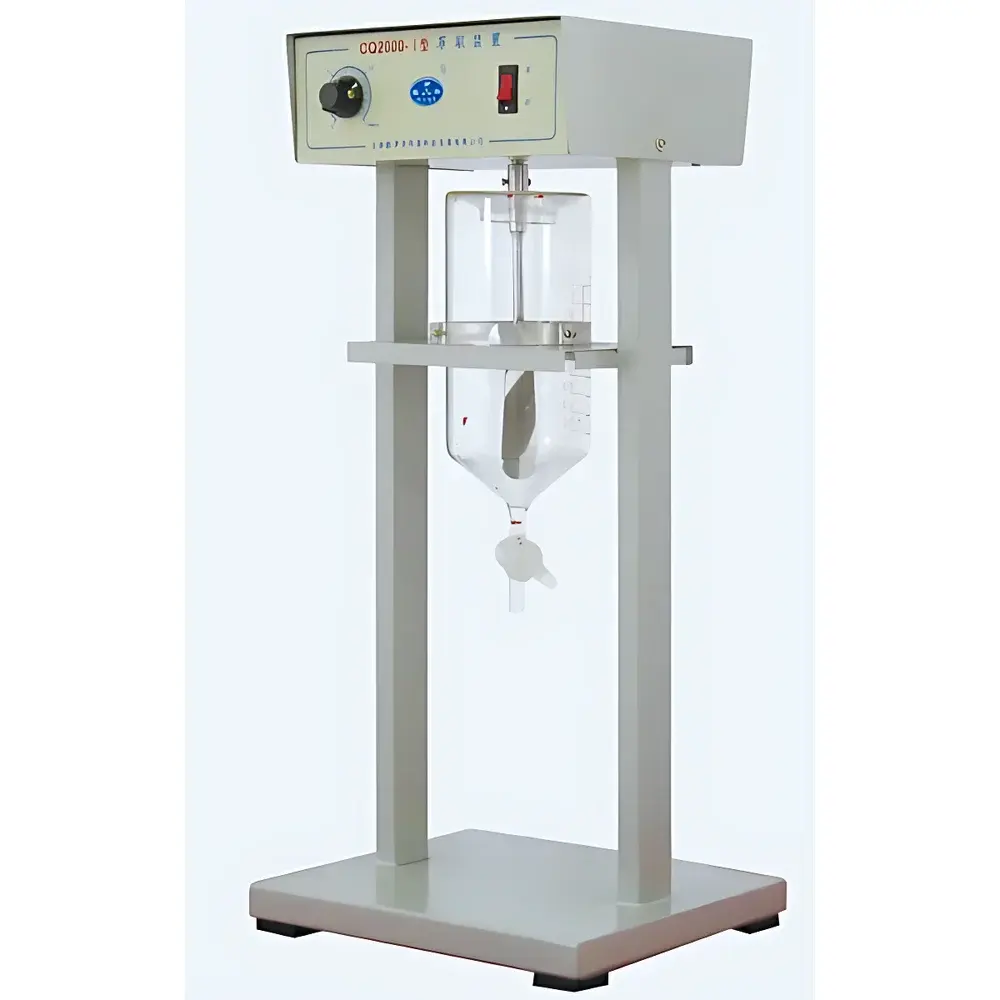
Oerl CQ2000-I Liquid-Liquid Extraction System
| Brand | Oerl |
|---|---|
| Origin | Jilin, China |
| Manufacturer Type | Authorized Distributor |
| Country of Manufacture | China |
| Model | CQ2000-I |
| Price Range | USD 0–1,450 (FOB) |
| Extraction Efficiency | >95% |
| Extraction Time | 3 min per sample |
| Agitation Mode | Bidirectional Rotational Oscillation |
| Sample Capacity | 1 × 1000 mL |
| Power Consumption | 10 W |
| Input Voltage | 220 V AC, 50 Hz |
| Dimensions (W×D×H) | 300 × 255 × 650 mm |
| Net Weight | 6 kg |
Overview
The Oerl CQ2000-I Liquid-Liquid Extraction System is an automated, benchtop-scale separation instrument engineered for reproducible and operator-independent liquid-liquid extraction (LLE) in analytical chemistry, environmental testing, pharmaceutical quality control, and food safety laboratories. It operates on the principle of controlled bidirectional rotational oscillation—generating consistent shear and interfacial contact between immiscible phases without emulsification or phase inversion—enabling rapid mass transfer and high-yield analyte partitioning. Unlike manual shaking or vortex-based methods, the CQ2000-I delivers standardized agitation kinetics across all runs, minimizing inter-operator variability and supporting method transfer under GLP and ISO/IEC 17025-compliant workflows. Its low-power, compact architecture makes it suitable for continuous use in multi-user lab environments where space, energy efficiency, and thermal stability are critical.
Key Features
- Bidirectional rotational oscillation mechanism ensures uniform mixing intensity and predictable residence time at the aqueous-organic interface, reducing co-extraction of interferents.
- Single-vessel configuration with 1000 mL capacity supports standard EPA Method 1664A (n-hexane extractable material), ASTM D3720 (oil & grease), and pharmacopeial LLE protocols requiring large-volume sample preparation.
- Programmable 3-minute extraction cycle provides deterministic throughput—ideal for batch processing prior to GC, HPLC, or ICP-MS analysis.
- Low thermal load design (10 W nominal power) prevents temperature-induced analyte degradation or solvent volatility shifts during extraction.
- Stainless steel and chemically resistant polymer housing complies with laboratory safety standards for organic solvent exposure (e.g., chloroform, ethyl acetate, hexane).
- Ergonomic vertical form factor (650 mm height) integrates seamlessly into fume hood workflows while maintaining accessibility for vessel loading/unloading.
Sample Compatibility & Compliance
The CQ2000-I accommodates standard 1000 mL glass or PTFE-lined separatory funnels and is compatible with common LLE solvents including dichloromethane, MTBE, n-hexane, ethyl acetate, and toluene. It meets mechanical performance criteria referenced in US EPA SW-846 Method 3510C (separation by agitation) and supports validation against ISO 1133-2:2020 (plastics—determination of melt mass-flow rate) when used for polymer extractables analysis. The system’s fixed agitation profile eliminates subjective operator input, thereby satisfying documentation requirements for audit-ready SOPs under FDA 21 CFR Part 11 (when paired with compliant lab information management systems). No moving parts require lubrication or calibration; routine verification consists solely of timing accuracy and rotational symmetry checks.
Software & Data Management
The CQ2000-I is a standalone hardware platform with no embedded microcontroller or digital interface. Operation is initiated via a momentary push-button with LED status indication; all parameters—including cycle duration and oscillation amplitude—are factory-set and non-adjustable to ensure inter-unit consistency. This design prioritizes robustness, electromagnetic compatibility (EMC Class B), and long-term reliability over software configurability. For laboratories requiring electronic recordkeeping, integration is achieved externally via time-stamped video logging, programmable PLC triggers, or barcode-scanned run initiation linked to LIMS entries. Audit trails for each extraction event must be maintained separately per ISO/IEC 17025 clause 7.5.2 (control of data and information management).
Applications
- Environmental analysis: Extraction of PAHs, PCBs, organochlorine pesticides, and petroleum hydrocarbons from water, soil leachates, and wastewater effluents.
- Pharmaceutical QC: Isolation of active pharmaceutical ingredients (APIs) and residual solvents from aqueous reaction mixtures prior to HPLC quantification (ICH Q2(R2) compliant).
- Food safety testing: Recovery of mycotoxins (e.g., aflatoxin B1), veterinary drug residues, and plasticizer migrants (e.g., DEHP) from homogenized food matrices.
- Clinical toxicology: Preparation of urine or plasma samples for LC-MS/MS detection of drugs of abuse and metabolites.
- Materials science: Solvent extraction of unreacted monomers or catalyst residues from polymer synthesis batches.
FAQ
Is the CQ2000-I compatible with automated funnel clamping systems?
Yes—it accepts industry-standard 1000 mL separatory funnels with ground-glass joints (ISO K29/32 or ASTM E287) and can be integrated with third-party robotic arms equipped with vacuum or pneumatic grippers.
Does the system support variable speed or time programming?
No—the oscillation frequency and 3-minute cycle are fixed at manufacture to guarantee method equivalence across installations and eliminate user-configurable variables that could compromise regulatory compliance.
What maintenance is required?
Annual visual inspection of drive belt tension and bearing smoothness; no scheduled lubrication or recalibration is specified in the technical manual.
Can it be used inside a fume hood without airflow interference?
Yes—the unit generates negligible convective heat and operates silently (<45 dB(A)), making it suitable for continuous operation within ventilated enclosures meeting ANSI/AIHA Z9.5 standards.
Is CE or UL certification available?
The CQ2000-I carries CCC certification for the Chinese market; CE marking is not applicable as it is classified as laboratory equipment under EU Directive 2014/30/EU (EMC) and 2014/35/EU (LVD) only upon request with full technical file submission.



