
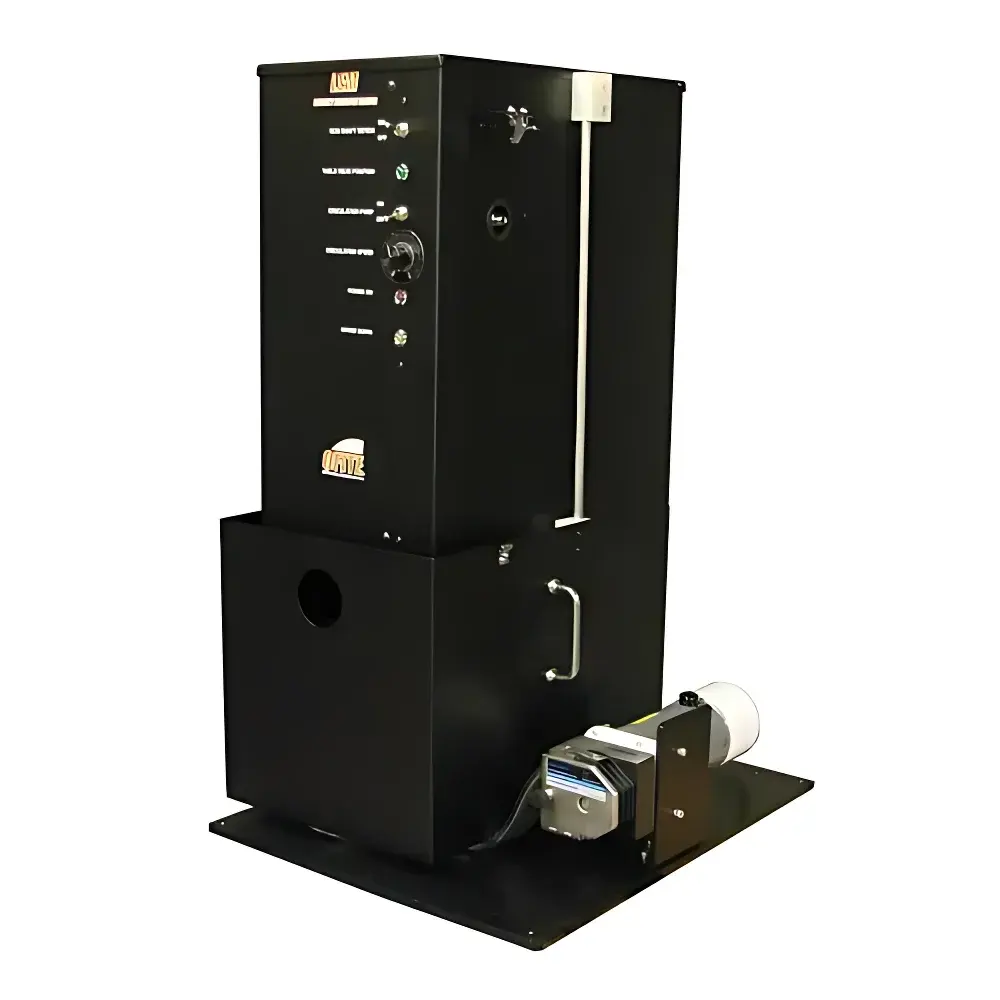
OFITE LEM Lubricity Evaluation System (Model 113-00)
| Brand | OFITE |
|---|---|
| Origin | USA |
| Manufacturer Status | Authorized Distributor |
| Origin Category | Imported |
| Model | 113-00 |
| Price | Upon Request |
| Power Supply | 220 V |
| Pneumatic Supply | 60–100 PSI |
| Sample Chamber Capacity | 350 mL |
| Mud Density Range | 0.83–18.0 lb/gal |
| Maximum Torque | 100 lbf·in |
| Torque Accuracy | ±0.1% of Full Scale |
| Maximum Lateral Load | 60 lbf |
| Maximum Rotational Speed | 200 rpm |
| Circulation Pump Speed | 20–500 rpm |
| Calibration Reference (Water) | μ = 0.32–0.36 |
| Test Cell Material | Acrylic |
| Rotating Shaft Material | AISI 4140 Steel, 37 HRC |
Overview
The OFITE LEM Lubricity Evaluation System (Model 113-00) is a precision-engineered laboratory instrument designed to quantify the boundary lubricity performance of drilling fluids, completion fluids, and lubricant additives under controlled, reproducible mechanical conditions. It operates on the principle of direct tribological measurement: a rotating steel shaft—representing the drill string—is pressed laterally against a stationary geological or metallic sample (e.g., casing, sandstone core, or formation-mimicking substrate) while fully immersed in the test fluid. Frictional resistance is measured in real time via high-fidelity torque transduction, enabling calculation of the coefficient of friction (μ) using the fundamental relationship μ = T / (F × r), where T is measured torque (lbf·in), F is applied lateral load (lbf), and r is the shaft radius (in). This configuration replicates key kinematic and loading conditions encountered downhole during rotary drilling operations, particularly at low relative velocity and high contact pressure—regimes where hydrodynamic film formation is minimal and boundary lubrication dominates.
Key Features
- Pneumatically actuated lateral loading mechanism ensures consistent, repeatable normal force application (up to 60 lbf) without mechanical hysteresis or drift.
- Programmable pneumatic impact hammer periodically separates the rotating shaft from the sample surface, creating a transient gap that enables controlled replenishment of fresh test fluid at the interface—mimicking dynamic fluid renewal observed during actual drill string rotation and reciprocation.
- Modular sample holder accommodates interchangeable specimens—including API-standard casing coupons, cylindrical sandstone cores (ASTM D4543-compliant), and custom-machined formation analogs—enabling comparative evaluation across lithologies and metallurgies.
- Integrated digital data acquisition system synchronously records rotational speed (0–200 rpm), shaft torque (0–100 lbf·in, ±0.1% FS accuracy), lateral load (0–60 lbf), and circulation pump speed (20–500 rpm) at user-defined sampling intervals.
- Rigid acrylic test cell (350 mL capacity) provides optical access for visual inspection and accommodates mud densities ranging from 0.83 to 18.0 lb/gal—covering water-based, synthetic-based, and weighted oil-based systems.
- Rotating shaft fabricated from heat-treated AISI 4140 steel (37 HRC) ensures dimensional stability, wear resistance, and surface consistency critical for inter-laboratory reproducibility.
Sample Compatibility & Compliance
The LEM supports standardized and application-specific sample geometries per industry protocols including API RP 13I (for drilling fluid lubricity), ASTM D2266 (lubricant friction testing), and ISO 12156-1 (diesel fuel lubricity). Sandstone core plugs are mounted in accordance with ASTM D4543 practices for intact rock specimen preparation. Casing coupons conform to API RP 5C1 dimensional tolerances. The system’s mechanical design and operational parameters align with GLP-compliant test execution requirements, supporting audit-ready documentation when paired with validated software workflows. While the base hardware does not include built-in 21 CFR Part 11 compliance features, its data export architecture (CSV, ASCII) facilitates integration into validated LIMS or ELN environments meeting FDA and EMA regulatory expectations.
Software & Data Management
The proprietary LEM Control Software provides real-time visualization and post-test analysis of six primary variables: rotational speed (rpm), shaft torque (lbf·in), lateral load (lbf), calculated coefficient of friction (μ), circulation pump speed (rpm), and elapsed time. Users define test parameters—including target rpm, lateral load setpoint, and hammer activation interval—prior to run initiation. All raw sensor outputs and derived metrics are timestamped and stored in structured binary archives, with export capability to comma-separated values (CSV) for third-party statistical analysis (e.g., JMP, MATLAB, Python pandas). Historical test files are indexed by date, operator ID, and sample identifier; version-controlled software updates maintain backward compatibility with legacy datasets. Calibration logs—including water reference runs (μ = 0.32–0.36)—are embedded within each test record to support traceability.
Applications
- Quantitative ranking of lubricity enhancers (e.g., fatty acid esters, graphite, nano-additives) in water-based and non-aqueous drilling fluids.
- Performance validation of synthetic-based mud (SBM) formulations under simulated downhole contact pressures and shear rates.
- Correlation studies between laboratory-measured μ and field-observed torque/drag behavior during directional drilling operations.
- Screening of corrosion inhibitor packages for synergistic effects on both metal–metal and metal–rock friction interfaces.
- Research into formation damage mechanisms related to filter cake lubricity and cuttings transport efficiency.
- Support for technical documentation required in IADC/IOGP HSE submissions and OEM equipment qualification dossiers.
FAQ
What standards does the LEM comply with for lubricity testing?
The system implements test methodologies aligned with API RP 13I Annex A and ASTM D2266, and supports sample preparation per ASTM D4543 for rock specimens.
Can the LEM be used with high-density weighted muds?
Yes—the system accommodates mud densities up to 18.0 lb/gal, verified through calibrated hydrometer and pressurized density cup validation protocols.
Is torque calibration traceable to NIST standards?
Torque sensors are factory-calibrated using NIST-traceable deadweight standards; users receive calibration certificates with uncertainty budgets.
How is fluid temperature controlled during testing?
The standard LEM does not include active thermal regulation; however, the acrylic cell is compatible with external circulating baths (−10 °C to +80 °C) via inlet/outlet ports.
Does the software support automated pass/fail criteria based on μ thresholds?
Yes—users may define configurable μ acceptance limits per test sequence; the software flags deviations in real time and appends status tags to exported reports.




