
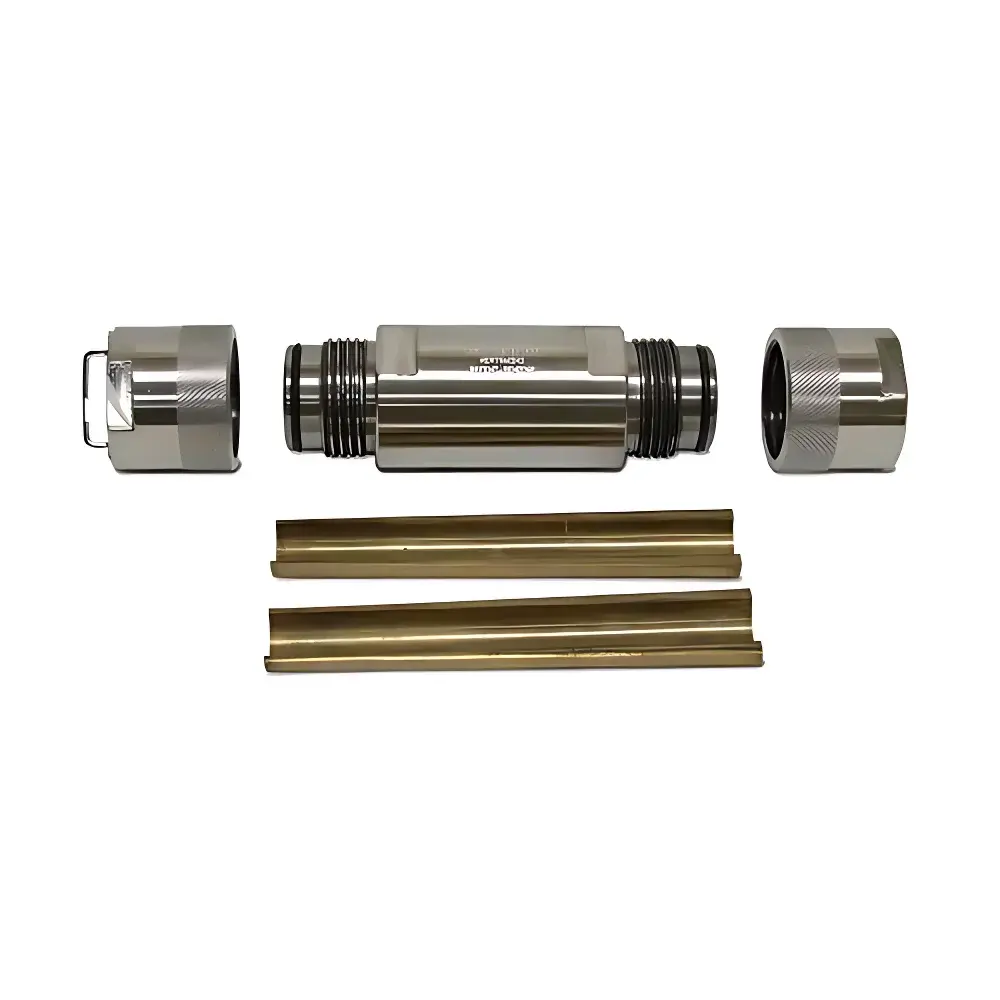
OFITE Model 122-186-101 Foam Cement Stability Testing Tube
| Brand | OFITE |
|---|---|
| Origin | USA |
| Manufacturer Status | Authorized Distributor |
| Origin Category | Imported |
| Model | 122-186-101 |
| Pricing | Upon Request |
| Max Pressure | 3,000 psi (20.7 MPa) |
| Max Temperature | 400 °F (204.4 °C) |
| Height | 10 in (25 cm) |
| Diameter | 2.75 in (7 cm) |
| Weight | 13.5 lb (6.3 kg) |
| Component Set | #122-186-001 (Cylinder Body), #122-186-002 (Split Brass Insert), #122-186-003 (End Cap), #122-186-010 (O-Ring), #122-186-501 (Handle) |
Overview
The OFITE Model 122-186-101 Foam Cement Stability Testing Tube is a precision-engineered pressure containment system designed for controlled thermal and mechanical evaluation of foam cement slurries under simulated downhole conditions. It operates on the principle of isolated isostatic curing: the sealed cylindrical assembly isolates the cement slurry from external pressure-transmitting media (e.g., hydraulic oil or nitrogen), eliminating cross-contamination while maintaining internal gas bubble integrity throughout the curing cycle. This isolation mechanism ensures that foam structure—critical to density control, compressive strength development, and long-term zonal isolation performance—is preserved without artificial collapse or coalescence induced by differential pressure gradients. The device is rated for continuous service at up to 3,000 psi (20.7 MPa) and 400 °F (204.4 °C), aligning with API RP 10B-2 and ISO 10427-2 requirements for cement slurry stability testing in oil and gas well construction.
Key Features
- Patented dual-conical geometry (US Patent No. 10,203,318): both the outer cylinder body and internal brass insert feature precisely machined tapered profiles, enabling clean, non-destructive ejection of the cured cement plug without cracking or shearing.
- Hermetically sealed pressure boundary: integrated high-temperature fluorocarbon O-ring (#122-186-010) ensures leak-tight integrity across the full operational envelope, preventing ingress of pressure medium and egress of entrained gas phases.
- Split-brass insert design (#122-186-002): two symmetrical semi-cylindrical components allow precise centering within the main tube and facilitate uniform radial consolidation during curing—critical for generating dimensionally consistent, ASTM C109-compliant test specimens.
- Modular component architecture: includes dedicated handle (#122-186-501) for safe handling at elevated temperatures, threaded end cap (#122-186-003) with torque-specification guidance, and corrosion-resistant 316 stainless steel cylinder body (#122-186-001).
- Multi-fluid compatibility: validated for use with nitrogen-stabilized, surfactant-based foam cements as well as conventional API Class G/H slurries, supporting comparative studies per API RP 10B-2 Annex E.
Sample Compatibility & Compliance
The 122-186-101 system accommodates standard 2.75-inch diameter × 10-inch height cement specimens, enabling direct correlation with core flooding, ultrasonic velocity, and unconfined compressive strength (UCS) test protocols. Its dimensional fidelity supports compliance with ASTM C307 (compressive strength of cylindrical specimens), ASTM C494 (chemical admixtures), and ISO 10427-2 (foamed cement characterization). The unit’s pressure/temperature rating satisfies API RP 10B-2 Section 7.4.2 for high-pressure/high-temperature (HPHT) foam stability assessment. All wetted surfaces are electropolished and passivated to prevent catalytic degradation of foaming agents. Documentation packages include material traceability certificates (MTRs) and ASME BPVC Section VIII Div. 1 compliance verification for pressure boundary components.
Software & Data Management
While the 122-186-101 is a standalone mechanical test fixture, it integrates seamlessly into digital cement evaluation workflows. When used with OFITE’s automated pressurization and thermal cycling systems (e.g., Model 122-190 Series), data acquisition conforms to FDA 21 CFR Part 11 requirements via timestamped, user-authenticated electronic records. Pressure ramp rates, dwell times, and temperature profiles are programmable and auditable. Raw specimen dimensions—measured post-ejection using calibrated digital calipers—are directly importable into OFITE CementLab™ v4.2 for automated density calculation (ρ = m/V), void fraction estimation, and statistical process control (SPC) charting against historical baselines.
Applications
- Quantitative assessment of foam collapse resistance under sustained HPHT conditions
- Density retention analysis for low-density (< 11 ppg) cement designs targeting shallow gas zones or depleted reservoirs
- Comparative evaluation of surfactant efficiency and gas diffusion kinetics across foam formulations
- Validation of curing time–strength development relationships in nitrogen-foamed systems
- Pre-qualification testing for cement systems intended for subsea, geothermal, or CO₂ sequestration wells where long-term annular integrity is mission-critical
FAQ
Can this tube be used with non-foamed cement slurries?
Yes. The 122-186-101 is fully compatible with conventional API Class G, H, and specialty slurries, serving as a robust alternative to standard API thickening time molds when dimensional consistency and contamination control are required.
Is the brass insert reusable?
Yes—the split-brass insert (#122-186-002) is designed for repeated use; however, visual inspection for galling or deformation is recommended prior to each test cycle per OFITE Maintenance Bulletin MB-186-02.
Does the system include calibration documentation?
Each unit ships with a Certificate of Conformance (CoC) referencing ASME B16.20 for O-ring specifications and NIST-traceable dimensional verification reports for critical bores and tapers.
What safety standards govern its operation?
The assembly complies with OSHA 1910.1200 (Hazard Communication), ANSI/ASME B31.4 (liquid transportation piping), and incorporates dual mechanical pressure relief pathways per API RP 14C guidelines for surface-controlled subsurface safety systems.
How is specimen ejection performed?
After cooling to ≤100 °F (38 °C), the end cap is removed, the handle is engaged, and gentle axial force—applied parallel to the taper axis—ejects the intact cement plug without rotational torque or lateral stress.






