
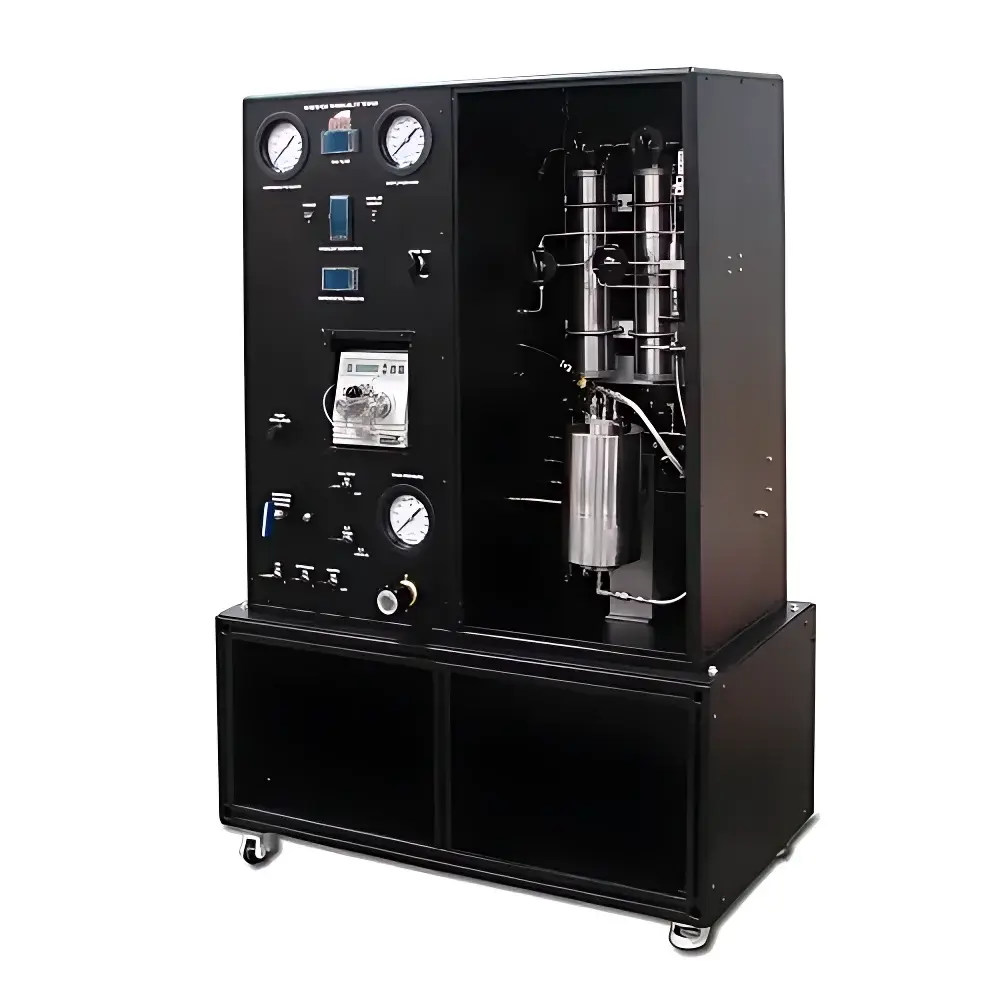
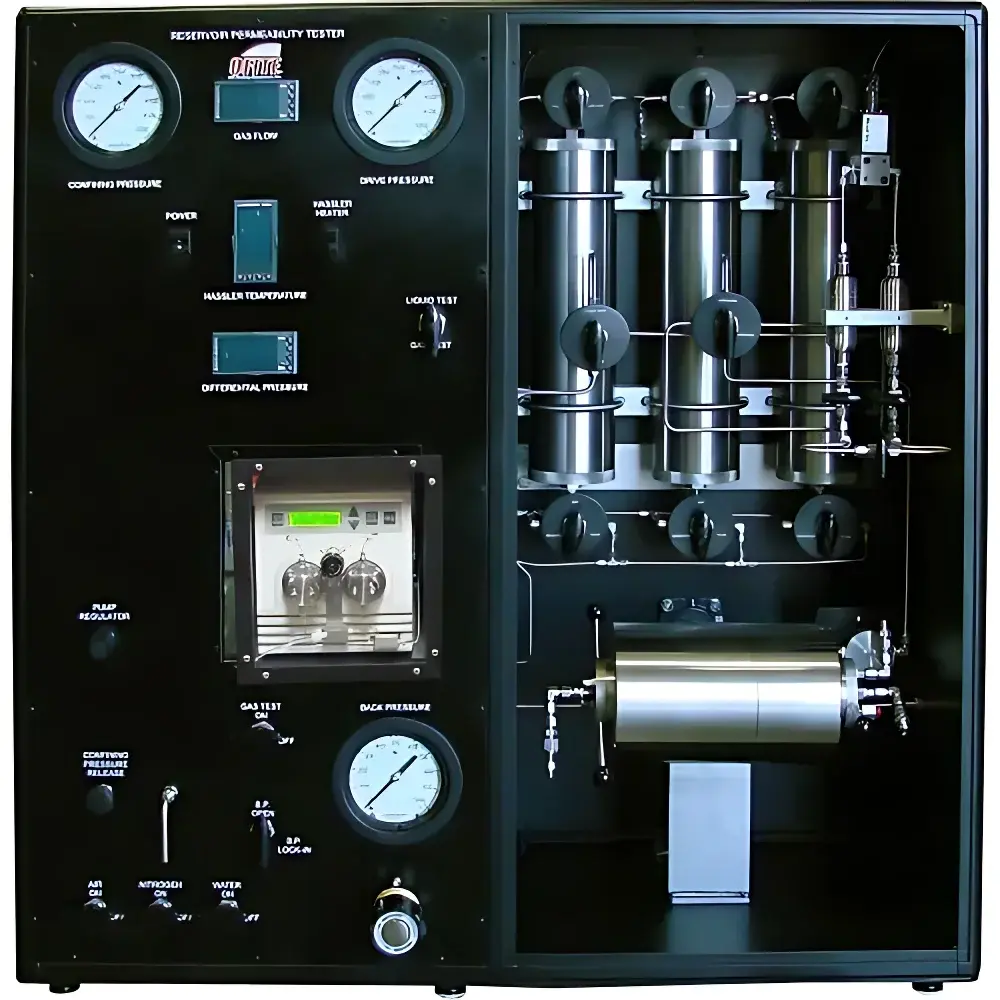
OFITE Model 127-00 Manual Gas/Liquid Core Flood Permeability Tester
| Brand | OFITE |
|---|---|
| Origin | USA |
| Manufacturer Status | Authorized Distributor |
| Origin Category | Imported |
| Model | 127-00 |
| Pricing | Upon Request |
Overview
The OFITE Model 127-00 Manual Gas/Liquid Core Flood Permeability Tester is a precision-engineered laboratory instrument designed for quantitative evaluation of absolute and relative permeability in reservoir rock core samples under controlled confining, differential, and backpressure conditions. Based on Darcy’s law fundamentals, the system enables steady-state and unsteady-state flow experiments to determine permeability to gas (e.g., nitrogen) and liquid phases (e.g., brine, kerosene, or synthetic oil), supporting critical reservoir characterization workflows in petroleum engineering laboratories. The tester accommodates both horizontal and vertical core orientation via its Hassler-type core holder—ensuring representative stress-state simulation across heterogeneous formations. Its manual valve-controlled fluid routing architecture provides full operator transparency and procedural repeatability, making it especially suitable for method development, acidizing response studies (including Acid Response Curve—ARC—generation), and comparative wettability assessments.
Key Features
- Three independent piston-driven intermediate vessels (1.5 L each), enabling sequential or simultaneous injection of up to three distinct fluids—including aqueous solutions, hydrocarbons, and inert gases such as nitrogen
- Hassler-style core holder with dual-axis orientation capability (horizontal/vertical), fabricated from ASTM A240 Grade 316 stainless steel; optional Hastelloy C-276 wetted components available for high-acidity or H₂S-laden fluid testing
- Modular two-piece cabinet design: lower compartment houses storage for ancillary tools and calibration standards; upper section integrates the rotating base platform with lockable positioning for stable alignment during testing
- Manual multi-port valve manifold allows precise directional control—forward flood, reverse flood, or shut-in—for evaluating non-Darcy flow effects, hysteresis, and trapping behavior
- Integrated PC-based data acquisition system with real-time pressure, temperature, and volumetric flow monitoring; supports time-synchronized logging at user-defined intervals
Sample Compatibility & Compliance
The Model 127-00 accepts cylindrical core plugs with diameters of 1.0 inch (25.4 mm) or 1.5 inches (38.1 mm), up to 6 inches (152.4 mm) in length. All wetted surfaces comply with NACE MR0175/ISO 15156 for sour service environments when specified with HC-276 construction. The system operates within defined thermal and pressure envelopes—maximum core holder temperature of 400 °F (204.4 °C), confining pressure up to 5000 psi (34.5 MPa), differential pressure up to 3000 psi (20.7 MPa), and backpressure up to 1000 psi (6.9 MPa)—enabling simulation of deep-reservoir conditions. Note: Not intended for use with heavy crude oils or viscous bitumen; test fluids must remain fully liquid-phase at ambient laboratory temperatures per API RP 40 and ISO 15752 guidelines.
Software & Data Management
The included Windows-compatible software provides intuitive configuration of test protocols, live visualization of pressure differentials (inlet/outlet/confined), real-time flow rate tracking (0–10 mL/min range), and automated calculation of permeability using standard Darcy-derived equations. Data export is supported in CSV and Excel formats for downstream analysis in MATLAB, Python, or commercial reservoir simulators. Audit trails, user access controls, and timestamped event logs align with GLP and GMP documentation requirements. While not inherently 21 CFR Part 11 compliant out-of-the-box, the software architecture supports integration with validated electronic signature modules for regulated QA/QC environments.
Applications
- Determination of absolute permeability to air, nitrogen, brine, and light hydrocarbon liquids
- Relative permeability curve generation (oil/water, gas/oil, gas/water systems)
- Acidizing efficiency assessment and Acid Response Curve (ARC) derivation per SPE Recommended Practice RP13B-2
- Core flooding studies for EOR screening (polymer, surfactant, low-salinity waterflooding)
- Wettability alteration evaluation via Amott-Harvey or USBM index protocols
- Calibration verification of automated core analysis systems (e.g., poroperm units)
FAQ
What sample dimensions are supported?
The system accommodates core plugs measuring either 1.0 inch or 1.5 inches in diameter, with maximum length of 6 inches.
Is nitrogen the only acceptable gas phase?
Nitrogen is standard due to inertness and regulatory acceptance; helium may be used for gas slippage correction where Knudsen number >0.01, subject to compatibility review.
Can this unit perform dynamic saturation monitoring?
No—this is a steady-state/manual flood system without integrated resistivity or CT scanning; saturation profiles require post-test sectioning or complementary imaging techniques.
What utilities are required for operation?
Compressed air (100 psi), nitrogen supply (2000 psi), potable water (30–40 psi), and dedicated 230 VAC / 30 A electrical circuit.
Is ASTM D2340 or ISO 15752 compliance verified?
The system meets mechanical and procedural requirements outlined in both standards; final method validation remains the responsibility of the end-user laboratory per ISO/IEC 17025 accreditation protocols.




