
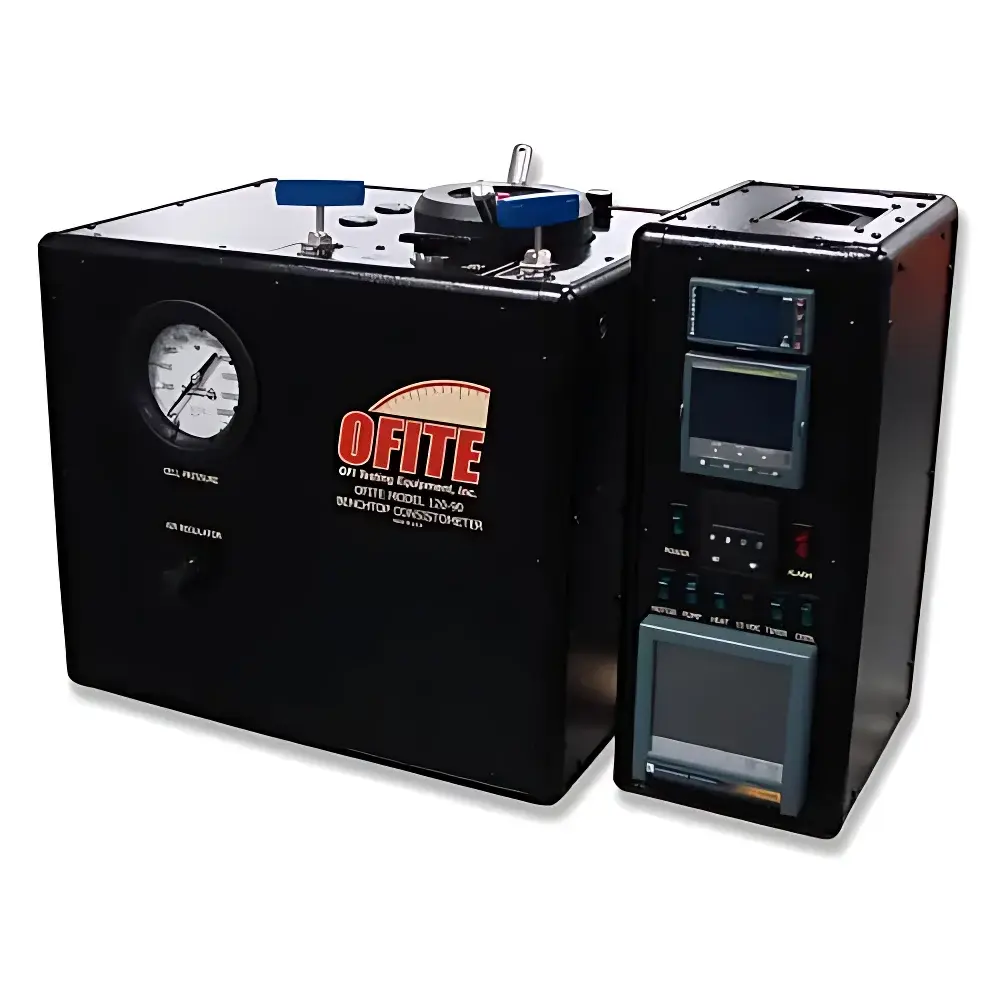
OFITE Model 130 Benchtop High-Temperature High-Pressure Cement Consistometer
| Brand | OFITE |
|---|---|
| Origin | USA |
| Model | 130 |
| Max Pressure | 16,000 psi (110.3 MPa) |
| Max Temperature | 400 °F (204.4 °C) |
| Temperature Control | Digital PID with ±1 °F resolution |
| Heating Power | 2500 W (optional 5000 W) |
| Mixer Speed | 150 rpm |
| Chamber Material | 316 Stainless Steel |
| Power Supply | 220 V, 50/60 Hz, 25 A |
| Dimensions | 25 × 16 × 20 in (63.5 × 40.6 × 50.8 cm) |
| Weight | 215 lb (97.6 kg) |
| Air/N₂ Supply Required | 100–150 psi (690–1035 kPa) |
| Cooling Water Supply Required | 40 psi (276 kPa) |
| Compliance | API RP 10B-2 (ISO 10426-2) |
Overview
The OFITE Model 130 Benchtop High-Temperature High-Pressure Cement Consistometer is an engineered test system designed to simulate downhole thermal and hydraulic conditions during oilwell cementing operations. It measures the rheological evolution—specifically the thickening time—of hydraulic cement slurries under controlled elevated temperature and pressure, following the standardized methodology defined in API Recommended Practice 10B-2 (equivalent to ISO 10426-2). The instrument employs a rotating paddle mechanism within a sealed, pressurized slurry chamber, where viscosity development is monitored via torque transmission through a magnetic coupling. This non-contact drive eliminates dynamic seal leakage—a critical reliability factor for extended high-pressure tests—and ensures mechanical integrity across repeated thermal cycles. The system’s compact footprint and integrated cooling jacket enable stable operation at up to 400 °F (204.4 °C) and 16,000 psi (110.3 MPa), making it suitable for both laboratory benchtop deployment and field-based quality assurance in cementing service units.
Key Features
- Magnetic drive system isolates the rotating paddle from the pressurized chamber, eliminating shaft seal wear and enabling long-duration, leak-free testing under extreme conditions.
- Integrated external cooling jacket circulates chilled water to maintain precise thermal equilibrium during exothermic cement hydration, minimizing thermal gradient-induced measurement drift.
- Digital PID temperature controller with ±1 °F resolution ensures repeatable thermal profiles across multiple test runs; optional 5000 W heater upgrade supports rapid ramp rates for accelerated testing protocols.
- Electronic timer with 0.1-minute resolution and programmable audible/visual alarms triggers automatic shutdown upon completion or deviation beyond user-defined thresholds for temperature or consistency.
- Factory-calibrated load cell and built-in weight calibration kit provide traceable verification of applied shear stress, supporting metrological compliance with ISO/IEC 17025 requirements for accredited laboratories.
- ASME-certified pressure vessel with dual safety redundancy: burst disc rated for 16,000 psi plus overpressure relief valve; all pressure readings displayed in psi with direct analog output for external data logging.
Sample Compatibility & Compliance
The Model 130 accommodates standard API-specified cement slurry volumes (typically 350–400 mL) in its 316 stainless steel mixing cup, compatible with Class A through G cements, retarders, accelerators, silica flour, and synthetic-based fluid additives. Slurry preparation follows ASTM C109/C305 procedures prior to loading. All operational parameters—including pressure ramp rate, hold duration, temperature soak time, and rotational speed—are configurable to replicate specific wellbore profiles per operator-defined job designs. The instrument meets the mechanical and procedural requirements of API RP 10B-2 Annex A for thickening time determination and supports audit readiness for GLP and GMP environments through documented calibration records, maintenance logs, and electronic signature-capable data acquisition (DAS option).
Software & Data Management
The optional Data Acquisition System (DAS) variant (Part No. 120-90-DAS) includes USB-connected analog-to-digital conversion hardware and Windows-compatible software compliant with FDA 21 CFR Part 11. It captures time-stamped pressure, temperature, torque, and rotational speed signals at user-selectable intervals (1–60 sec), generating .csv and .pdf reports with embedded metadata (operator ID, sample ID, calibration status, environmental conditions). Audit trails record all parameter changes, file exports, and user logins; electronic signatures are enforced for report finalization. Raw data files are stored with SHA-256 checksums to ensure integrity, and the software supports export to LIMS platforms via ODBC or HL7 interfaces.
Applications
- Determination of thickening time for primary and remedial cementing slurries under realistic downhole conditions.
- Evaluation of thermal stability and set-on-demand behavior of lightweight foamed cements and nanomaterial-modified formulations.
- Validation of chemical additive performance (e.g., fluid loss control agents, dispersants) across pressure-temperature matrices.
- Supporting cement sheath integrity modeling by correlating thickening profiles with compressive strength development curves (per API RP 10B-11).
- Field QA/QC for offshore rig cementing operations where portability and rapid turnaround are essential.
FAQ
What standards does the OFITE 130 comply with?
It is fully aligned with API RP 10B-2 (ISO 10426-2) for thickening time measurement and incorporates design elements meeting ASME BPVC Section VIII Div. 1 for pressure containment.
Is the instrument suitable for low-temperature testing?
Yes—the digital PID controller supports setpoints from ambient to 400 °F, and the cooling jacket enables active heat extraction for sub-ambient stabilization when paired with a chiller unit.
Can the Model 130 be integrated into an automated lab network?
With the DAS option, it provides Modbus TCP and analog 4–20 mA outputs for PLC interfacing, and its software supports scheduled batch testing and remote monitoring via secure VPN.
What maintenance is required between tests?
Standard protocol includes cleaning the 316 SS mixing cup and paddle with inhibited acid solution, verifying burst disc integrity, checking hydraulic oil level in the air-driven pump, and validating temperature sensor offset annually per NIST-traceable reference.
Does OFITE provide calibration certification?
Each unit ships with a factory calibration certificate covering pressure transducer, RTD, torque sensor, and timer; on-site recalibration services are available globally through authorized service partners.






