
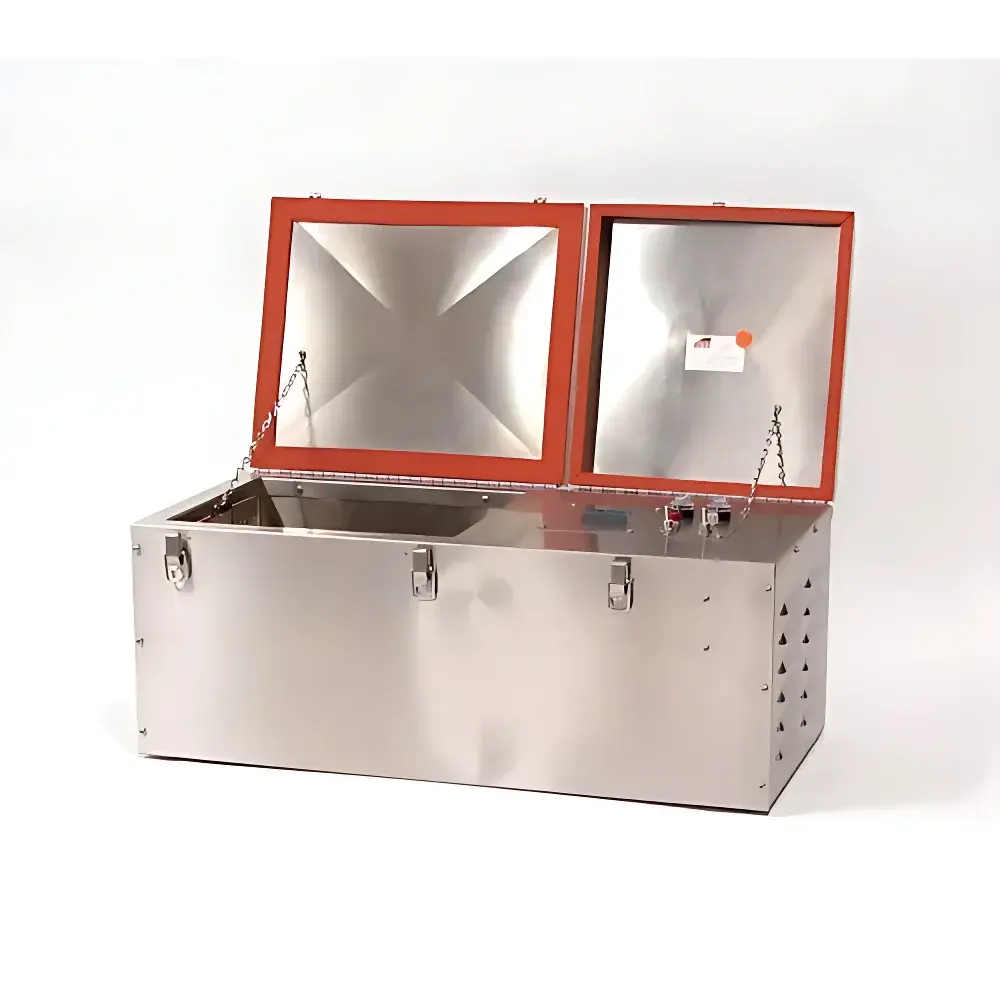
OFITE Model 174-00-1 Portable Three-Roll Thermal Aging Oven
| Brand | OFITE |
|---|---|
| Origin | USA |
| Manufacturer Status | Authorized Distributor |
| Origin Category | Imported |
| Model | 174-00-1 |
| Quotation | Upon Request |
| Maximum Temperature | 232.2 °C |
| Motor Speed | Adjustable up to 25 RPM |
| Heater Power | 150 W |
| Capacity | Two 260 mL or two 500 mL aging cans (cans sold separately) |
| Dimensions (Packaging) | 63.5 × 30.5 × 27.9 cm |
| Weight (Packaging) | 24.1 kg |
| Part Number | 174-00-1 (Oven Only, Cans Excluded) |
Overview
The OFITE Model 174-00-1 Portable Three-Roll Thermal Aging Oven is an engineered solution for simulating downhole thermal stress on drilling fluids during wellbore circulation. Based on the foundational principles of controlled thermal aging under rotational shear—governed by U.S. Patent No. 4,677,843—it replicates the combined effects of elevated temperature and mechanical agitation experienced by mud systems in high-temperature wells. Unlike static ovens, this unit subjects fluid samples to continuous, low-shear rolling motion across three parallel stainless-steel rollers, enabling realistic simulation of fluid dynamics during extended exposure. Designed specifically for field deployment, it operates reliably in non-laboratory environments while maintaining traceable temperature stability and rotational consistency. Its operational range spans from ambient conditions up to 232.2 °C, supporting evaluation protocols aligned with API RP 13B-1, ISO 10414-1, and ASTM D6938 standards for drilling fluid rheology and thermal stability assessment.
Key Features
- Three-roll configuration accommodates two 260 mL or two 500 mL pressure-rated aging cans simultaneously—enabling comparative testing under identical thermal and mechanical conditions.
- Adjustable motor speed (0–25 RPM) provides precise control over shear input during aging, critical for distinguishing thermally induced degradation from shear-enhanced breakdown.
- Stainless-steel construction—including rollers, housing, and internal chamber—ensures corrosion resistance against aggressive drilling fluid chemistries and long-term dimensional stability.
- Fiberglass-reinforced PTFE roller bearings reduce friction and eliminate metal-on-metal wear, extending service life and minimizing maintenance intervals between calibration cycles.
- Digital temperature controller with external LED display enables real-time monitoring without opening the chamber; integrated solid-state thermostat delivers ±1.5 °C accuracy across the full 38–232.2 °C operating range.
- Compact footprint and integrated carrying handles support rapid transport between rig sites, core labs, and field service vehicles—fully compliant with OSHA and IEC 61000-6-4 electromagnetic compatibility requirements for portable industrial equipment.
Sample Compatibility & Compliance
The Model 174-00-1 is validated for use with standard API-compliant aging cans (e.g., OFITE 170-00-1 for 260 mL, 170-00-2 for 500 mL), which are rated for pressures up to 10,000 psi at elevated temperatures. It supports both water-based and oil-based mud systems, synthetic-based fluids, and advanced nano-additive formulations. The unit meets essential safety and performance criteria outlined in API RP 13I, ISO 10414-1 Annex A, and NACE TM0177 for materials compatibility testing. All electrical components conform to UL 61010-1 and CE marking requirements for laboratory and field-use instrumentation. When operated with documented SOPs and calibrated reference thermocouples, data generated satisfies GLP audit trails per 21 CFR Part 58 and supports regulatory submissions under EPA 40 CFR Part 797.
Software & Data Management
While the Model 174-00-1 operates as a standalone hardware platform without embedded firmware or cloud connectivity, its analog/digital hybrid architecture ensures full compatibility with third-party data acquisition systems. Users may integrate the oven’s PT100 sensor output (via optional 4–20 mA transmitter module) into SCADA networks or LIMS platforms such as LabWare LIMS or Thermo Fisher SampleManager. Temperature setpoints and actual readings can be logged externally using calibrated chart recorders or USB-enabled thermocouple interfaces (e.g., Omega HH802U). All operational parameters—including ramp rate, dwell time, and RPM profile—are manually recorded per API RP 13B-1 Section 6.3 documentation requirements, supporting full traceability in QA/QC workflows.
Applications
- Evaluation of thermal stability limits for viscosifiers (e.g., xanthan gum, polyacrylamides) and fluid-loss additives under simulated HPHT conditions.
- Assessment of emulsion stability and phase separation behavior in invert emulsion muds after prolonged thermal exposure.
- Screening of antioxidant and scavenger package efficacy in synthetic-based fluids exposed to >200 °C downhole environments.
- Validation of reconditioning protocols for spent drilling fluids prior to disposal or reuse.
- Supporting R&D of next-generation nanomaterial-enhanced muds where particle agglomeration kinetics are temperature- and shear-dependent.
FAQ
Does the Model 174-00-1 include aging cans?
No—the unit ships as oven-only (part number 174-00-1). Compatible 260 mL and 500 mL pressure cans must be ordered separately.
What is the recommended calibration frequency?
Per API RP 13I Section 7.2, temperature sensors should be verified before each test series using NIST-traceable reference thermometers; full system calibration is advised every six months or after 200 operational hours.
Can the oven operate continuously at 232.2 °C?
Yes—rated for uninterrupted operation at maximum temperature when installed in well-ventilated areas with ambient temperatures below 40 °C and relative humidity ≤80% non-condensing.
Is the unit suitable for GMP-regulated environments?
It supports GMP compliance when used within documented procedures, maintained per manufacturer guidelines, and included in instrument qualification protocols (IQ/OQ/PQ) with defined acceptance criteria.
What power supply is required?
Standard 120 V AC, 60 Hz, single-phase input; a dedicated 15 A circuit is recommended for stable thermal regulation.




