
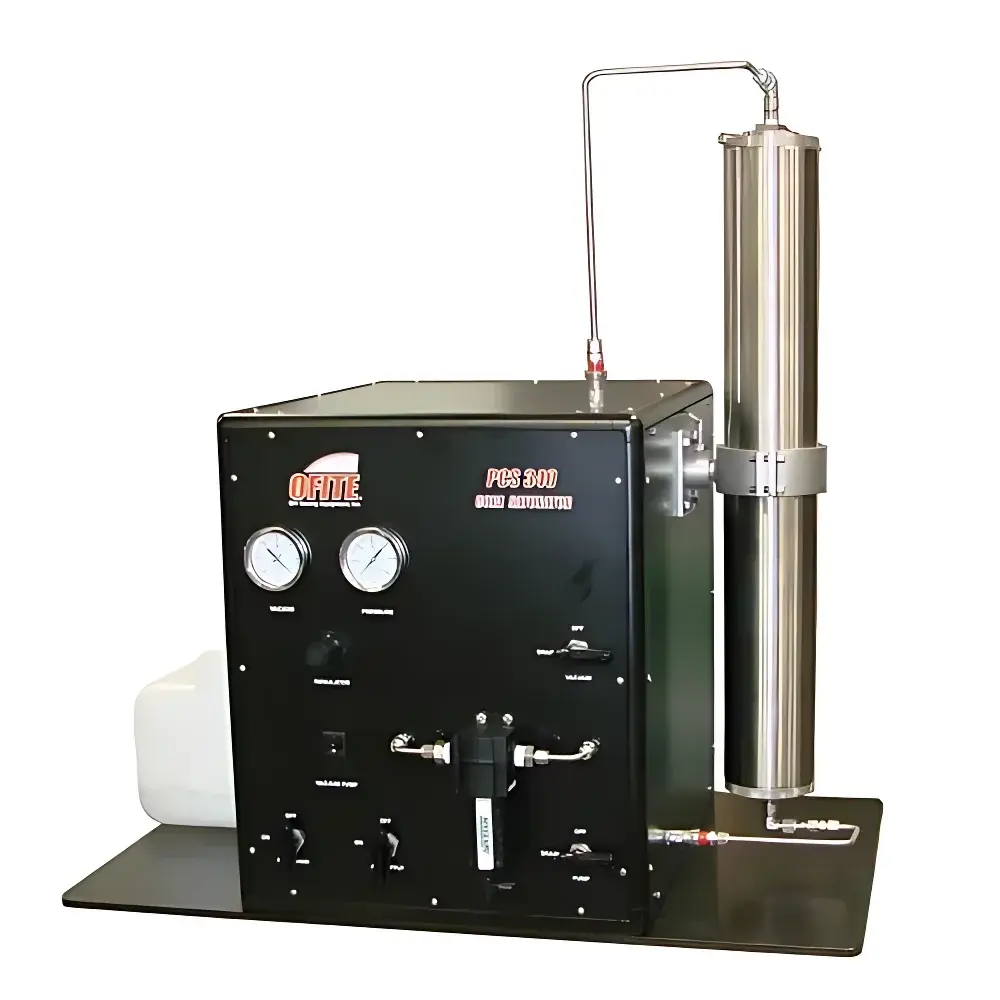
OFITE PCS-340 Core Vacuum Saturation System
| Key | Brand: OFITE |
|---|---|
| Origin | USA |
| Model | 127-70-1 |
| Max Pressure | 2500 PSI |
| Max Core Dimensions | 3 in diameter × 24 in length |
| Air Supply Requirement | 100–120 PSI (689.5–827.4 kPa) |
| Voltage Variant | 230 V |
Overview
The OFITE PCS-340 Core Vacuum Saturation System is an engineered laboratory instrument designed to achieve complete fluid saturation of cylindrical rock core samples prior to permeability, porosity, or relative permeability measurements. It operates on the principle of sequential vacuum evacuation followed by controlled pressure-driven fluid impregnation—ensuring full displacement of entrapped air and minimizing residual gas pockets that compromise measurement integrity. This two-stage saturation protocol directly addresses a primary source of experimental error in core analysis: incomplete saturation leading to non-representative effective permeability values and prolonged time-to-steady-state during subsequent flow tests. The system integrates a pressure-rated test chamber, a high-capacity vacuum pump, a pneumatically actuated positive-displacement saturation pump, and a dedicated saturant reservoir—all mounted on a rigid, service-accessible frame compliant with ANSI Z535 and ISO 13857 safety guidelines.
Key Features
- Two-phase saturation cycle: vacuum draw-down (≤10 mTorr typical base pressure) followed by pressurized fluid injection up to 2500 PSI—enabling saturation of low-permeability shales and tight carbonates.
- Modular chamber design accommodating cores up to 3 inches (76.2 mm) in diameter and 24 inches (609.6 mm) in length—compatible with standard API RP 40 and ASTM D3505 core handling protocols.
- Pneumatic drive system eliminates electrical hazards in solvent-rich environments; air supply regulated at 100–120 PSI ensures consistent pump stroke force and repeatable saturation pressure ramp rates.
- Pressure vessel constructed from ASTM A105 carbon steel with ASME Section VIII Div. 1 certification; all wetted surfaces are electropolished 316 stainless steel for chemical resistance against brines, hydrocarbons, and surfactant-laden fluids.
- Integrated pressure transducers (0–3000 PSI range, ±0.1% FS accuracy) and vacuum gauges with digital readouts provide real-time monitoring traceable to NIST standards.
Sample Compatibility & Compliance
The PCS-340 supports saturation of consolidated and unconsolidated core materials—including sandstone, limestone, dolomite, shale, and synthetic porous media—using aqueous, hydrocarbon, or supercritical CO₂-based saturants. Sample holders accept both unconfined plugs and jacketed cores fitted with Viton® or Kalrez® O-rings per API RP 61 specifications. The system meets functional requirements outlined in ISO 17025 for calibration traceability and supports GLP-compliant workflows through documented operating procedures, maintenance logs, and third-party verification reports. Optional pressure decay leak testing mode satisfies QA/QC criteria defined in ASTM D5084 for saturated core integrity validation prior to transport or further analysis.
Software & Data Management
While the PCS-340 operates as a stand-alone hardware platform, its analog pressure and vacuum outputs (4–20 mA) are compatible with industry-standard SCADA and LIMS interfaces (e.g., LabVantage, Thermo Fisher SampleManager). Users may integrate real-time saturation curves into custom Python- or MATLAB-based analysis pipelines via Modbus RTU communication (RS-485 port, optional add-on). All operational parameters—including vacuum hold time, pressurization rate, final saturation pressure, and dwell duration—are manually logged per SOPs aligned with FDA 21 CFR Part 11 requirements when paired with electronic lab notebooks (ELNs) supporting audit trails and user authentication.
Applications
- Pre-saturation conditioning for steady-state and unsteady-state permeability tests per API RP 40 and ISO 15112.
- Brine saturation of reservoir core prior to enhanced oil recovery (EOR) screening experiments involving polymer floods or low-salinity water injection.
- Full saturation of low-permeability unconventional reservoir samples (e.g., Wolfcamp, Bakken) where capillary trapping impedes conventional immersion methods.
- Quality control of core preparation in commercial core analysis laboratories accredited to ISO/IEC 17025:2017.
- Method development for multi-fluid saturation sequences (e.g., oil → water → gas) used in three-phase relative permeability studies.
FAQ
What vacuum level can the PCS-340 achieve before fluid injection?
The integrated vacuum pump achieves a base pressure of ≤10 mTorr under clean, dry conditions—sufficient to remove >99.9% of interstitial air from most sedimentary rocks with permeability ≥0.1 mD.
Is the system compatible with corrosive saturants such as HCl or HF-based fluids?
Standard configuration uses 316 SS and Viton® seals rated for pH 1–12; for HF or concentrated oxidizers, optional Hastelloy C-276 components and Kalrez® 6375 seals are available upon request.
Can the PCS-340 be used for centrifuge-assisted saturation?
No—the system relies exclusively on vacuum-pressure differential; centrifugal saturation requires separate instrumentation per API RP 40 Annex B.
Does OFITE provide factory calibration certificates with each unit?
Yes—each PCS-340 ships with NIST-traceable calibration documentation for pressure and vacuum sensors, valid for 12 months from date of shipment.
What maintenance intervals are recommended for the pneumatic pump and vacuum pump?
Air-driven pump requires quarterly inspection of diaphragm integrity and lubrication of pneumatic actuators; vacuum pump oil should be changed every 500 operating hours or annually, whichever occurs first.






