
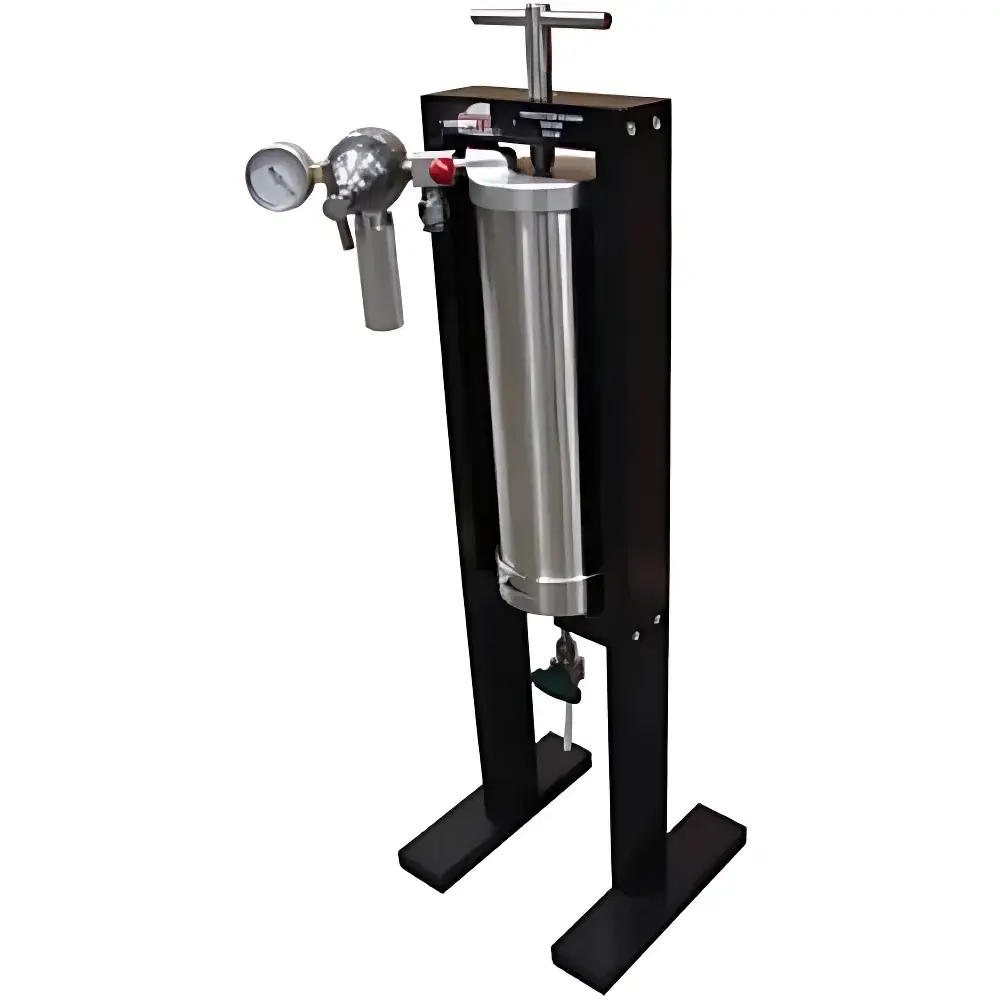
OFITE PST Screen Filtration Tester (Model 810-00-1)
| Brand | OFITE |
|---|---|
| Origin | USA |
| Manufacturer Status | Authorized Distributor |
| Origin Category | Imported |
| Model | 810-00-1 |
| Pricing | Upon Request |
| Pressure Source | CO₂ |
| Sample Chamber Dimensions | 7.8 cm ID × 27.6 cm L |
| Sample Volume Capacity | 1000 mL |
| Screen Diameter | 50 mm |
| Overall Dimensions | 29 × 20 × 69 cm |
| Weight | 10.9 kg |
Overview
The OFITE PST Screen Filtration Tester (Model 810-00-1) is a field-deployable, pressure-driven filtration evaluation system engineered to assess the compatibility between reservoir drilling fluids—particularly invert emulsions and water-based muds—and downhole sand control screens under simulated wellbore conditions. Unlike conventional API RP 13I filter press apparatuses that measure static fluid loss through filter paper, the PST operates on a dynamic screen-cake formation principle: test fluid is pressurized against a mounted screen at the base of a vertical sample chamber, and filtrate volume is measured over time as flow initiates and potentially declines due to bridging or plugging. This methodology directly replicates the critical interface behavior observed during gravel pack or standalone screen completion operations, where screen blinding can compromise sand control integrity and lead to premature failure. Designed and manufactured in the United States, the PST adheres to core mechanical and safety standards for oilfield instrumentation, including ASME B31.4 piping design principles for low-pressure gas actuation systems.
Key Features
- CO₂-actuated pressure source enables safe, controllable, and repeatable differential pressure application up to 100 psi (690 kPa), with integrated pressure regulator and relief valve compliant with OSHA 1910.169 requirements.
- Modular screen mounting base accepts standard 50 mm diameter screens—including wire-wrapped, pre-packed, slotted, and laser-cut variants—with optional advanced base kits accommodating screen substrates up to 6.4 mm thick.
- Transparent acrylic sample chamber (7.8 cm internal diameter × 27.6 cm height) permits real-time visual observation of cake formation, fluid front migration, and screen blinding onset.
- Integrated bottom-mounted quick-release valve allows precise timing of filtration initiation; filtrate is collected in a calibrated graduated cylinder for volumetric quantification at defined intervals (e.g., 1, 3, 5, 10 min).
- Compact footprint (29 × 20 × 69 cm) and lightweight aluminum frame (10.9 kg) support transportability between laboratory, rig floor, and remote field sites without requiring fixed utilities or compressed air infrastructure.
Sample Compatibility & Compliance
The PST accommodates a broad spectrum of non-aqueous and aqueous drilling fluid systems, including calcium chloride–based invert emulsions, polymeric water-based muds, and low-solids synthetic-based fluids. It is routinely deployed in accordance with internal operator screening protocols aligned with ISO 10414-2 (Petroleum and natural gas industries — Drilling fluids — Part 2: Laboratory testing of sand control fluids) and API RP 13B-2 (Recommended Practice for Field Testing of Drilling Fluids). While not a certified GLP instrument, its mechanical repeatability supports data traceability when operated under documented SOPs, and all pressure components are stamped per ASME Section VIII Div. 1. The absence of electrical components renders it intrinsically safe for Zone 1 hazardous area deployment when used with approved CO₂ supply lines.
Software & Data Management
The PST is a manually operated, analog measurement system with no embedded electronics or firmware. Data acquisition relies on operator-recorded time–volume pairs using stopwatch timing and calibrated glassware. For digital integration, users commonly pair the PST with third-party spreadsheet templates or LIMS modules configured for ASTM D1141-compliant reporting structures. Optional accessories include a digital timer with programmable interval alerts and a USB-connected precision scale for gravimetric filtrate analysis—both compatible with 21 CFR Part 11–compliant audit trail workflows when validated within a GxP environment.
Applications
- Evaluation of screen plugging resistance during pre-job qualification of sand control fluids prior to gravel pack placement.
- Comparative assessment of multiple screen geometries (slot width, wire diameter, wrap pitch) under identical fluid rheology and pressure profiles.
- Screen compatibility testing for managed pressure drilling (MPD) applications involving high-density invert emulsions.
- Rapid field-side verification of fluid contamination effects—e.g., cement filtrate invasion or lost circulation material (LCM) carryover—on screen permeability.
- Supporting root cause analysis of post-completion screen failures by correlating lab-scale PST results with downhole pressure transient data.
FAQ
What pressure range is supported by the CO₂ system?
The integrated CO₂ regulator delivers stable, adjustable pressure from 0 to 100 psi (0–690 kPa), with factory-set relief at 110 psi for overpressure protection.
Can the PST be used with high-temperature fluids?
No. The acrylic chamber and elastomeric seals are rated for ambient operation only (15–35°C); elevated temperature testing requires custom stainless-steel chambers and high-temp gasketing, available as OEM-engineered modifications.
Is calibration required before each test?
Yes. Users must verify zero-point alignment of the graduated cylinder and confirm CO₂ regulator accuracy using a NIST-traceable pressure gauge prior to each test series.
Does OFITE provide method documentation for regulatory submissions?
OFITE supplies a comprehensive User Manual (Rev. D, 2023) containing test procedure steps, maintenance schedules, and metrological traceability statements for all supplied components—suitable for inclusion in technical appendices of regulatory filings.
How is screen retention efficiency quantified?
While the PST does not directly output retention %, users calculate normalized filtrate volume (mL/1000 mL/min) and compare trends across screen types; absolute values are interpreted relative to historical baseline data generated under identical test conditions.





