
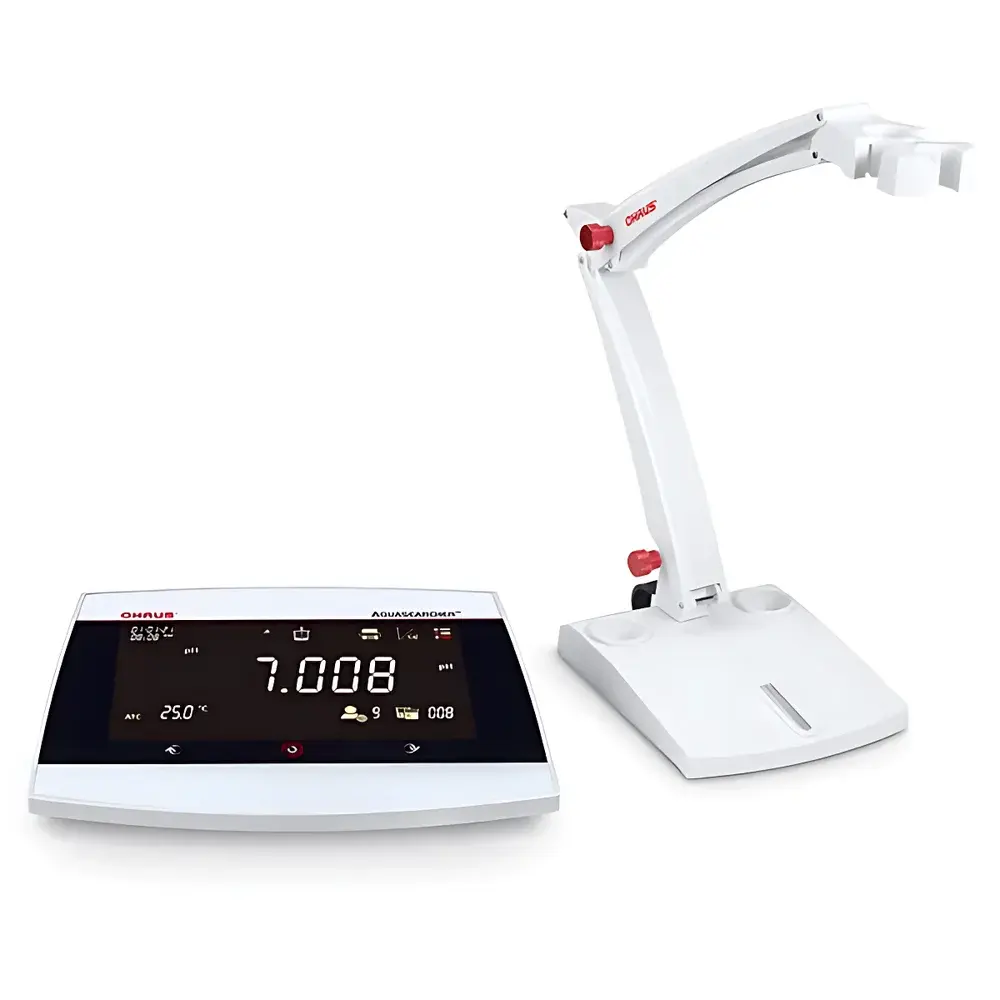
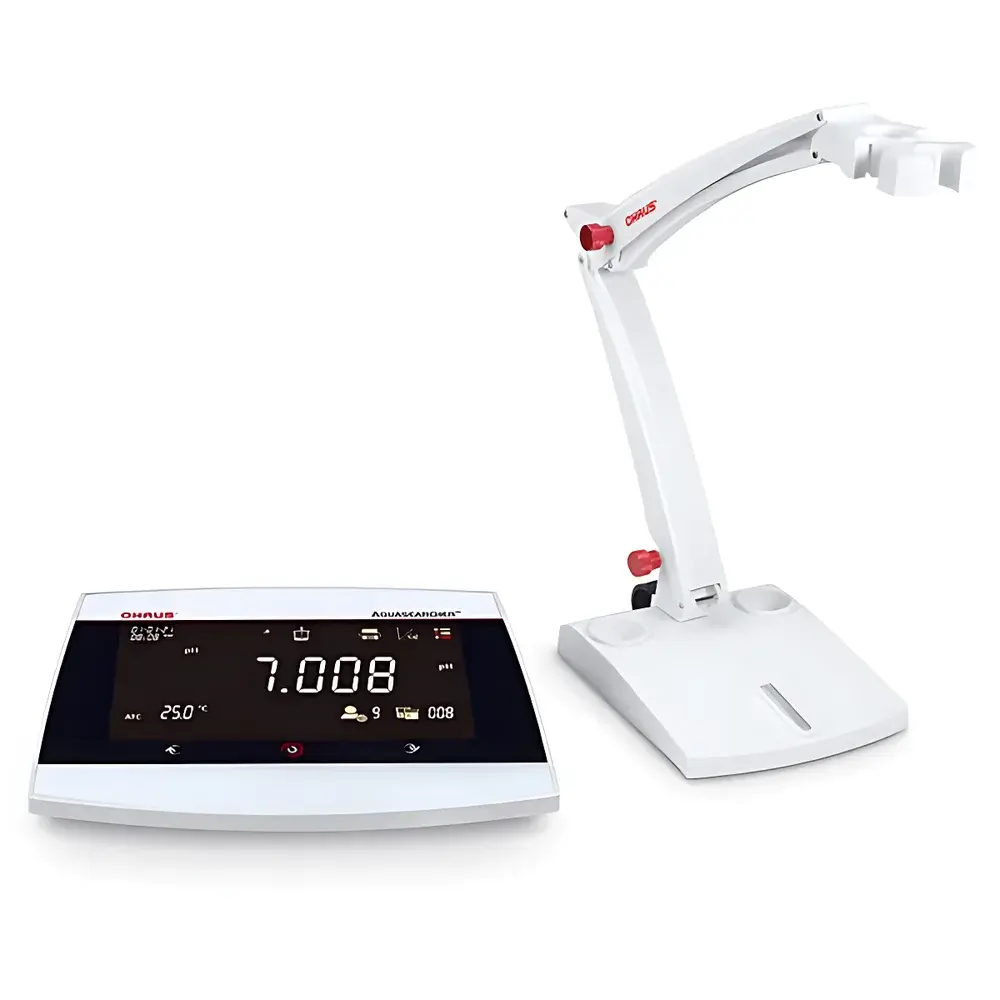
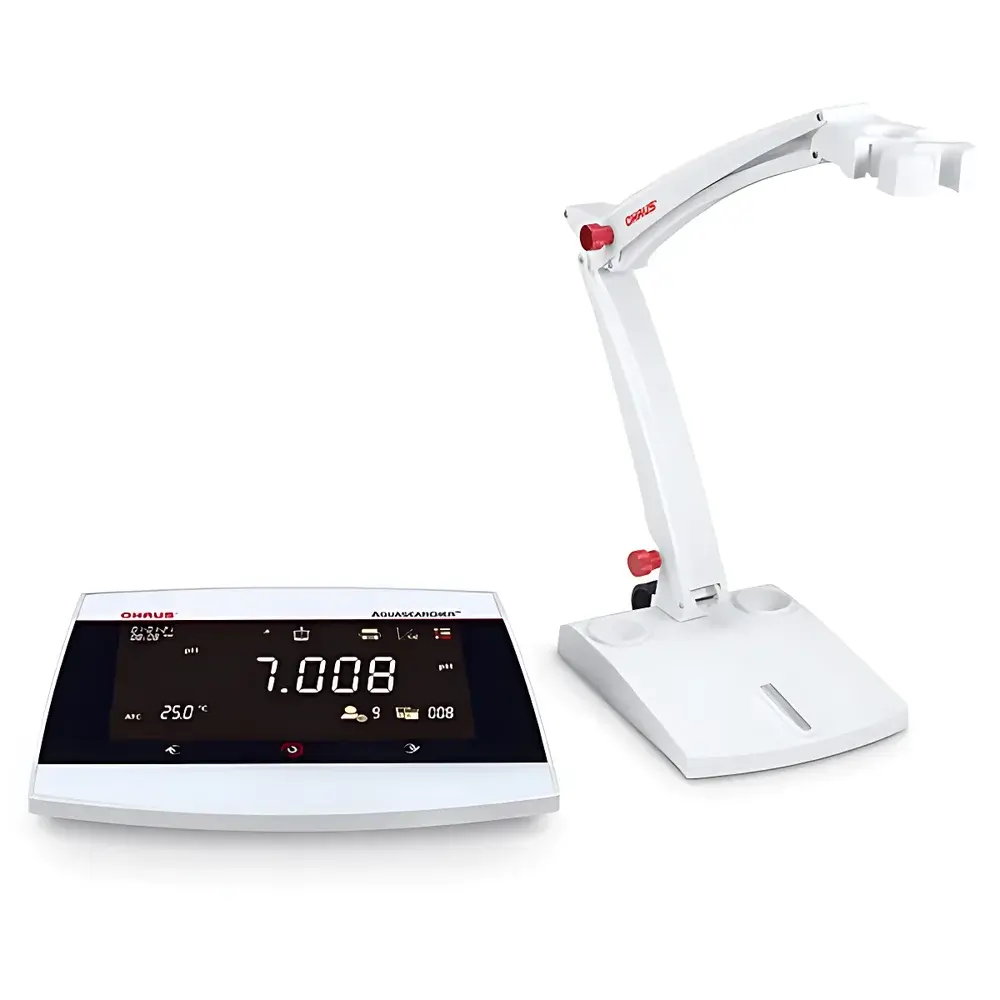
OHAUS AB41PH-B Benchtop pH/mV/ORP Meter
| Brand | OHAUS |
|---|---|
| Origin | USA |
| Model | AB41PH-B |
| Instrument Type | Benchtop |
| Parameter Types | pH / mV / ORP / Temperature |
| Measurement Range | –2.000 to 20.000 pH |
| Temperature Range | –10.0 to 125.0 °C |
| mV Range | –2000.00 to +2000.00 mV |
| Resolution | 0.001 pH / 0.1 mV / 0.1 °C |
| Accuracy | ±0.002 pH / ±0.3 mV / ±0.3 °C |
| Display | Backlit LCD with dot-matrix line |
| Dimensions (L×H×W) | 210 × 51 × 142 mm |
| Net Weight | 0.5 kg |
| Operating Environment | 5–40 °C, ≤80% RH (non-condensing) |
| Power Supply | AC adapter (included) |
Overview
The OHAUS AB41PH-B is a precision benchtop electrochemical meter engineered for reliable, high-resolution measurement of pH, mV (redox potential), ORP, and temperature in laboratory and quality control environments. Built on a stable potentiometric measurement architecture, the instrument employs a high-impedance input circuitry (>1012 Ω) to minimize electrode loading and ensure signal integrity across wide pH ranges—from strongly acidic (–2.000 pH) to highly alkaline (20.000 pH) solutions. Its dual-channel analog-to-digital conversion system supports simultaneous real-time acquisition of electrode potential and temperature, enabling automatic temperature compensation (ATC) using either built-in or external Pt1000 sensors. Designed for routine analytical workflows requiring traceable accuracy, the AB41PH-B delivers ±0.002 pH accuracy—meeting performance benchmarks expected in ISO/IEC 17025-accredited labs and supporting compliance with USP , ASTM E70, and CLSI C3-A4 standards for pH measurement validation.
Key Features
- Triple-parameter capability: Simultaneous measurement and display of pH, mV/ORP, and temperature with independent calibration routines.
- High-resolution readout: 0.001 pH resolution with 0.1 mV and 0.1 °C resolution on respective channels—optimized for low-drift applications including buffer standardization and titration endpoint verification.
- Backlit dot-matrix LCD: Single-line display with intuitive icon-driven interface; supports contrast adjustment for variable ambient lighting conditions.
- Robust input protection: Electrode input complies with IEC 61000-4-2 (ESD) and features overvoltage protection up to ±30 V—ensuring longevity when interfacing with combination electrodes or reference half-cells.
- Stable power architecture: Integrated AC power supply eliminates battery drift concerns; includes universal voltage input (100–240 VAC, 50/60 Hz) and meets UL/CSA/CE safety requirements.
- Calibration flexibility: Supports 1–3 point pH calibration with NIST-traceable buffers; mV offset verification mode enables electrode health diagnostics without recalibration.
Sample Compatibility & Compliance
The AB41PH-B interfaces with standard BNC-compatible pH electrodes (e.g., glass-bodied combination electrodes, refillable reference junctions, and double-junction configurations) and accepts optional Pt1000 temperature probes for enhanced ATC fidelity. It is validated for use with aqueous and mildly non-aqueous samples—including buffered saline solutions, fermentation broths, pharmaceutical formulations, and environmental water extracts. While the meter itself does not include an integrated electrode, its input impedance and noise rejection characteristics are optimized for compatibility with industry-standard sensors from Metrohm, Thermo Fisher, Hamilton, and Hanna. The device conforms to electromagnetic compatibility (EMC) requirements per IEC 61326-1 and carries CE marking for laboratory instrumentation. For regulated environments, its fixed calibration memory (with timestamped calibration logs) supports basic GLP documentation needs—though full 21 CFR Part 11 compliance requires integration with external LIMS or data acquisition software.
Software & Data Management
The AB41PH-B operates as a standalone instrument with no embedded USB or Bluetooth connectivity. All calibration and measurement data remain resident on-device only—displayed in real time and retained until overwritten or manually reset. No internal memory storage or export functionality is provided; users must record values manually or integrate the unit into a larger data capture system via analog output (if equipped with optional analog module) or third-party serial adapters. This design prioritizes operational simplicity and regulatory stability—eliminating firmware update dependencies and reducing validation scope for QC laboratories operating under static SOPs. Calibration history—including date, buffer IDs, slope (%), and offset (mV)—is viewable directly on-screen and may be transcribed for audit trails compliant with ISO 17025 clause 7.7 and FDA guidance on laboratory equipment qualification.
Applications
- Pharmaceutical QC: Monitoring pH of injectables, ophthalmic solutions, and dissolution media per USP monographs.
- Food & Beverage: Verifying acidity in dairy products, fermented beverages, and acidified sauces during HACCP critical control point checks.
- Academic Research: Teaching fundamental electrochemistry principles, including Nernst equation validation and liquid junction potential analysis.
- Environmental Testing: Field-deployable lab backup for wastewater pH profiling and soil extract analysis (when paired with ruggedized electrodes).
- Chemical Manufacturing: Process water monitoring, catalyst slurry characterization, and cleaning validation rinse solution verification.
FAQ
Does the AB41PH-B include a pH electrode?
No. The instrument is supplied without electrodes; users must select and purchase compatible BNC-input pH, ORP, or temperature probes separately.
Can it perform automatic temperature compensation (ATC)?
Yes—when connected to a Pt1000 temperature probe (sold separately), the AB41PH-B applies real-time ATC using the Nernstian temperature coefficient.
Is calibration data stored with timestamps?
Yes. Each calibration event records date, buffer pH values, measured mV, slope, and offset—accessible via on-screen navigation.
What is the maximum sample temperature the meter can measure?
The temperature measurement range extends to 125.0 °C, but this assumes use of a high-temperature-rated Pt1000 probe; standard probes are typically rated to 100 °C.
Does it support GLP or 21 CFR Part 11 compliance?
The AB41PH-B provides foundational GLP support (calibration logging, user-accessible history), but lacks electronic signature, audit trail encryption, or password-protected configuration—features required for full 21 CFR Part 11 adherence.






