
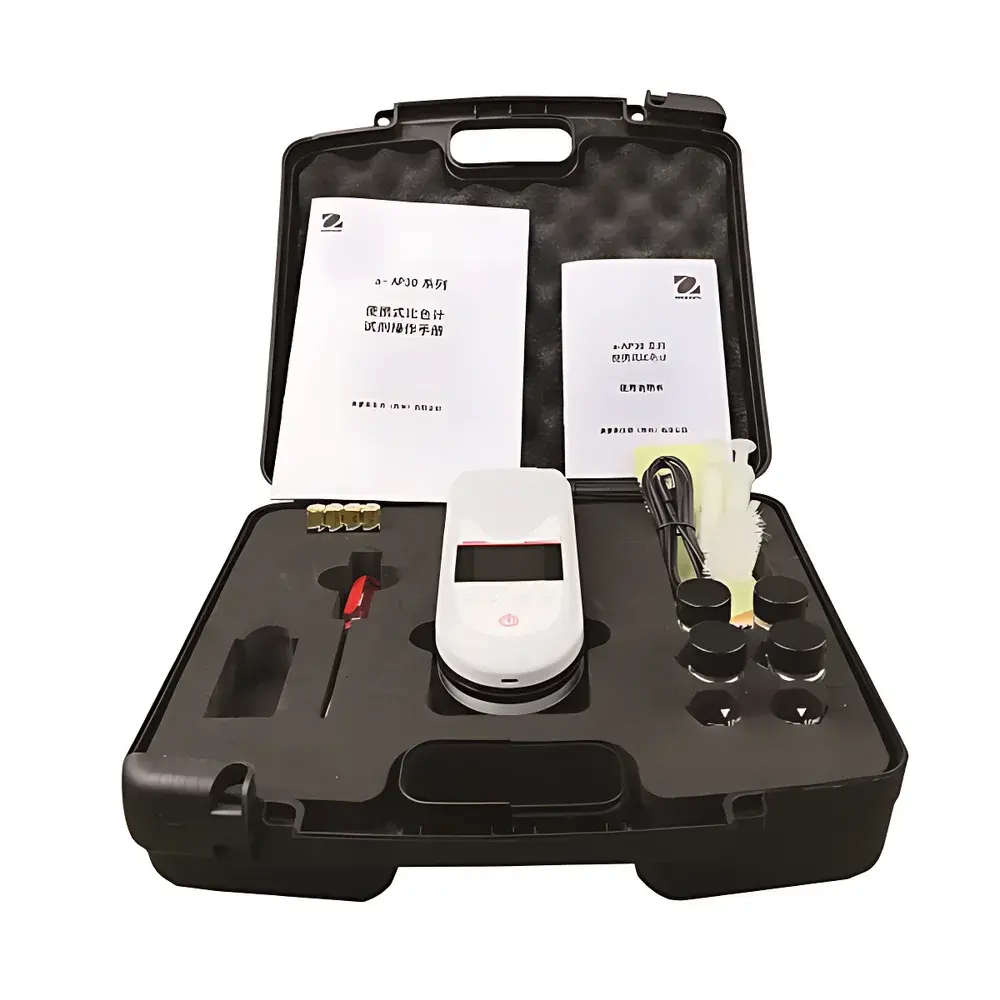
OHAUS AP30CLH Portable Photometric Water Quality Analyzer
| Brand | OHAUS |
|---|---|
| Origin | Shanghai, China |
| Manufacturer Type | Direct Manufacturer |
| Country of Origin | China |
| Model | AP30CLH |
| Instrument Type | Portable / Handheld Water Quality Analyzer |
| Measurable Parameters | Free Chlorine & Total Chlorine |
| Light Source | Multi-wavelength LED (525 nm, 610 nm) |
| Detection Principle | Absorption Photometry (Colorimetric Method per DPD Chemistry) |
| Data Storage | 5,000 measurement records with timestamp |
| Power Supply | 4 × AAA batteries (alkaline or Ni-MH) |
| Battery Life | >20,000 measurements per set (typical usage) |
| Enclosure Rating | IP67 |
| Interface | Micro-USB (for data export and firmware update) |
| Display | High-brightness monochrome OLED (128 × 64 pixels) |
| Auto-Power-Off | Adjustable (1–30 min) |
| Dimensions | 165 × 78 × 42 mm |
| Weight | 220 g (without batteries) |
Overview
The OHAUS AP30CLH Portable Photometric Water Quality Analyzer is a field-deployable, LED-based photometer engineered for rapid, reliable quantification of free chlorine and total chlorine in water samples using standardized colorimetric chemistry (DPD method). It operates on the principle of absorption photometry: sample solutions react with DPD reagents to form colored complexes whose absorbance is measured at precisely selected wavelengths—525 nm for free chlorine and 610 nm for total chlorine. The instrument’s optical path is optimized for minimal stray light and thermal drift, ensuring high reproducibility across variable ambient conditions. Designed specifically for on-site environmental monitoring, the AP30CLH delivers laboratory-grade accuracy without requiring benchtop infrastructure, making it suitable for routine verification in drinking water distribution systems, wastewater effluent points, swimming pool maintenance, cooling tower management, and industrial process water control.
Key Features
- Multi-wavelength LED optical system with factory-calibrated emission peaks at 525 nm and 610 nm—no moving parts or lamp replacement required.
- IP67-rated enclosure with sealed optical chamber and gasketed micro-USB port, enabling operation in rain, dust, or high-humidity environments (e.g., pump stations, outdoor reservoirs).
- Low-reagent consumption design: each test requires ≤1.0 mL sample volume and ≤20 mg DPD tablet mass—reducing operational cost and chemical waste.
- High-contrast monochrome OLED display with wide viewing angle and sunlight-readable luminance (>200 cd/m²), functional across –10 °C to +50 °C ambient range.
- Intelligent power management: automatic shutdown with user-selectable delay (1–30 minutes); average current draw <15 µA in standby mode.
- Integrated data logging with time/date stamping, sequence ID, and operator code fields—supports GLP-compliant recordkeeping when exported via USB.
Sample Compatibility & Compliance
The AP30CLH accepts aqueous samples within turbidity ≤1 NTU and temperature range 5–40 °C. It complies with standard methods for chlorine analysis including ASTM D1253-22 (Standard Test Method for Total Chlorine in Water), ISO 7393-2:2018 (Water quality — Determination of free chlorine and total chlorine — Part 2: Colorimetric method using N,N-diethyl-p-phenylenediamine (DPD)), and US EPA Method 334.0. Sample handling adheres to ISO/IEC 17025:2017 requirements for field instrumentation validation. The device supports traceability through unique serial-numbered calibration verification checks and built-in zero-reference diagnostics prior to each measurement cycle.
Software & Data Management
Data export is performed via native USB connection to Windows/macOS/Linux systems without proprietary drivers—recognized as a standard CDC ACM device. Exported CSV files include columns for measurement ID, date/time, parameter type (free/total Cl₂), concentration (mg/L as Cl₂), unit, operator ID, and instrument serial number. Firmware updates are delivered through OHAUS’ publicly available Instrument Manager Desktop Utility (v2.1+), which logs all update events with cryptographic checksum verification. Audit trail functionality meets FDA 21 CFR Part 11 requirements when used in conjunction with validated organizational procedures for electronic records.
Applications
- Drinking water utilities performing compliance checks at entry points, storage tanks, and distribution nodes.
- Municipal wastewater treatment plants verifying disinfection efficacy prior to discharge.
- Commercial and public swimming pool operators conducting daily residual chlorine verification per CDC Model Aquatic Health Code.
- Industrial facilities managing cooling water biocide dosing and boiler feedwater residual control.
- Environmental consulting firms executing field surveys for regulatory reporting under Clean Water Act Section 305(b) assessments.
- Emergency response teams assessing post-disaster water safety during flood or infrastructure failure scenarios.
FAQ
Does the AP30CLH require annual recalibration by an accredited lab?
No—its solid-state LED光源 and stable optical geometry eliminate routine recalibration. However, users must perform daily zero and span verification using supplied standards per ISO 7393-2 Annex B.
Can the instrument store custom calibration curves for non-standard reagents?
No—the AP30CLH uses fixed, factory-loaded calibration algorithms aligned exclusively with OHAUS-certified DPD tablets (Cat. No. AP-CL-REAG). Third-party reagents are not supported.
Is the micro-USB interface compatible with mobile devices?
No—it is designed only for host PC connectivity; no OTG or Android/iOS driver support is provided.
What is the recommended maintenance interval for the optical cell?
Clean the cuvette chamber with lint-free tissue and isopropyl alcohol after every 100 measurements or when visible residue accumulates—no disassembly required.
Does the AP30CLH meet CE or UKCA marking requirements?
Yes—certified to EN 61326-1:2013 (EMC) and EN 61010-1:2010 (safety) with Declaration of Conformity issued by TÜV Rheinland (Certificate No. R 50428505 0001).
Related Products







