
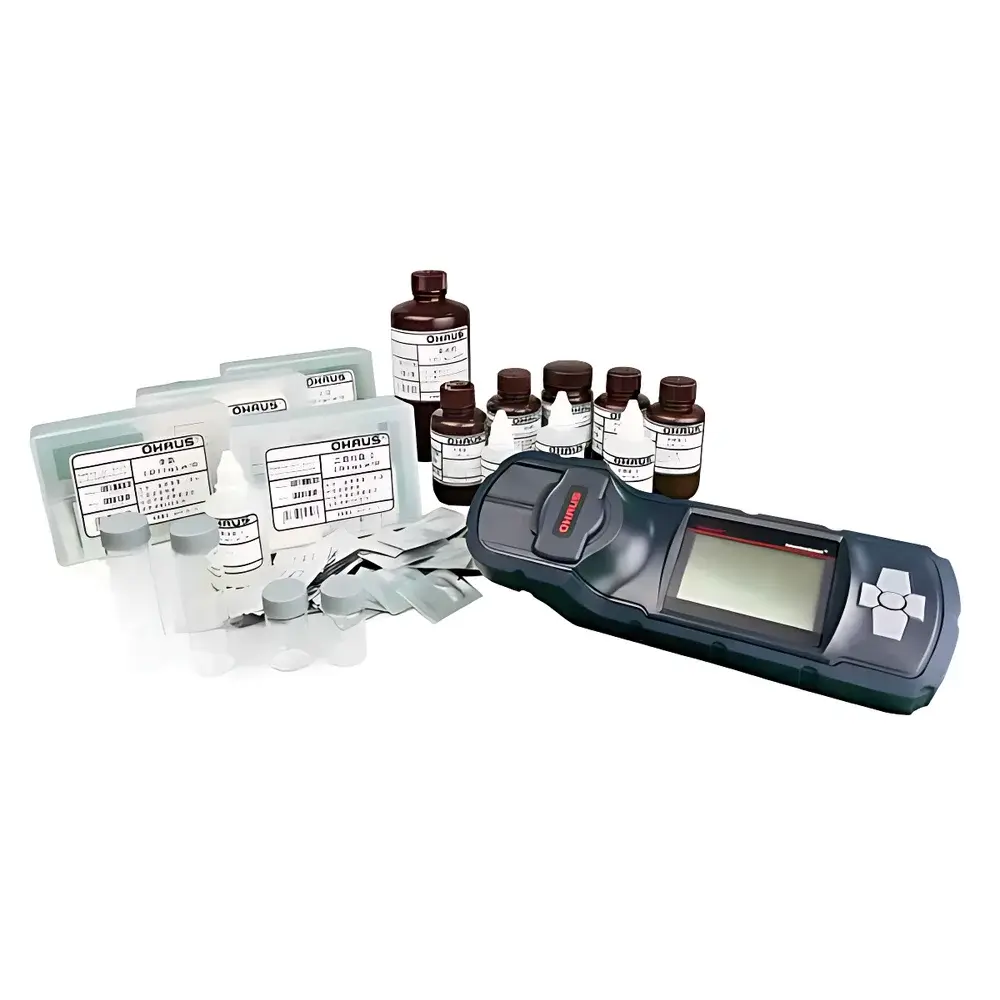
OHAUS AP50MM Portable Multi-Parameter Colorimeter & Turbidimeter
| Brand | OHAUS |
|---|---|
| Origin | Shanghai, China |
| Manufacturer Type | Manufacturer |
| Country of Origin | China |
| Model | AP50MM |
| Pricing | Upon Request |
| Display | 160 × 240 pixel dot-matrix LCD, sunlight-readable |
| Power Supply | 4 × AA alkaline batteries |
| Measurement Principle | Nephelometric turbidity (90° scattered light) and absorbance-based colorimetry |
| Data Storage | 30,000 measurement records with timestamp (date & time) |
| Auto-Power-Off | Yes |
| Included Accessories | Carrying case |
| Sample Compatibility | Standard 13 mm, 16 mm, and 25 mm round cuvettes |
| Communication Interface | None (NA) |
Overview
The OHAUS AP50MM Portable Multi-Parameter Colorimeter & Turbidimeter is an integrated field-deployable optical instrument engineered for rapid, reliable quantification of water quality parameters in situ. It operates on two complementary photometric principles: (1) nephelometric turbidity measurement per ISO 7027 and EPA Method 180.1—detecting 90° scattered light intensity from suspended particles using a calibrated tungsten or LED source; and (2) absorbance-based colorimetry across seven fixed wavelengths (420 nm, 470 nm, 520 nm, 560 nm, 610 nm, 660 nm, and 850 nm), enabling compliance with standard methods including APHA 2120B (turbidity), APHA 4500-Cl G (free chlorine), APHA 4500-NH3 F (ammonia), and ISO 6226 (phosphate). Designed for operational continuity in variable ambient lighting—including direct sunlight—the instrument features a high-contrast 160 × 240 pixel monochrome LCD with optimized backlighting and anti-glare surface treatment. Its solid-state optical architecture eliminates moving parts in the detection path, ensuring long-term stability and resistance to mechanical shock during transport or field use.
Key Features
- Pre-programmed method library supporting over 50 water quality parameters—including turbidity (NTU/FNU), free & total chlorine, nitrate, nitrite, phosphate, ammonia, iron, copper, hardness, and permanganate index—each aligned with internationally recognized analytical protocols.
- Automated wavelength selection: The instrument dynamically selects the optimal LED source based on the selected test method, eliminating manual filter changes and reducing operator error.
- Integrated calibration diagnostics: Real-time validation of zero and span calibration points with pass/fail feedback; automatic flagging of out-of-tolerance conditions before measurement initiation.
- Robust data integrity framework: Stores up to 30,000 measurements with embedded UTC timestamp (date + time), user ID field (optional), and method identifier—supporting traceability requirements under GLP and municipal QA/QC programs.
- Ergonomic portable design: Lightweight housing (≤ 450 g) with one-handed operation, IP65-rated enclosure for dust and splash resistance, and compatibility with 13 mm, 16 mm, and 25 mm round glass or plastic cuvettes.
- Extended field autonomy: Powered by four standard AA alkaline cells delivering ≥ 20,000 measurements per set under typical usage; auto-power-off after 10 minutes of inactivity conserves battery life without compromising startup readiness.
Sample Compatibility & Compliance
The AP50MM accepts industry-standard round-format cuvettes without adapter requirements, accommodating both laboratory-grade fused silica and cost-effective disposable polystyrene variants. All preprogrammed methods adhere to applicable sections of ASTM D1889, ISO 7027-1:2016 (turbidity), ISO 6779 (chlorine), and US EPA Drinking Water Standards. While not certified for regulatory submission under 21 CFR Part 11, its audit-ready data log structure—including immutable timestamps and method metadata—facilitates internal validation and supports third-party verification workflows required by municipal utilities and industrial pretreatment programs. The instrument complies with IEC 61010-1:2010 for electrical safety and meets CE marking requirements for portable instrumentation in environmental monitoring applications.
Software & Data Management
Data export is performed via manual transcription or optional external barcode/QR code scanning of printed reports generated on-site. Though no native USB or Bluetooth interface is integrated, the structured timestamped log format enables seamless import into LIMS-compatible spreadsheets (CSV/Excel) or custom QA databases. Each record includes parameter name, measured value, unit, detection limit indicator (if applicable), cuvette ID (user-entered), operator code, and GPS-optional field (via companion mobile app integration—sold separately). Firmware updates are delivered via SD card (not included), with version-controlled release notes traceable to OHAUS Technical Bulletin TB-AP50MM-Rev4.
Applications
The AP50MM serves as a primary screening tool across decentralized water management systems: routine monitoring of cooling tower conductivity and biocide residuals in HVAC maintenance; real-time verification of coagulant dosing efficacy in raw water intake stations; effluent compliance checks at WWTP discharge points per local NPDES permit limits; daily sanitation verification in public swimming pools and spas; boiler feedwater iron and silica tracking in power generation facilities; and educational laboratory exercises in environmental chemistry curricula requiring method standardization and reproducible photometric technique training.
FAQ
Does the AP50MM support GLP-compliant data archiving?
It provides timestamped, method-identified records suitable for internal GLP documentation; however, electronic signature and full 21 CFR Part 11 compliance require integration with validated third-party data capture software.
Can custom calibration curves be loaded?
No—only factory-loaded, method-specific curves compliant with APHA, ISO, and EPA standards are supported; user-defined curve entry is intentionally disabled to maintain metrological integrity.
Is the instrument suitable for seawater analysis?
Yes, for parameters such as chloride (mercuric thiocyanate method), nitrate (cadmium reduction), and turbidity—provided appropriate salinity compensation is applied manually per method instructions.
What is the turbidity measurement range and detection limit?
0.01–1000 NTU (nephelometric turbidity units) with ±2% reading accuracy above 1 NTU and ±0.01 NTU repeatability at low concentrations, per ISO 7027 calibration validation protocol.
Are reagents included with the instrument?
No—reagent kits (including EPA-compliant DPD, salicylate, and ascorbic acid formulations) and pre-filled sealed tubes are available as configurable accessories (catalog numbers AP-REAG-KIT-CL, AP-REAG-KIT-NH3, etc.).





