
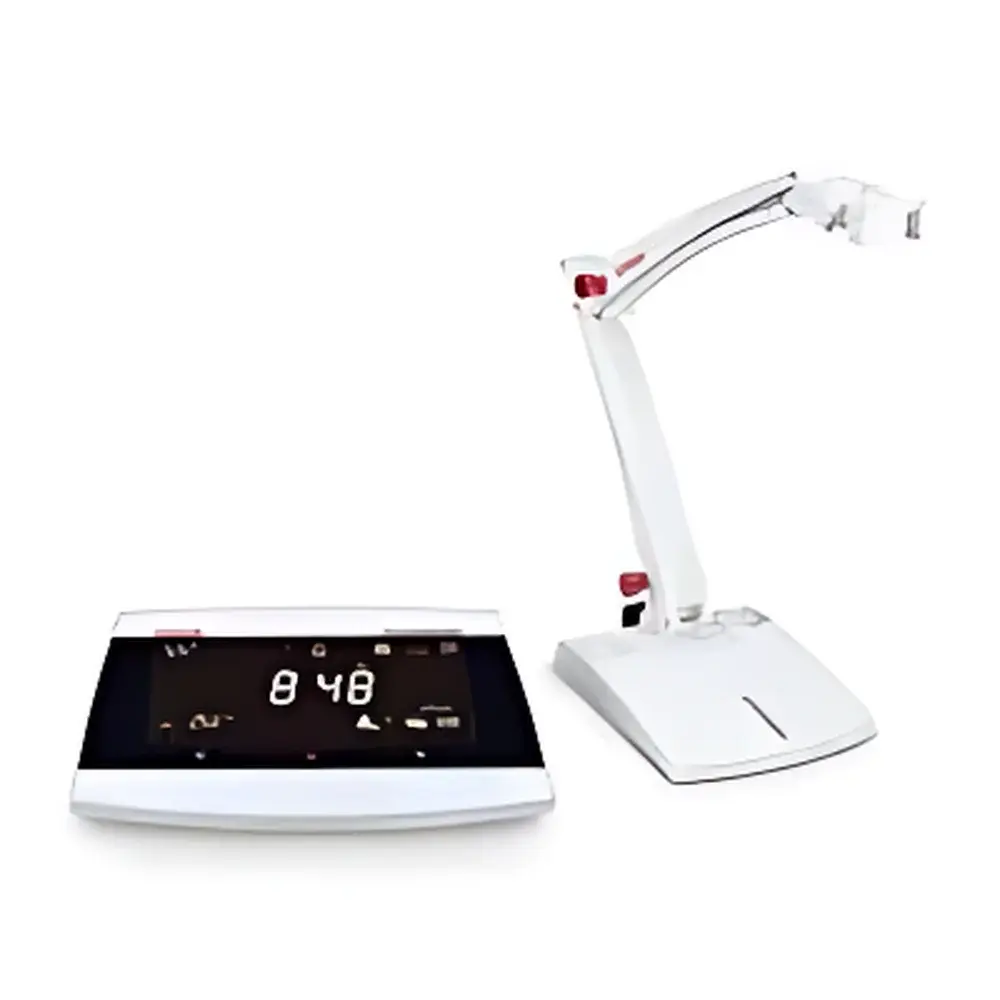
OHAUS AQUASEARCHER™ AB33EC Benchtop Conductivity Meter
| Brand | OHAUS |
|---|---|
| Origin | Jiangsu, China |
| Manufacturer Type | Manufacturer |
| Origin Category | Domestic |
| Model | AB33EC-B |
| Detection Parameters | Single-parameter (Conductivity/TDS/Resistivity/Salinity/Temperature) |
| Form Factor | Benchtop |
| Conductivity Range | 0.001 μS/cm – 1000 mS/cm |
| TDS Range | 0.01 mg/L (auto-ranging) |
| Resistivity Range | 1 – 100 MΩ·cm |
| Salinity Range | 0 – 100 psu |
| Temperature Range | −5.0 to 110.0 °C |
| Accuracy | ±0.5% of reading ±2 digits |
| Minimum Resolution | 0.001 μS/cm |
Overview
The OHAUS AQUASEARCHER™ AB33EC Benchtop Conductivity Meter is an engineered solution for precise, multi-parameter electrochemical analysis in quality control laboratories, environmental monitoring stations, and academic research settings. Based on four-wire conductivity measurement principles with temperature compensation (ATC or manual), the instrument delivers traceable, reproducible results across five interrelated parameters: electrical conductivity, total dissolved solids (TDS), resistivity, salinity (psu), and temperature. Its architecture adheres to fundamental electrochemical standards—employing a stable AC excitation signal to minimize polarization errors and electrode fouling—ensuring long-term stability in routine aqueous sample analysis. Designed as part of the OHAUS STARTER series, the AB33EC-B prioritizes metrological integrity without compromising intuitive operation, making it suitable for both entry-level technicians and experienced lab personnel requiring GLP-compliant documentation.
Key Features
- 6.5-inch backlit monochrome LCD display with segmented + dot-matrix layout—optimized for legibility under varied ambient lighting conditions and glove-compatible operation
- Capacitive touch keypad with haptic feedback and ergonomic layout—enabling rapid navigation, parameter selection, and calibration confirmation without mechanical wear
- i-Steward intelligent calibration management system—automatically logs calibration events, tracks electrode health indicators, and issues configurable “calibration due” alerts based on user-defined intervals or usage thresholds
- Dual communication interfaces: RS-232 (for legacy printer or LIMS integration) and USB (for direct PC connectivity and firmware updates)
- Robust ABS housing with integrated electrode holder and cable management groove—designed for clutter-free benchtop deployment in ISO 17025-accredited environments
- Internal data storage for up to 1,000 measurement records—including timestamp, parameter value, unit, temperature, and calibration status—supporting audit-ready traceability
Sample Compatibility & Compliance
The AB33EC-B is validated for use with standard two- or four-electrode conductivity cells (not included), supporting measurements in deionized water, tap water, wastewater effluents, seawater dilutions, nutrient solutions, and pharmaceutical rinse waters. Its measurement algorithms apply standardized conversion factors per ASTM D1125 (conductivity/TDS), ISO 7888 (electrical conductivity of water), and USP (water conductivity testing). The device operates within environmental specifications of 5–40 °C and ≤80% RH (non-condensing), meeting IEC 61010-1 safety requirements for laboratory electrical equipment. While not certified for intrinsic safety or hazardous area use, its design supports routine compliance with internal SOPs aligned with FDA 21 CFR Part 11 (when paired with validated data export workflows) and EU GMP Annex 11 principles for electronic records.
Software & Data Management
Data retrieval is facilitated via USB mass-storage mode or RS-232 ASCII output, enabling seamless import into Excel, LabArchives, or custom LIMS platforms. No proprietary software is required; exported .csv files include column headers compliant with MIQE and CLSI GP26-A3 metadata conventions (e.g., “Timestamp_UTC”, “Conductivity_μS_cm”, “Temp_C”, “Calibration_ID”). The onboard memory retains full context for each reading—including active calibration curve ID, electrode constant used, and temperature compensation method (linear or non-linear)—to support retrospective root-cause analysis during QA investigations. Audit trail functionality is implemented at the firmware level: all configuration changes, calibration actions, and data deletions are time-stamped and immutable within device memory.
Applications
- Pharmaceutical water system validation (PW, WFI, and purified water conductivity monitoring per USP )
- Environmental field lab analysis of surface water, groundwater, and wastewater treatment influent/effluent
- Food & beverage QC for brine concentration, syrup conductivity, and cleaning-in-place (CIP) rinse verification
- Academic teaching labs—demonstrating ionic strength relationships, electrolyte dissociation, and temperature coefficient effects
- Electroplating bath management—tracking conductive salt depletion and additive degradation trends over time
FAQ
Does the AB33EC-B include a conductivity electrode?
No—the meter is supplied without electrodes. Compatible sensors include OHAUS COND-100 (K=1.0 cm⁻¹) and COND-200 (K=10.0 cm⁻¹) cells, sold separately.
Can the instrument perform automatic temperature compensation (ATC)?
Yes—when used with a built-in or external ATC probe (e.g., Pt1000), the device applies NIST-traceable linear or non-linear compensation algorithms per IUPAC recommendations.
Is the data storage function password-protected?
No—but all stored entries are write-locked after acquisition; deletion requires physical access and explicit menu confirmation, satisfying basic ALCOA+ data integrity expectations.
What is the recommended calibration frequency?
OHAUS recommends initial calibration upon installation, followed by daily verification using certified reference standards (e.g., 1413 μS/cm KCl) in high-precision applications—or per your site’s risk-based calibration schedule per ISO/IEC 17025 Clause 7.7.
Can the AB33EC-B be powered solely by USB bus power?
No—it requires the included AC adapter (100–240 VAC input); USB serves data transfer only, not power delivery.





