
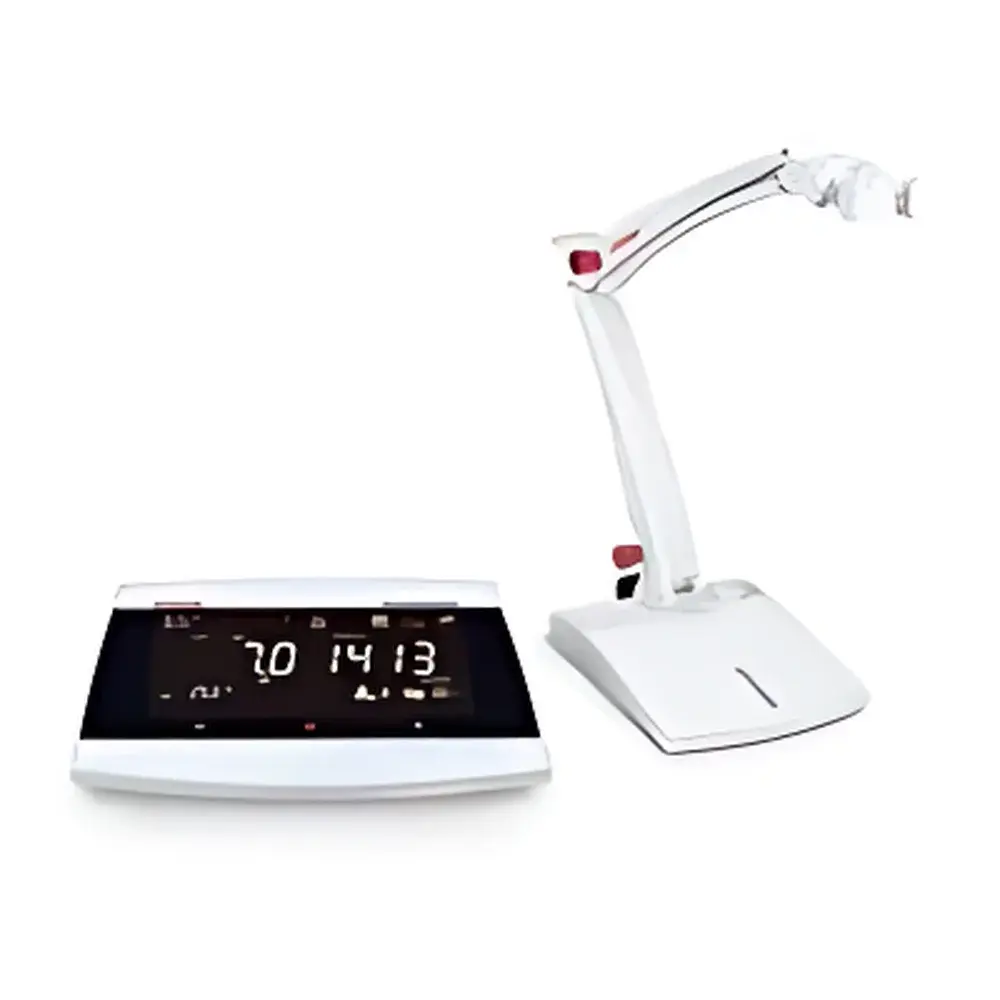
OHAUS AQUASEARCHER™ AB33M1 Benchtop Multi-Parameter pH/Conductivity Meter
| Brand | OHAUS |
|---|---|
| Origin | Jiangsu, China |
| Manufacturer Type | Manufacturer |
| Regional Category | Domestic (China) |
| Model | AB33M1-B |
| Instrument Type | Benchtop |
| Parameter Types | pH, ORP, Conductivity, TDS, Salinity, Resistivity, Temperature |
| Measurement Accuracy | ±0.01 pH |
| pH Range | −2.00 to 20.00 |
| Resolution | 0.01 pH / 1 mV / 0.1 °C |
| Temperature Accuracy | ±0.3 °C |
| Calibration Solution Standard | China-specific buffer set |
| Display | 6.5-inch backlit segmented & dot-matrix LCD with capacitive touch keys |
| Data Storage | 1000 entries |
| Communication | RS232 and USB |
| Power | AC adapter |
| Dimensions (H×L×W) | 51 × 210 × 142 mm |
| Net Weight | 0.5 kg |
| Operating Environment | 5–40 °C, ≤80% RH (non-condensing) |
| Housing Material | ABS |
| Electrode Support | Integrated independent electrode stand |
| Key Features | i-Steward intelligent calibration management, dual-channel measurement capability, calibration expiry alert, auto-recognition of electrode type and calibration solution |
Overview
The OHAUS AQUASEARCHER™ AB33M1 Benchtop Multi-Parameter pH/Conductivity Meter is a rigorously engineered electrochemical platform designed for routine and quality-critical measurements in academic laboratories, pharmaceutical QC units, environmental testing facilities, and industrial process support environments. Built upon OHAUS’ STARTER series architecture, the AB33M1 implements potentiometric and conductimetric measurement principles in accordance with ISO 3696, ASTM D1125, and USP guidelines for pH and conductivity validation. Its dual-channel design enables simultaneous monitoring of pH and conductivity—or any two compatible parameters—without cross-interference, ensuring high reproducibility across sequential or parallel analyses. The instrument employs a stable reference junction architecture and temperature-compensated algorithms compliant with NIST-traceable calibration protocols, supporting both manual and automated calibration workflows.
Key Features
- i-Steward intelligent calibration assistant: Guides users through step-by-step calibration with real-time feedback, automatic slope and offset verification, and built-in compliance logging for GLP/GMP traceability.
- Dual independent measurement channels: Enables concurrent acquisition of pH/ORP and conductivity/TDS/salinity/resistivity—each with dedicated sensor input, gain control, and temperature compensation.
- 6.5-inch capacitive touch display: High-contrast segmented + dot-matrix LCD with adjustable backlight; supports intuitive navigation, parameter configuration, and on-screen calibration without external software.
- Calibration expiry warning system: Monitors elapsed time since last calibration and alerts users prior to scheduled recalibration intervals—configurable per parameter and user-defined tolerance thresholds.
- Robust data integrity framework: Stores up to 1000 measurement records with timestamp, operator ID (optional), electrode serial number, calibration history, and environmental conditions (temperature, atmospheric pressure).
- Modular connectivity: Dual-port interface (RS232 and USB) supports direct export to LIMS, Excel-compatible CSV files, and integration with laboratory automation systems compliant with ASTM E1384 and ISO/IEC 17025 data exchange requirements.
Sample Compatibility & Compliance
The AB33M1 is validated for aqueous and mildly buffered solutions across pH −2.00 to 20.00, including aggressive alkaline media (e.g., NaOH up to 1 mol/L) and low-ionic-strength samples (e.g., deionized water, ultrapure water). Conductivity measurement spans 0.01 µS/cm to 200 mS/cm, accommodating ultra-low-conductivity applications per ASTM D5391 and high-salinity seawater analysis per ISO 7888. All calibrations utilize China-certified buffer standards (GB/T 27501–2011), with optional NIST-traceable solutions available via OHAUS-certified distributors. The device meets IEC 61010-1 safety requirements for laboratory electrical equipment and complies with electromagnetic compatibility (EMC) standards EN 61326-1 and RoHS Directive 2011/65/EU.
Software & Data Management
No proprietary software installation is required—the AB33M1 operates as a standalone instrument with embedded firmware supporting full audit trail functionality. All calibration events, measurement records, and system diagnostics are stored internally with immutable timestamps and user-accessible metadata fields. Data export via USB mass storage mode generates timestamped .csv files containing raw values, compensated results, electrode status flags, and calibration coefficients. For regulated environments, the unit supports 21 CFR Part 11-compliant operation when paired with OHAUS LabLink Pro (v4.2+), enabling electronic signatures, role-based access control, and secure audit log archiving.
Applications
- Pharmaceutical water system monitoring (PW, WFI, Purified Water) per USP and EU Ph. Eur. 2.2.38.
- Electrolyte formulation QA in battery material R&D and production lines.
- Environmental wastewater effluent characterization under China’s HJ 1147–2020 and EPA Method 120.1.
- Food and beverage pH stability testing during fermentation, pasteurization, and shelf-life studies.
- Academic teaching labs requiring robust, multi-parameter instrumentation for electrochemistry and analytical chemistry curricula.
FAQ
Does the AB33M1 support automatic temperature compensation (ATC) for all measured parameters?
Yes—integrated Pt1000 RTD sensor provides real-time ATC for pH, conductivity, TDS, salinity, and resistivity calculations per DIN EN 27888 and ISO 7888 algorithms.
Can the instrument store calibration data for multiple electrodes?
Yes—up to five electrode profiles can be saved, each with unique identification, calibration history, and performance metrics (slope, offset, response time).
Is GLP-compliant printout functionality available?
Yes—via RS232-connected thermal printers or USB-exported reports with full metadata, including calibration certificates, measurement uncertainty estimates, and operator authentication logs.
What electrode types are compatible with the AB33M1’s dual-channel inputs?
Standard BNC and 6-pin DIN connectors accept all OHAUS pH, ORP, and conductivity probes—including refillable double-junction pH electrodes, solid-state ORP sensors, and toroidal/conductive conductivity cells rated for 0–100 °C.
Does the unit meet FDA or ISO 17025 requirements for accredited testing laboratories?
When operated within specified environmental limits and with documented calibration procedures using certified reference materials, the AB33M1 satisfies measurement uncertainty and traceability criteria outlined in ISO/IEC 17025:2017 Clause 7.7 and FDA Guidance for Industry on Analytical Procedures and Methods Validation.






