
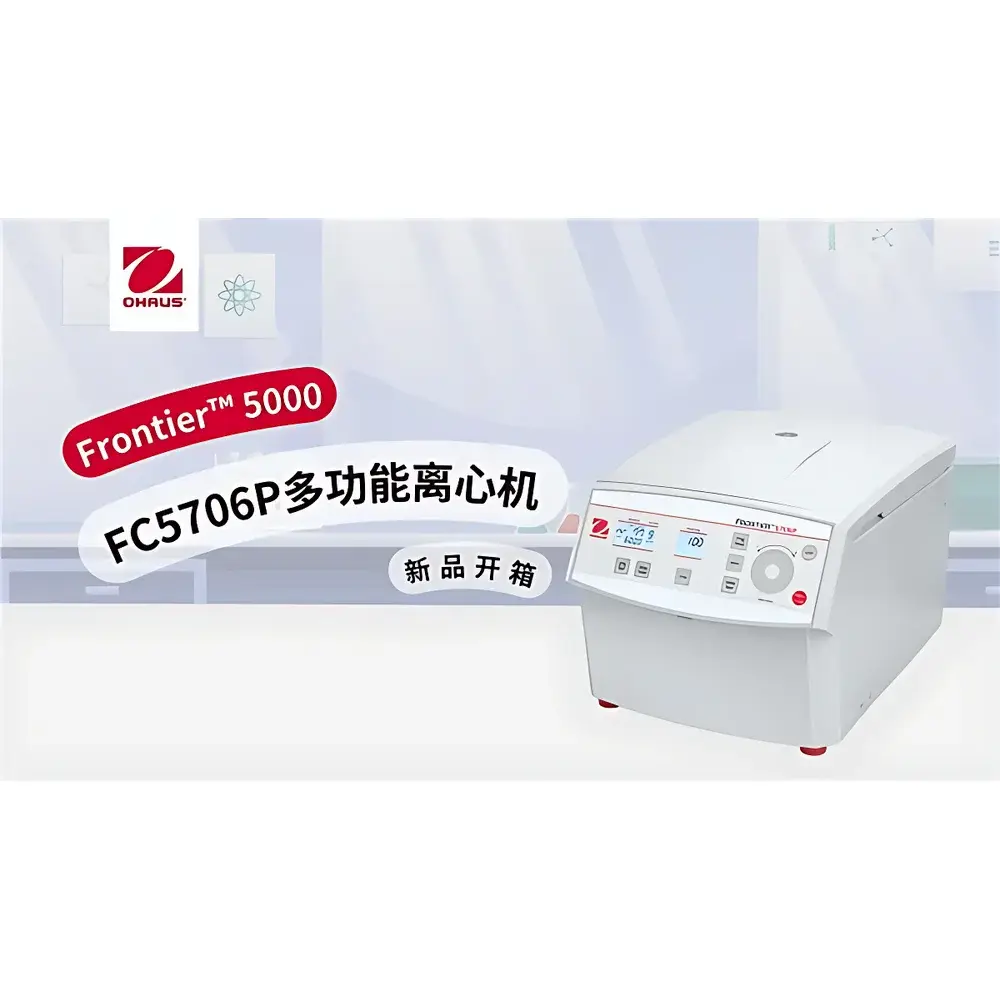
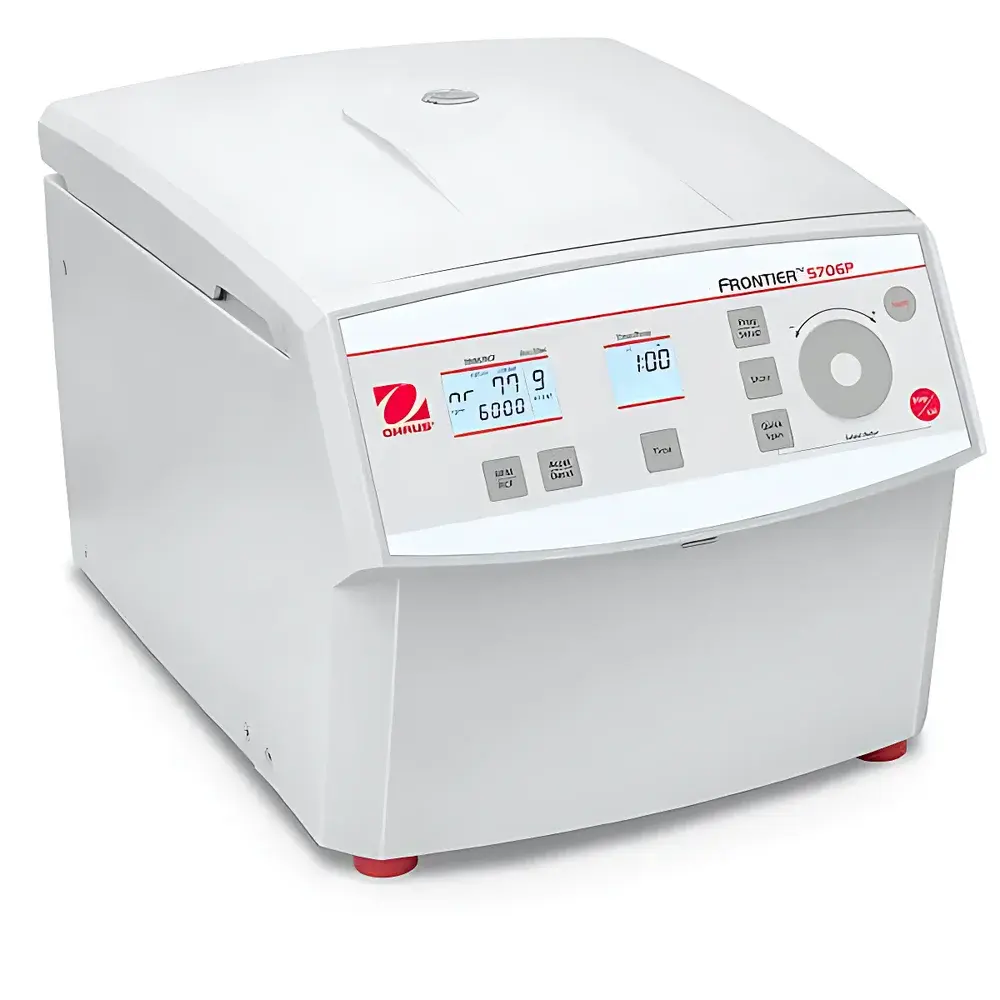
OHAUS Frontier™ 5000 Multi Benchtop Centrifuge FC5706P+R77
| Brand | OHAUS |
|---|---|
| Origin | Jiangsu, China |
| Manufacturer Type | Original Equipment Manufacturer (OEM) |
| Instrument Type | Benchtop Centrifuge |
| Speed Range | 200 – 6,000 rpm |
| Max RCF | 4,427 × g |
| Max Capacity | 6 × 50 mL |
| Dimensions (L×H×W) | 540 mm × 365 mm × 370 mm |
| Net Weight | 14.2 kg |
| Noise Level | ≤ 56 ± 2 dB(A) |
| Power Supply | AC, 70 W |
| Operating Environment | 5°C – 35°C, ≤ 80% RH (non-condensing) |
| Safety Certifications | CE, FCC |
| Rotor Compatibility | Angle (6×50 mL, 12×15 mL, 18×1.5/2.0 mL), Swing-Out (4×10 mL, 6×5 mL) |
| Timer Range | 10 s – 99 h 59 min 59 s, Continuous, Short Spin |
| Acceleration/Deceleration Steps | 10 each |
| Display | Backlit LCD, dual-line |
| Rotor Recognition | Manual ID |
| Motor | Brushless DC |
| Program Storage | 99 protocols |
Overview
The OHAUS Frontier™ 5000 Multi Benchtop Centrifuge FC5706P+R77 is a compact, high-reliability low-speed centrifuge engineered for routine laboratory separation tasks requiring precise control over rotational speed and relative centrifugal force (RCF). Operating on the principle of sedimentation under controlled gravitational acceleration, this instrument enables efficient pelleting of cells, bacteria, subcellular organelles, and precipitated macromolecules—without inducing thermal or mechanical stress associated with high-speed operation. Its brushless DC motor delivers consistent torque across the full speed range (200–6,000 rpm), minimizing vibration and ensuring long-term mechanical stability. Designed to meet the spatial constraints of modern bioscience labs, the unit occupies less than 0.2 m² of benchtop footprint while maintaining robust structural integrity and acoustic performance (<56 dB[A]). The integrated narrow-profile chassis eliminates the need for external ventilation or dedicated cooling infrastructure, making it suitable for shared instrumentation spaces and GLP-compliant environments where ambient temperature control is maintained per ISO/IEC 17025 requirements.
Key Features
- Intuitive backlit LCD interface with dual-line display for simultaneous readout of speed (rpm), RCF (×g), time remaining, and rotor identification status
- Programmable storage for up to 99 user-defined protocols—including speed, time, acceleration/deceleration profiles, and run mode (continuous, timed, short spin)
- Mechanical lid lock with positive engagement mechanism compliant with IEC 61010-2-020 safety standards for centrifuge equipment
- Brushless DC motor architecture ensuring maintenance-free operation, reduced electromagnetic interference, and extended service life (>20,000 hours MTBF)
- Modular rotor compatibility supporting five standard configurations: 6×50 mL angle, 12×15 mL angle, 18×1.5/2.0 mL angle, 4×10 mL swing-out, and 6×5 mL swing-out—each validated for maximum load and imbalance tolerance
- Adjustable acceleration and deceleration ramps (10-step grading) to minimize sample resuspension during braking, critical for fragile pellets in cell culture or clinical specimen processing
Sample Compatibility & Compliance
This centrifuge accommodates common laboratory vessels including conical-bottom and round-bottom polypropylene tubes (1.5–50 mL), as well as microcentrifuge tubes and PCR strips via optional adapters. All rotors are manufactured from anodized aluminum alloy meeting ASTM B557 tensile strength specifications and certified for autoclave sterilization (121°C, 20 min). The system complies with EU Directive 2014/30/EU (EMC), 2014/35/EU (LVD), and FCC Part 15 Subpart B for electromagnetic emissions. While not refrigerated, its operational envelope (5–35°C, non-condensing humidity ≤80% RH) aligns with CLSI GP26-A4 guidelines for ambient-temperature centrifugation in diagnostic and research settings. No internal refrigeration circuitry implies no requirement for ISO 13485-certified cold chain validation—reducing qualification burden in GMP-aligned QC laboratories.
Software & Data Management
The FC5706P+R77 operates as a standalone instrument without embedded networking or data export functionality; however, its parameter logging and protocol recall capabilities support audit-ready documentation per FDA 21 CFR Part 11 Annex 11 principles when used in conjunction with laboratory information management systems (LIMS). Each run stores timestamped metadata—including start/stop time, selected rotor ID, final speed, elapsed duration, and error codes—in non-volatile memory. Operators may manually record these values into electronic lab notebooks (ELNs) or paper-based batch records. For facilities implementing ALCOA+ data integrity frameworks, the device’s mechanical interlock, password-free access control, and deterministic timer behavior provide foundational traceability. Optional rotor-specific calibration certificates (traceable to NIST standards) are available upon request for IQ/OQ validation packages.
Applications
- Routine pelleting of mammalian and bacterial cells prior to lysis or media exchange
- Sedimentation of blood components (e.g., serum separation from clotted whole blood using 15–50 mL conical tubes)
- Clarification of crude lysates and supernatant harvesting in protein purification workflows
- Preparative isolation of nuclei, mitochondria, and lysosomal fractions at low RCF thresholds
- Quality control centrifugation of reagents, buffers, and formulated biologics to detect particulate matter per USP
- Educational use in undergraduate biochemistry and microbiology laboratories due to intuitive operation and safety-first design
FAQ
Is the FC5706P+R77 suitable for clinical diagnostics applications?
Yes—its CE marking, mechanical safety interlocks, and compliance with IEC 61010-2-020 make it appropriate for CLIA-waived and moderate-complexity testing environments, provided local SOPs define appropriate rotor loading, balancing, and maintenance intervals.
Can this centrifuge be validated for GMP manufacturing processes?
It supports IQ/OQ execution through documented calibration of speed and timer accuracy, mechanical inspection checklists, and rotor lifecycle tracking—though formal PQ requires integration with process-specific acceptance criteria defined by the user.
Does the instrument support automatic rotor recognition?
No—rotor identification is manual; users must select the correct rotor type from the menu before initiating a run to ensure accurate RCF calculation and safety limit enforcement.
What is the maximum allowable imbalance tolerance for the 6×50 mL angle rotor?
Per OHAUS technical specification sheet #30130878 Rev. C, the maximum permissible mass difference between opposing tubes is ±0.5 g at 6,000 rpm.
Is firmware upgrade capability available?
Firmware updates are performed exclusively by authorized OHAUS service centers using proprietary diagnostic tools; no end-user flashable interface is provided.



