
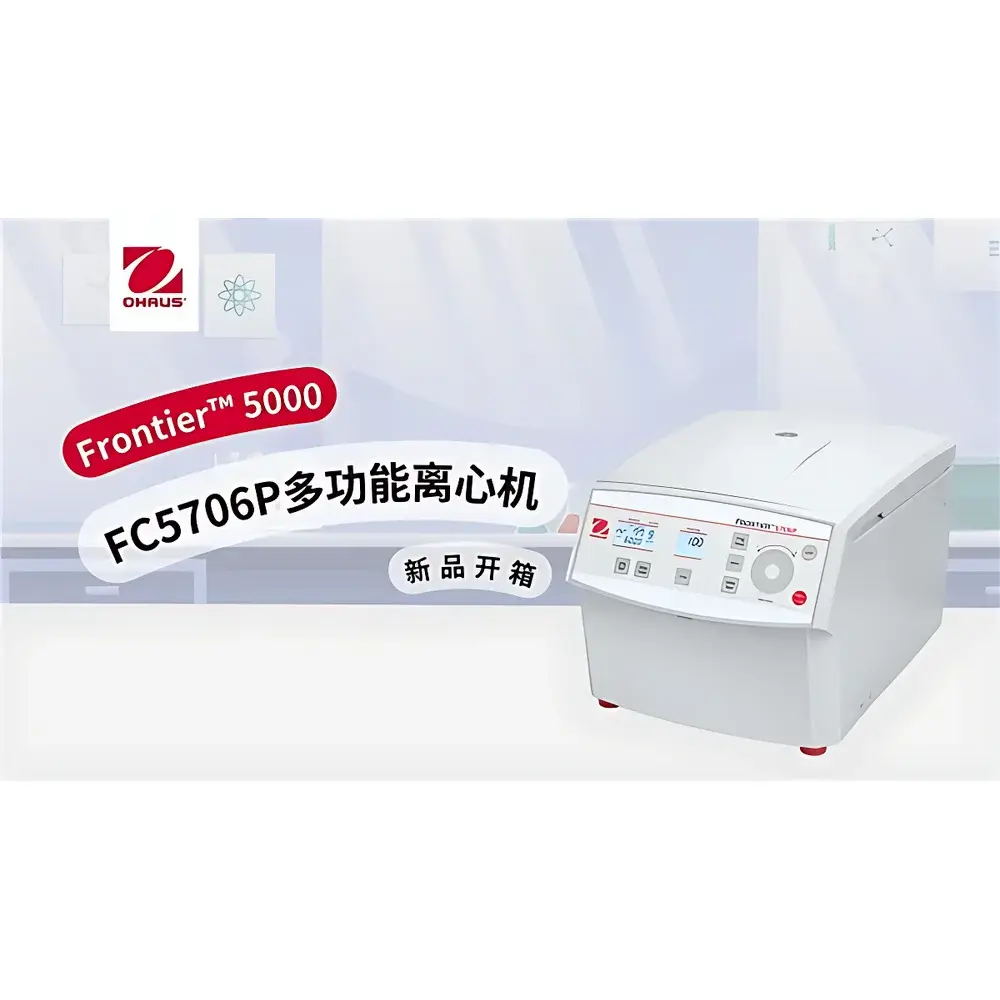
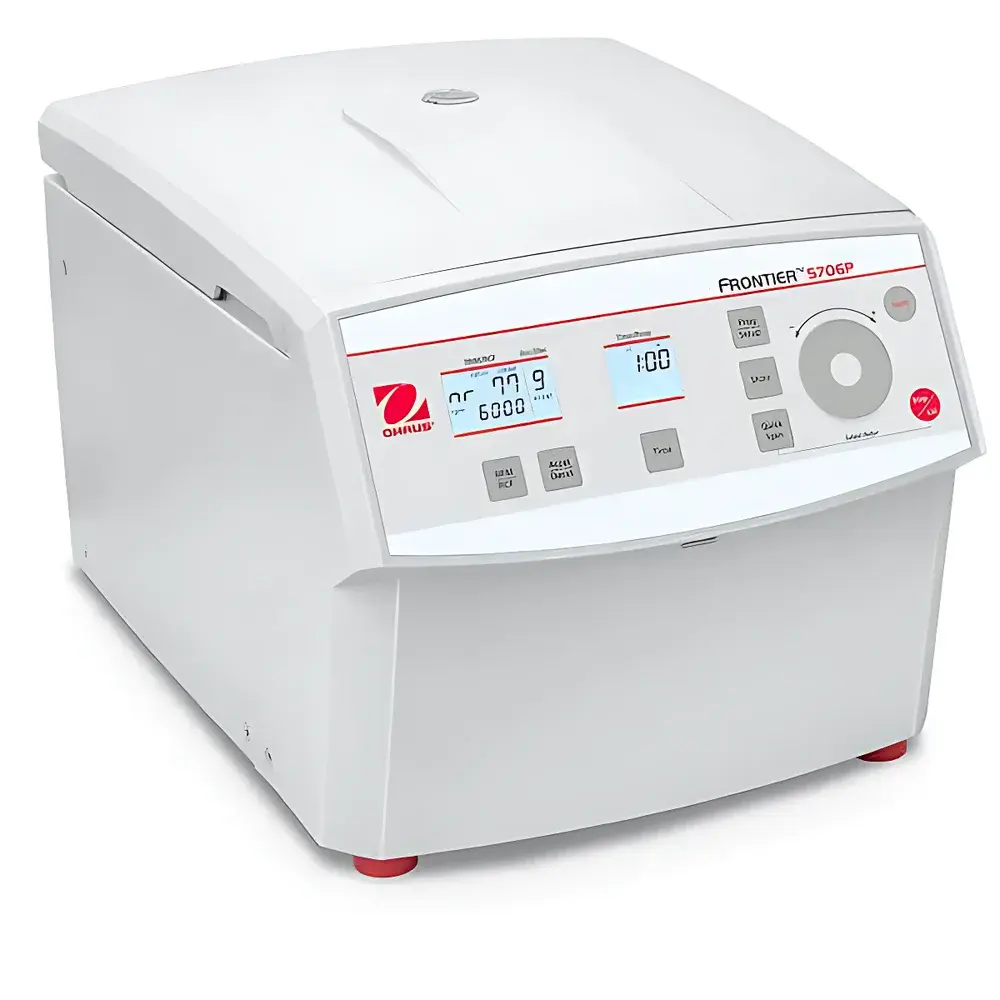
OHAUS Frontier™ 5000 Multi Benchtop Centrifuge FC5706P+R78
| Brand | OHAUS |
|---|---|
| Origin | Jiangsu, China |
| Manufacturer Type | Manufacturer |
| Product Category | Domestic |
| Model | FC5706P+R78 |
| Instrument Type | Benchtop Centrifuge |
| Speed Range | 200 – 6,000 rpm |
| Max RCF | 4,427 × g |
| Max Capacity | 6 × 50 mL |
| Dimensions (L×H×W) | 540 mm × 365 mm × 323 mm |
| Net Weight | 14.2 kg |
| Noise Level | ≤ 56 ± 2 dB(A) |
| Power Consumption | 70 W |
| Display | Backlit LCD, Dual-line |
| Acceleration/Deceleration Steps | 10 each |
| Timer Range | 10 s – 99 h 59 min 59 s, Continuous, or Instant Spin |
| Safety Certifications | CE, FCC |
| Operating Environment | 5°C – 35°C, ≤ 80% RH (non-condensing) |
| Motor | Brushless DC, Integrated Narrow-Profile Design |
| Rotor Recognition | Manual |
| Included Rotor | Angle Rotor 6 × 50 mL RB/FA (P/N 30130878) |
| Programmable Protocols | 99 |
| Enclosure Lock | Mechanical Lid Lock |
Overview
The OHAUS Frontier™ 5000 Multi Benchtop Centrifuge FC5706P+R78 is a precision-engineered, low-speed centrifuge designed for routine separation tasks in clinical, academic, and industrial laboratories. Operating on the principle of sedimentation under controlled centrifugal force, it enables efficient pelleting of cells, bacteria, organelles, and particulate matter from suspension—without thermal stress or mechanical shear that may compromise sample integrity. With a speed range of 200–6,000 rpm and a maximum relative centrifugal force (RCF) of 4,427 × g, this instrument delivers reproducible separation performance across diverse sample types while maintaining operational safety and ergonomic efficiency. Its compact footprint (540 × 365 × 323 mm) and integrated narrow-profile architecture minimize benchtop occupancy—a critical advantage in space-constrained core facilities and teaching labs.
Key Features
- Brushless DC motor: Ensures quiet operation (≤ 56 ± 2 dB[A]), extended service life, reduced maintenance, and consistent torque delivery across the full speed range.
- Intuitive backlit LCD interface: Dual-line display with real-time feedback of rpm, RCF, time remaining, and acceleration/deceleration status—optimized for gloved operation and rapid protocol verification.
- Programmable memory: Stores up to 99 user-defined protocols, including speed, time, acceleration/deceleration profiles, and rotor-specific parameters—supporting method standardization and GLP-aligned workflow documentation.
- Mechanical lid lock: Complies with IEC 61010-1 safety requirements; interlocks automatically during rotation and remains engaged until rotor comes to complete stop.
- Universal rotor compatibility: Supports multiple interchangeable rotors—including angle rotors (6 × 50 mL, 12 × 15 mL, 18 × 1.5/2.0 mL) and swing-out rotors (4 × 10 mL, 6 × 5 mL)—enabling flexible adaptation to varying tube geometries (conical, round-bottom) and volume requirements.
- Thermal management: Passive heat dissipation design eliminates need for active cooling—reducing power draw (70 W nominal), eliminating condensation risk, and simplifying installation in non-refrigerated lab environments.
Sample Compatibility & Compliance
The FC5706P+R78 accommodates standard laboratory tubes up to 50 mL capacity, including polypropylene conical-bottom and round-bottom centrifuge tubes compliant with ISO 8573-1 and ASTM D4169 packaging integrity standards. Its rotor geometry supports uniform sedimentation kinetics for bacterial cultures (e.g., E. coli, Bacillus subtilis), mammalian cell suspensions (HEK293, CHO), blood fractionation (RBC/WBC separation), and environmental samples (soil extracts, wastewater particulates). The system meets CE marking requirements under Directive 2014/30/EU (EMC) and 2014/35/EU (LVD), as well as FCC Part 15 Subpart B for electromagnetic emissions. While not refrigerated, its operating envelope (5–35°C, ≤ 80% RH, non-condensing) aligns with ISO/IEC 17025 clause 5.3.2 for environmental control of testing equipment.
Software & Data Management
This centrifuge operates as a standalone instrument without proprietary software dependency. All operational parameters are set and logged directly via the front-panel interface. Timestamped run records—including start/stop time, final speed, total runtime, and selected rotor ID—are retained in non-volatile memory for audit trail purposes. Though lacking USB or Ethernet connectivity, its programmable protocol storage and mechanical lock status logging support basic traceability required under GLP Annex 11 and FDA 21 CFR Part 11 for non-electronic record systems (e.g., paper-based SOP adherence logs). Export of run data requires manual transcription; no cloud synchronization or remote monitoring capability is implemented.
Applications
- Routine pelleting of microbial cultures prior to DNA/RNA extraction or protein harvesting.
- Clarification of cell lysates and crude tissue homogenates in molecular biology workflows.
- Preparative separation of plasma, serum, and whole blood components in clinical diagnostics settings.
- Sedimentation of precipitated proteins or antibody complexes in immunoassay development.
- Removal of insoluble debris from environmental water or soil suspension samples prior to filtration or spectroscopic analysis.
- Standardized washing steps in ELISA plate preparation and microcentrifuge tube-based assays.
FAQ
Is the FC5706P+R78 suitable for use with radioactive or biohazardous samples?
Yes—when operated inside certified biosafety cabinets or fume hoods and equipped with sealed rotors and aerosol-tight tube caps meeting ISO 15190:2020 containment guidelines.
Can I use third-party rotors with this centrifuge?
No—only OHAUS-certified rotors (e.g., P/N 30130878, 30130877, 83041499) are validated for mechanical integrity, balance tolerance, and RCF accuracy at maximum speed.
Does the centrifuge support automatic rotor identification?
No—rotor type must be manually confirmed by the operator prior to run initiation to ensure correct RCF calculation and safety interlock engagement.
What is the minimum recommended ambient temperature for stable operation?
5°C—the unit is not rated for cold-room use; condensation ingress may impair motor insulation and electronic reliability.
How often should preventive maintenance be performed?
OHAUS recommends biannual inspection of lid latch mechanism, rotor threads, and motor housing ventilation—per documented maintenance log per ISO/IEC 17025 clause 6.4.3.



