
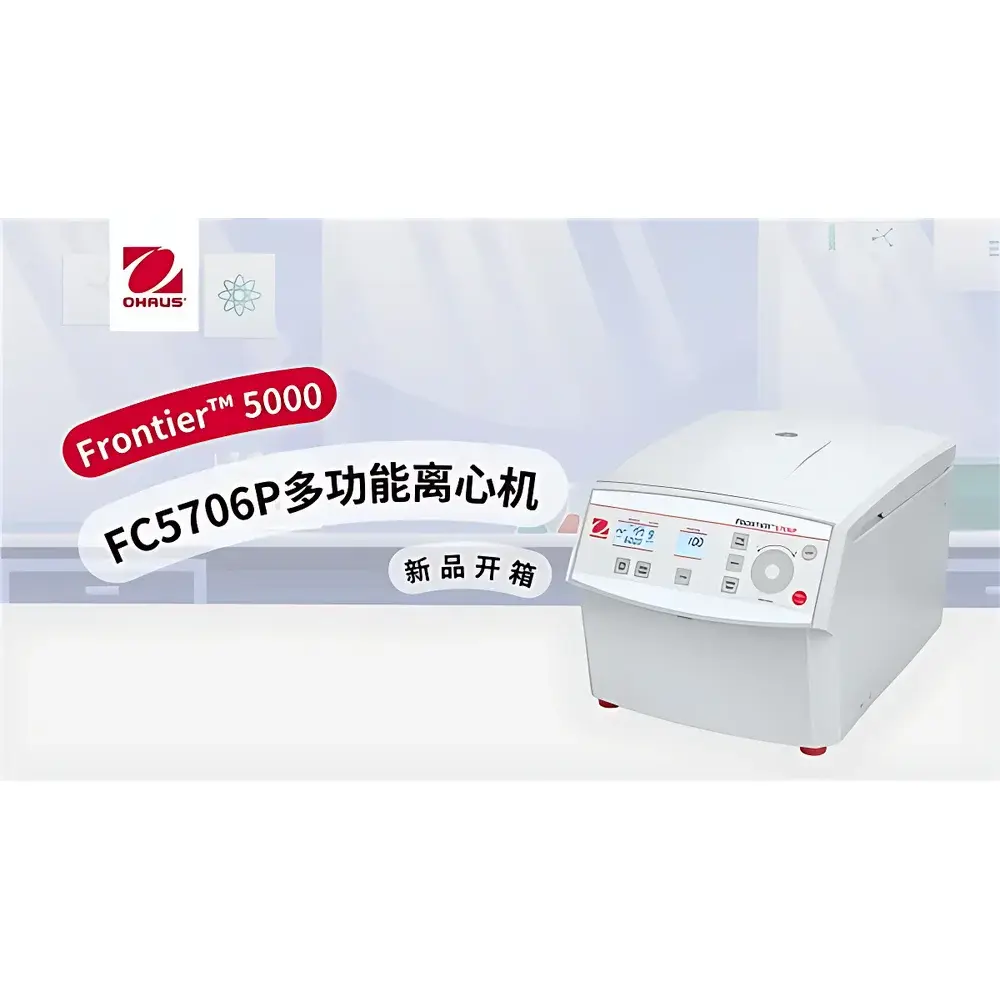
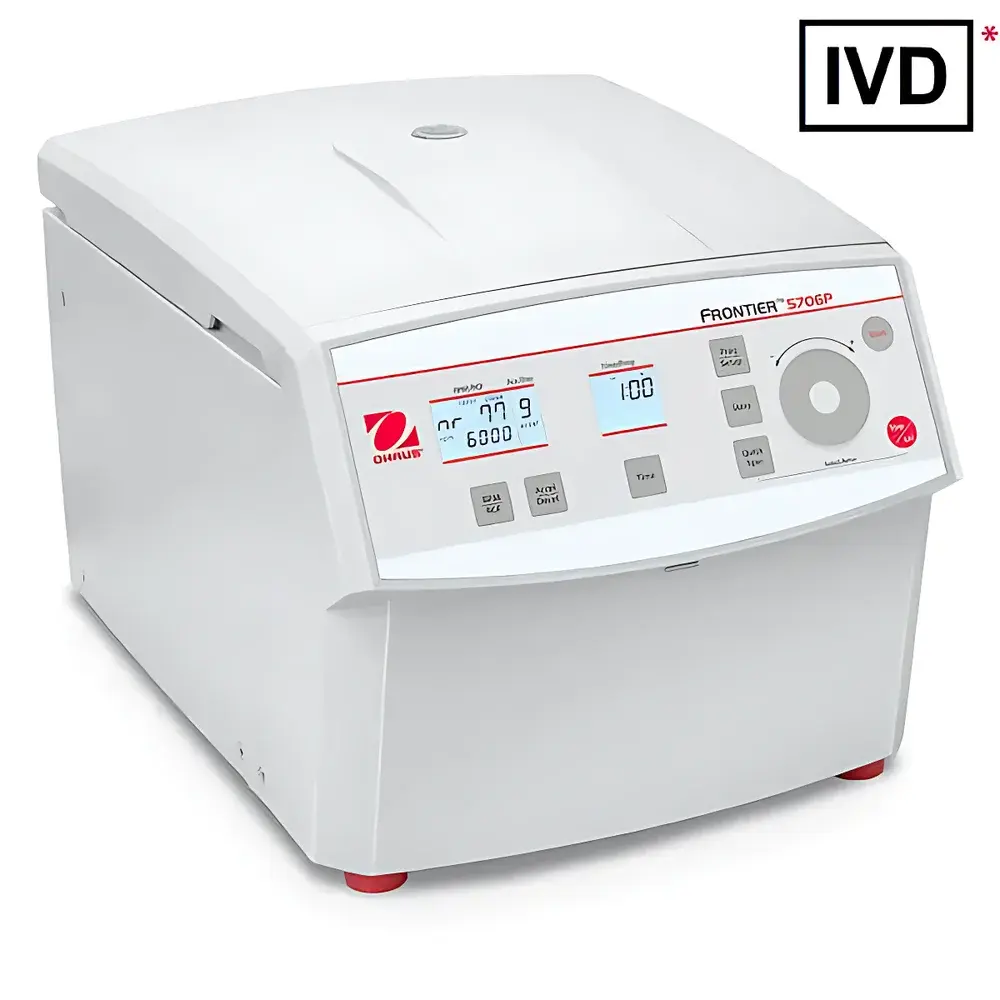
OHAUS Frontier™ 5000 Series FC5706P+R77 Benchtop Low-Speed Centrifuge
| Brand | OHAUS |
|---|---|
| Origin | Jiangsu, China |
| Manufacturer Type | Manufacturer |
| Origin Category | Domestic |
| Model | FC5706P+R77 (Medical Centrifuge) |
| Instrument Type | Benchtop Centrifuge |
| Speed Range | 200 – 6,000 rpm |
| Max RCF | 4,427 × g |
| Max Capacity | 6 × 50 mL |
| Dimensions (L×H×W) | 540 mm × 365 mm × 323 mm |
| Net Weight | 14.2 kg |
| Motor | Brushless DC |
| Noise Level | ≤ 56 ± 2 dB(A) |
| Display | Backlit LCD, Dual-Line |
| Operating Environment | 5°C – 35°C, ≤ 80% RH (non-condensing) |
| Safety Certification | CE |
| Acceleration/Deceleration Steps | 10 each |
| Timer Range | 10 sec – 99 min 59 sec |
| Power Consumption | 70 W |
| Rotor Recognition | Manual |
| Lid Lock | Mechanical |
| Programs Stored | 99 |
| Rotor Compatibility | Angle (6×50 mL RB/FA, 12×15 mL RB/FA, 18×1.5/2.0 mL), Swing-Out (4×10 mL, 6×5 mL) |
Overview
The OHAUS Frontier™ 5000 Series FC5706P+R77 is a CE-certified benchtop low-speed centrifuge engineered for reliability, operational simplicity, and space-efficient integration into clinical laboratories, point-of-care facilities, and routine biomedical research environments. Designed specifically for medical specimen processing—including whole blood, serum, plasma, urine, and bacterial pellet recovery—it operates on the principle of sedimentation force generation via controlled rotational acceleration. The unit delivers precise, reproducible separation performance across its full speed range (200–6,000 rpm), achieving a maximum relative centrifugal force (RCF) of 4,427 × g—sufficient for efficient pelleting of mammalian cells, bacteria, and particulate matter without compromising sample integrity or thermal stability. Its brushless DC motor ensures quiet operation (≤ 56 ± 2 dB[A]), extended service life, and minimal electromagnetic interference—critical in shared diagnostic workspaces where acoustic and electrical noise must be tightly managed.
Key Features
- Compact footprint (540 × 365 × 323 mm) optimized for limited benchtop real estate in clinical labs and mobile testing units;
- Intuitive dual-line backlit LCD interface with clear parameter visibility under varied ambient lighting conditions;
- Mechanical lid lock system compliant with IEC 61010-2-020 safety requirements for centrifuge operation;
- Programmable timer (10 seconds to 99 minutes 59 seconds) supporting continuous run, timed spin, and short-pulse centrifugation modes;
- 99 user-programmable protocols stored onboard for rapid recall of frequently used methods;
- 10-step acceleration and deceleration control enabling gentle braking for sensitive biological samples such as coagulated blood or fragile cell layers;
- Brushless DC motor architecture eliminating carbon dust accumulation, reducing maintenance intervals and enhancing long-term torque consistency;
- Integrated narrow-body housing design minimizing vibration transmission to adjacent instrumentation.
Sample Compatibility & Compliance
The FC5706P+R77 supports standardized clinical tube formats—including conical-bottom (RB) and round-bottom (FA) tubes—as well as common evacuated blood collection tubes (e.g., EDTA, heparin, serum separator tubes). Its rotor ecosystem includes five certified configurations: 6×50 mL angle (31013397), 12×15 mL angle (30130877), 18×1.5/2.0 mL angle (83041499), 4×10 mL swing-out (31013397), and 6×5 mL swing-out (30130880). All rotors are balanced per ISO 15197:2013 Annex B and validated for use within specified RCF limits. The instrument meets essential safety and electromagnetic compatibility (EMC) requirements per EN 61326-1 and EN 61000-6-3, and carries CE marking under the EU Medical Device Regulation (MDR) Annex II classification for Class I non-sterile, non-measuring laboratory equipment. While not refrigerated, its operating temperature range (5–35°C) aligns with standard CLIA and CAP-accredited lab environmental specifications.
Software & Data Management
This centrifuge operates as a standalone instrument without embedded connectivity or remote software interfaces. All parameter inputs, run logs, and program selections are retained locally on the device’s non-volatile memory. The absence of network ports, USB host functionality, or cloud-based data export reflects its design intent: adherence to strict data governance frameworks common in regulated clinical settings—where uncontrolled data transfer may conflict with HIPAA, GDPR, or local health authority IT security policies. Audit trails are maintained through manual recordkeeping; users may document run parameters (speed, time, RCF, rotor ID) in paper-based or LIMS-integrated logbooks. For GLP/GMP environments requiring electronic records, external documentation systems remain the recommended compliance pathway.
Applications
- Routine serum/plasma separation from whole blood specimens prior to immunoassay or clinical chemistry analysis;
- Urine sediment concentration for microscopic urinalysis;
- Bacterial pellet harvesting in microbiology workflows (e.g., Gram stain preparation, culture inoculation);
- Cell washing steps in basic hematology or flow cytometry sample prep;
- Clarification of tissue homogenates or cell lysates in academic or hospital-based research;
- Processing of small-volume biobanked specimens where high-throughput automation is unnecessary;
- Training and educational use in medical laboratory science programs due to robust mechanical design and intuitive operation.
FAQ
Is the FC5706P+R77 suitable for centrifuging infectious or biohazardous samples?
Yes—when used with sealed, certified biosafety-compatible rotors and tubes (e.g., OSHA-compliant capped conical tubes), and operated inside appropriate containment (e.g., biosafety cabinet for open-tube handling pre- and post-run).
Does this model support automatic rotor identification?
No—rotor recognition is manual; users must confirm rotor type and load configuration before initiating runs to ensure safe RCF calculation and speed limitation.
Can it be used for density gradient separations?
Not recommended—the unit lacks programmable deceleration profiles required for preserving gradient integrity; it is optimized for simple pelleting and supernatant removal.
What maintenance is required beyond routine cleaning?
Annual verification of rotor balance, lid lock engagement force, and speed calibration by an OHAUS-authorized service technician is advised per ISO/IEC 17025 traceability guidelines.
Is the power supply compatible with international voltages?
The standard AC input is 100–240 V, 50/60 Hz; no additional voltage converter is needed for global deployment, though region-specific power cords must be selected at time of order.



