
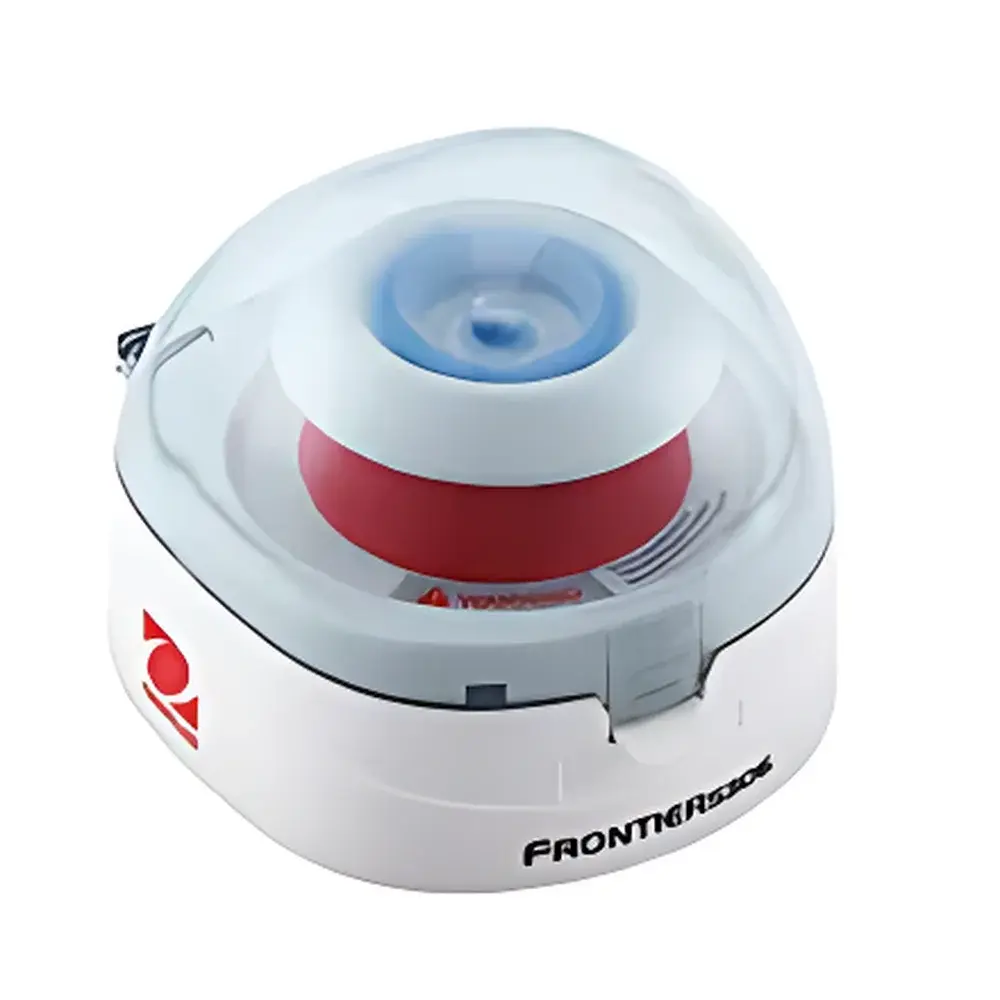
OHAUS Frontier™ FC5306 Compact Benchtop Centrifuge
| Brand | OHAUS |
|---|---|
| Origin | USA |
| Manufacturer Type | Original Equipment Manufacturer (OEM) |
| Product Category | Imported Instrument |
| Model | FC5306 |
| Instrument Type | Palm-Sized Centrifuge |
| Speed Range | Up to 6,000 rpm |
| Maximum RCF | 2,000 × g |
| Maximum Capacity | 8 × 1.5 mL or 2.0 mL microtubes |
| Dimensions (W×D×H) | 150 × 168 × 128 mm |
| Motor Type | Brushless DC Motor |
| Rotor Type | Fixed-angle rotor (pre-installed) |
| Safety Features | Dual interlock lid system, automatic imbalance detection, low-voltage DC power supply (24 V) |
| Compliance | Designed and manufactured in accordance with IEC 61010-1:2010 for laboratory electrical safety |
Overview
The OHAUS Frontier™ FC5306 Compact Benchtop Centrifuge is an entry-level, palm-sized centrifuge engineered for routine microcentrifugation tasks in research laboratories, clinical diagnostics, and quality control environments. Utilizing fixed-angle rotor geometry and brushless DC motor technology, the FC5306 generates controlled radial acceleration to separate suspended particles—such as cellular debris, precipitated proteins, or nucleic acid pellets—from liquid phases based on sedimentation velocity differences governed by Stokes’ law. Its design targets applications requiring rapid, low-force pelleting of biological macromolecules (e.g., DNA, RNA, plasmids, small-volume cell lysates) without thermal stress or mechanical shear degradation. With a maximum speed of 6,000 rpm and a corresponding RCF of 2,000 × g, the FC5306 operates within the optimal range for microtube-based protocols compliant with ISO 15195 and CLSI EP15-A3 guidelines for analytical precision in clinical microbiology and molecular biology workflows.
Key Features
- One-touch operation: Power-on activation eliminates multi-step programming—ideal for high-throughput sample processing where workflow continuity is critical.
- Tool-free rotor exchange: The integrated fixed-angle rotor is secured via a snap-fit mechanism; no wrenches or alignment tools are required for installation or removal, reducing cross-contamination risk and maintenance downtime.
- Brushless DC motor architecture: Delivers consistent torque output across speed ranges, minimizes acoustic noise (<52 dB(A)), and enables rapid acceleration to set speed in ≤12 seconds (0–6,000 rpm).
- Dual mechanical/electronic safety interlocks: Lid latch engagement is verified both physically (microswitch) and electronically (real-time position monitoring); centrifugation halts immediately if lid opens or misaligns during operation.
- Active imbalance detection: Accelerometer-based sensing continuously monitors vibration signatures; automatic deceleration initiates if mass asymmetry exceeds ±0.5 g per tube position, preventing rotor damage and ensuring GLP-compliant operational integrity.
- Low-voltage DC power architecture (24 V): Eliminates reliance on mains AC voltage at the instrument level, significantly reducing electrical hazard exposure per IEC 61010-1 Clause 6.3.2 and enhancing compatibility with mobile lab carts or biosafety cabinet-integrated setups.
Sample Compatibility & Compliance
The FC5306 accepts standard 1.5 mL and 2.0 mL conical-bottom microcentrifuge tubes (e.g., Eppendorf Safe-Lock®, Axygen MaxyClear®) without adapters. Its fixed-angle rotor (12° tilt) ensures reproducible pellet formation along the tube wall, minimizing resuspension during deceleration. All structural components—including housing, rotor cavity, and lid—are constructed from reinforced polypropylene copolymer and anodized aluminum alloy, meeting USP Class VI biocompatibility requirements for repeated contact with diagnostic reagents. The device complies with electromagnetic compatibility standards EN 61326-1:2013 and carries CE marking under the EU Laboratory Equipment Directive 2014/30/EU. It supports audit-ready documentation per FDA 21 CFR Part 11 when used with OHAUS LogIt™ software (optional add-on).
Software & Data Management
While the FC5306 operates as a standalone unit with no embedded display or programmable memory, it interfaces seamlessly with OHAUS LogIt™ PC-based data logging software via USB-B port. This enables timestamped recording of run parameters (start/stop time, actual speed, duration), event logs (lid open/close, imbalance alerts), and export to CSV or PDF formats for inclusion in electronic lab notebooks (ELN). All data files are digitally signed and support SHA-256 hashing for integrity verification—meeting ALCOA+ principles for data attribution, legibility, contemporaneity, originality, accuracy, completeness, consistency, and enduring retention.
Applications
- Routine pelleting of PCR products, restriction digests, and column-purified nucleic acids prior to ethanol precipitation or downstream sequencing library preparation.
- Clarification of bacterial lysates in plasmid miniprep workflows (e.g., alkaline lysis followed by neutralization and centrifugal phase separation).
- Microvolume protein precipitation using acetone or TCA, particularly in proteomics sample prep where minimal carryover is essential.
- Centrifugal concentration of dilute antibody solutions or enzyme preparations in assay development labs.
- Point-of-care specimen processing in mobile health units where space, power constraints, and operator training levels necessitate intuitive, fail-safe instrumentation.
FAQ
Is the FC5306 compatible with PCR strip tubes or 0.2 mL tubes?
No—the rotor geometry and tube holder design are optimized exclusively for individual 1.5 mL and 2.0 mL microcentrifuge tubes. Strip tubes require specialized rotors not supported by this model.
Does the FC5306 include a rotor brake?
Yes—it features an active electronic braking system that decelerates from 6,000 rpm to rest in ≤18 seconds, reducing turnaround time between runs without compromising rotor longevity.
Can the FC5306 be operated inside a refrigerated environment?
It is rated for ambient operating temperatures of 5–40 °C and relative humidity ≤80% non-condensing; operation below 10 °C is not validated and may affect motor efficiency and lid seal performance.
What maintenance is required beyond routine cleaning?
No scheduled lubrication or calibration is needed. Wipe exterior surfaces with 70% isopropyl alcohol; inspect rotor cavity monthly for microcracks or deformation using visual magnification per OHAUS Service Bulletin F-FC5306-REV4.



