
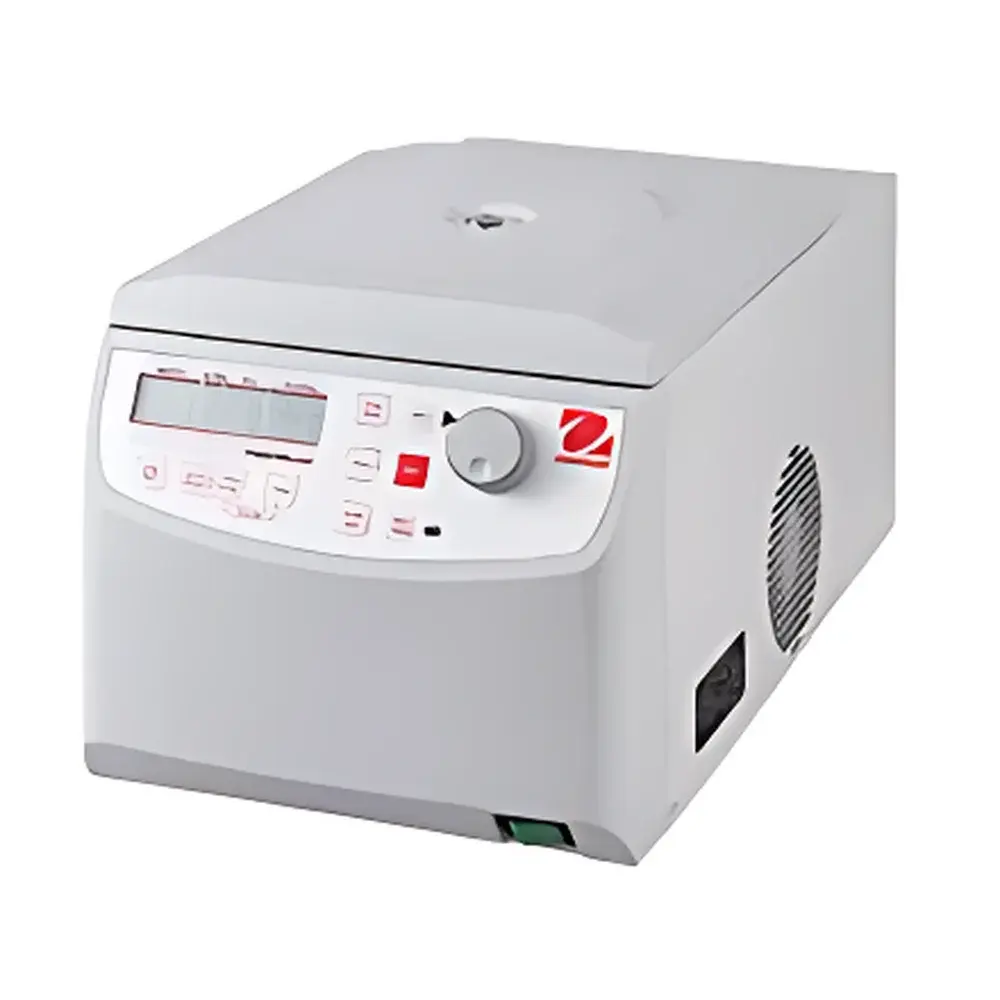
OHAUS FRONTIER™ FC5515R Micro-Ultracentrifuge with Refrigeration
| Brand | OHAUS |
|---|---|
| Origin | Germany |
| Manufacturer Type | Original Equipment Manufacturer (OEM) |
| Product Category | Imported Instrument |
| Model | FRONTIER™ FC5515R |
| Instrument Type | Benchtop Centrifuge |
| Speed Class | High-Speed Centrifuge (>15,000 rpm) |
| Function | Refrigerated Centrifuge |
| Configuration | Fixed-Angle Rotor Centrifuge |
| Maximum Capacity | 44 × 1.5 mL / 2.0 mL or 12 × 5 mL |
| Maximum Speed | 15,200 rpm |
| Maximum RCF | 21,953 × g |
| Dimensions (W × D × H) | 287 × 561 × 292 mm |
Overview
The OHAUS FRONTIER™ FC5515R is a high-performance benchtop refrigerated micro-ultracentrifuge engineered for precision separation of small-volume biological samples in demanding laboratory environments. Utilizing fixed-angle rotor architecture and a brushless induction motor, it delivers consistent rotational stability at speeds up to 15,200 rpm—generating a maximum relative centrifugal force (RCF) of 21,953 × g. Its closed-loop refrigeration system maintains precise temperature control between –20 °C and +40 °C, with rapid pre-cooling capability (≤10 min from +23 °C to +4 °C), ensuring thermal integrity during extended runs. Designed for molecular biology, clinical diagnostics, and pharmaceutical QC workflows, the FC5515R complies with IEC 61010-1 for electrical safety and meets ISO 13485-aligned manufacturing standards as an OEM-built instrument produced in Germany.
Key Features
- Brushless induction motor with zero carbon brush wear—ensures long-term torque consistency and eliminates maintenance intervals associated with commutator degradation.
- Triple-layer safety architecture: electronic rotor lock with explosion-proof design, adaptive imbalance detection (real-time mass distribution monitoring), and overspeed protection with automatic shutdown.
- Ergonomic rotary control dial with IPX4-rated waterproof front panel; supports instant spin (short-run mode) without parameter entry.
- Dual-line LCD display showing simultaneous RPM/RCF, time remaining, temperature, and rotor identification—enabling real-time operational verification without menu navigation.
- Pre-stored rotor profiles automatically convert user-input RPM ↔ RCF values based on selected rotor geometry and radius—eliminating manual calculation errors per ISO 21501-4 guidance.
- 10 independent acceleration/deceleration ramp profiles—programmable for sensitive sample types (e.g., nucleic acid pellets, exosome isolates) to minimize shear-induced aggregation.
- No-thread “Snap-on” rotor attachment mechanism—mechanically secured without tools, reducing risk of misalignment or ejection under transient load conditions.
Sample Compatibility & Compliance
The FC5515R accommodates up to 44 tubes of 1.5–2.0 mL capacity or 12 × 5 mL tubes across seven validated fixed-angle rotors—including hermetically sealed variants certified to EN 61010-2-020 for containment of biohazardous aerosols. All rotors are autoclavable at 121 °C for 20 minutes, supporting GLP-compliant decontamination protocols. Tube compatibility spans 0.2–5 mL volumes (including PCR strips and low-retention microtubes), enabling direct integration into nucleic acid purification, protein precipitation, and cell organelle isolation workflows. The instrument’s temperature stability (±0.5 °C at +4 °C setpoint, full-speed operation) satisfies USP environmental requirements for sterile compounding support applications.
Software & Data Management
While the FC5515R operates via embedded firmware without external PC dependency, its 99-user protocol memory includes timestamped run logs with audit trail metadata (start/stop time, rotor ID, final temperature, actual RCF). All stored parameters adhere to ALCOA+ principles—attributable, legible, contemporaneous, original, accurate, complete, consistent, enduring, and available—for regulatory review. Optional RS-232 interface enables connection to LIMS systems for automated data export, and firmware updates maintain alignment with evolving FDA 21 CFR Part 11 requirements for electronic records and signatures.
Applications
- High-yield pelleting of plasmid DNA, viral particles, and extracellular vesicles (EVs) from clarified supernatants.
- Routine clarification of bacterial lysates prior to chromatographic purification.
- Separation of subcellular fractions (mitochondria, nuclei) using density gradient-compatible rotors.
- Concentration of dilute protein solutions for downstream MS analysis—minimizing denaturation via controlled deceleration ramps.
- QC release testing of sterile-filtered biologics where temperature-sensitive stability must be preserved throughout centrifugation.
FAQ
Does the FC5515R support rotor validation documentation for GMP audits?
Yes—OHAUS provides Certificate of Conformance (CoC) and rotor-specific performance validation reports upon request, including RCF calibration traceability to NIST-traceable tachometers.
Can the instrument maintain +4 °C during continuous operation at 15,200 rpm?
Yes, when equipped with the standard 44-place 1.5/2.0 mL rotor and ambient lab temperature ≤25 °C, thermal equilibrium at +4 °C is sustained for ≥90 minutes at maximum speed.
Is rotor imbalance compensation performed dynamically or statically?
Imbalance detection is dynamic and continuous—using motor current signature analysis to identify asymmetrical mass distribution during acceleration, deceleration, and steady-state rotation.
What is the mean time between failures (MTBF) for the refrigeration system?
Based on accelerated life testing under ISO 13374-2 condition monitoring protocols, the compressor-cooling module demonstrates MTBF >25,000 hours at nominal load.
Are rotor lifetime limits tracked by the onboard firmware?
No—rotor service life is managed externally per OHAUS’s Rotational Fatigue Log (RFL) guidelines; firmware does not embed usage counters but displays rotor model and serial number for manual log reconciliation.



