
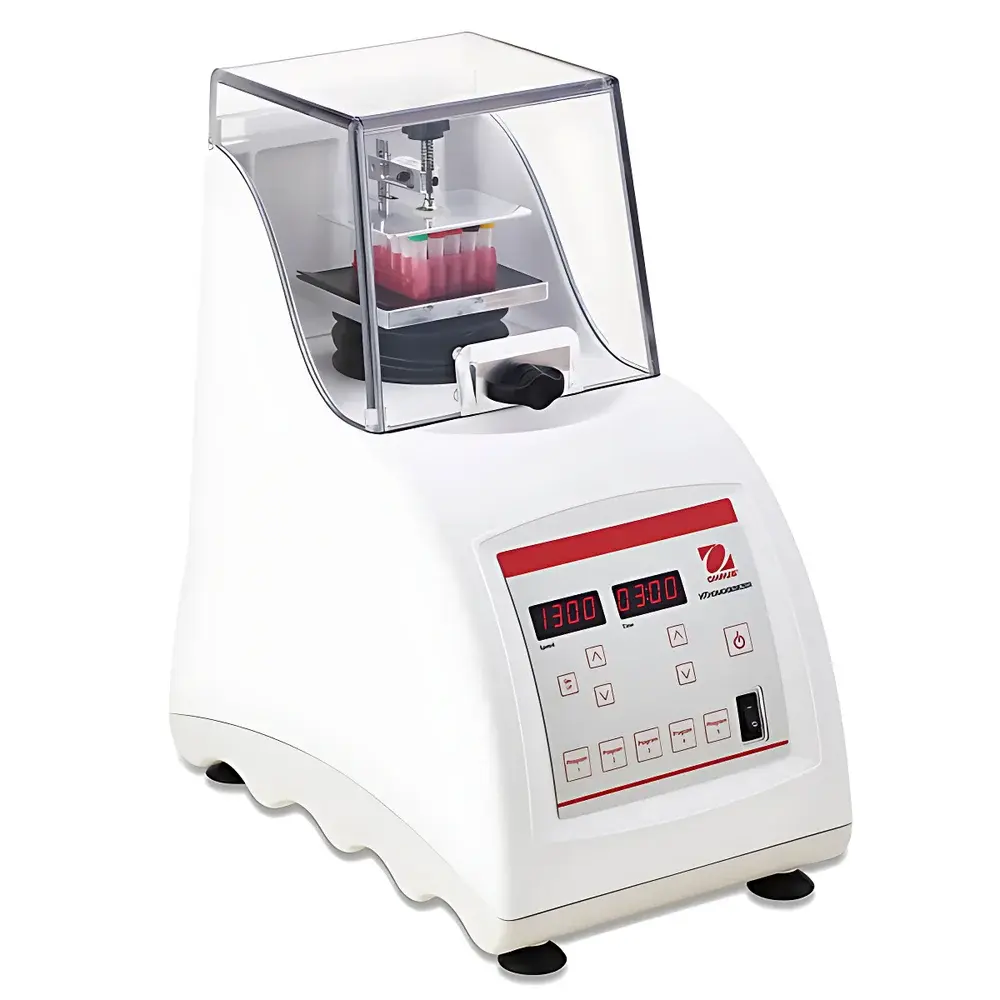
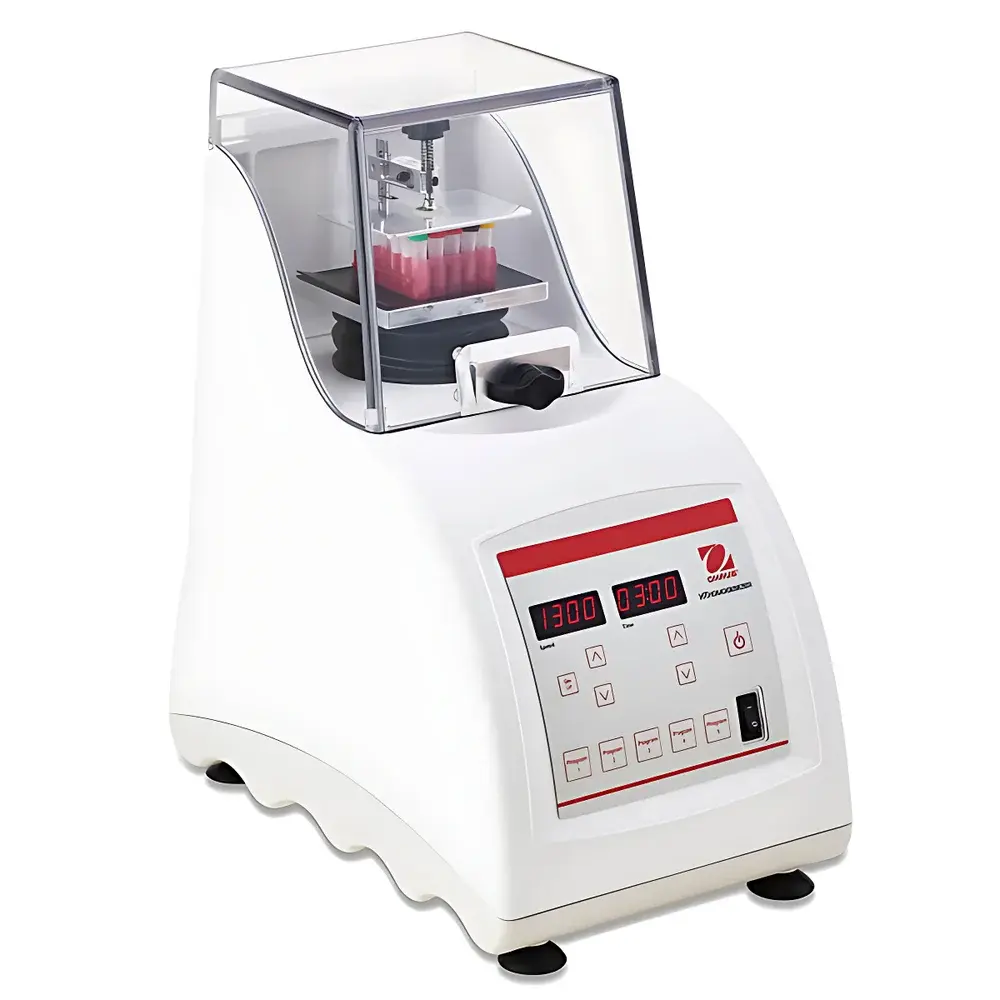
OHAUS HT-250 High-Throughput Biological Sample Homogenizer
| Brand | OHAUS |
|---|---|
| Origin | Jiangsu, China |
| Manufacturer Type | Direct Manufacturer |
| Regional Classification | Domestic (China) |
| Model | HT-250 |
| Pricing | Upon Request |
Overview
The OHAUS HT-250 High-Throughput Biological Sample Homogenizer is an engineered benchtop platform designed for reproducible, mechanical lysis and homogenization of diverse biological matrices using high-frequency orbital shaking combined with bead-beating action. It operates on the principle of kinetic energy transfer—where precisely controlled oscillatory motion agitates grinding media (e.g., ceramic, steel, or zirconia beads) within sealed sample vessels—disrupting cellular structures through shear stress, impact, and friction. Unlike rotor-stator or ultrasonic systems, this instrument delivers scalable, low-heat, non-contact lysis ideal for preserving labile biomolecules (e.g., RNA, proteins, metabolites) across parallel processing formats. Its architecture supports walk-away operation for unattended batch processing, making it suitable for core facilities, QC labs, and translational research environments requiring consistent upstream sample preparation prior to downstream analysis (e.g., qPCR, NGS library prep, ELISA, or proteomics workflows).
Key Features
- Modular sample carrier system accommodating 0.2–50 mL tubes, 96-well PCR plates, 24- or 48-well deep-well plates, and custom-fit containers—no proprietary adapters required.
- Five pre-optimized, user-selectable protocols calibrated for common specimen types: Gram-negative/positive bacteria, yeast/fungi, fibrous plant tissues, soft animal organs (liver, spleen), and cultured mammalian cells.
- Digital speed control (200–3000 rpm) with ±5 rpm accuracy and programmable run time (10 s–60 min) enabling method standardization across operators and shifts.
- Integrated safety interlock with lid-sensor activation and automatic shutdown upon imbalance detection or door opening during operation.
- Compact footprint (28 × 32 × 25 cm) with noise-dampened housing (<65 dB(A) at 1 m), compliant with ISO 15707 for laboratory equipment acoustic emission.
- Corrosion-resistant stainless-steel chamber and IP20-rated electrical enclosure meeting IEC 61000-6-3 for electromagnetic compatibility in shared lab spaces.
Sample Compatibility & Compliance
The HT-250 accommodates a broad range of biological input materials—including microbial pellets, frozen tissue sections, whole blood lysates, and plant leaf discs—when paired with appropriate bead types and lysis buffers. Vessel compatibility extends to polypropylene, polycarbonate, and reinforced glass containers rated for ≥3000 × g centrifugal force. The system aligns with Good Laboratory Practice (GLP) documentation requirements via traceable protocol execution logs (accessible via USB export). While not certified under FDA 21 CFR Part 11 out-of-the-box, its operational parameters support audit-ready workflows when integrated with validated LIMS or electronic lab notebook (ELN) systems. It meets ISO 13485-aligned manufacturing standards as a Class I medical device accessory per MDR Annex VIII criteria.
Software & Data Management
The HT-250 operates via an embedded microcontroller interface with tactile membrane keypad and backlit LCD display. All protocol parameters—including speed, duration, pause intervals, and cycle repeats—are stored in non-volatile memory (retention >10 years). Audit trails record timestamped start/stop events, error codes (e.g., E01: lid open, E03: motor overload), and active protocol ID for each run. Data export is supported via USB 2.0 port (FAT32-formatted flash drive) in CSV format, compatible with common data management platforms including LabWare LIMS, Thermo Fisher SampleManager, and open-source tools like OpenLab ELN. No cloud connectivity or proprietary software installation is required, minimizing IT validation burden.
Applications
- Routine nucleic acid extraction from bacterial cultures and clinical isolates for antimicrobial resistance profiling.
- High-yield protein solubilization from recalcitrant plant tissues prior to 2D-DIGE or LC-MS/MS analysis.
- Standardized homogenization of rodent tissue biobanks to ensure inter-batch consistency in pharmacokinetic studies.
- Pre-analytical processing of FFPE-derived samples for targeted DNA methylation assays.
- Cell disruption for enzyme activity assays where thermal denaturation must be minimized (e.g., lactate dehydrogenase kinetics).
FAQ
Is the HT-250 compatible with cryogenic grinding using liquid nitrogen-cooled adapters?
No—this model is not designed for sub-ambient operation; ambient-temperature bead beating only. For cryo-homogenization, consider OHAUS CryoMill-compatible systems.
Can protocols be password-protected to prevent unauthorized modification?
Protocol editing requires physical access and a three-button sequence; no user-level password system is implemented.
What maintenance schedule is recommended for long-term reliability?
Biannual inspection of drive belt tension and bearing lubrication; annual calibration verification using a certified tachometer and timer standard.
Does the instrument support GLP-compliant electronic signatures?
No—electronic signature functionality is not embedded; integration with third-party ELN/LIMS is required for 21 CFR Part 11 compliance.
Are spare parts such as replacement carriers or bead kits available directly from OHAUS?
Yes—OHAUS maintains global distribution channels for consumables (Cat. No. HT-BK-01 for 2.8 mm stainless steel beads; HT-CR-96 for 96-well plate carriers) with lead times under 5 business days in EMEA and North America.



