
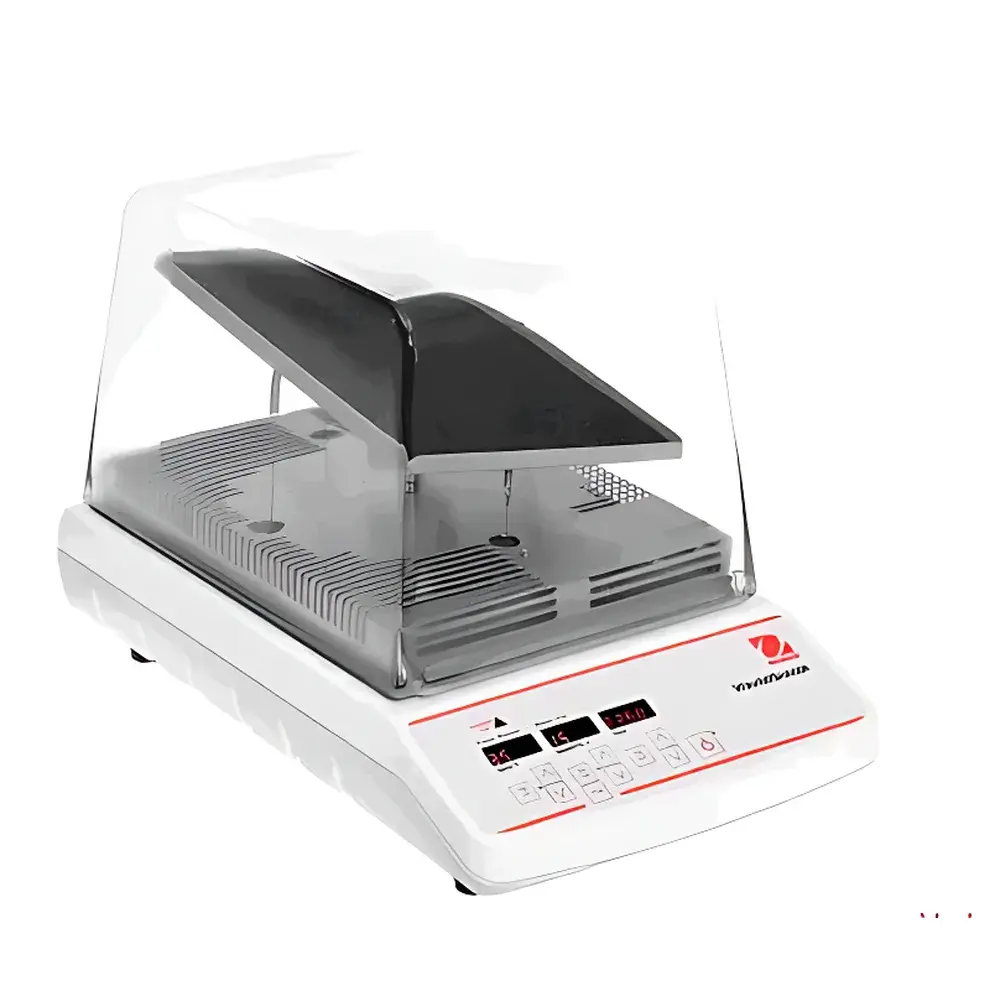
OHAUS ISWV02HDG Advanced Temperature-Controlled 2D Rocker and 3D Orbital Shaker
| Brand | OHAUS |
|---|---|
| Origin | USA |
| Manufacturer Type | Direct Manufacturer |
| Product Category | Imported Instrument |
| Model | ISWV02HDG |
| Instrument Type | Full-Temperature Oscillator / Shaker |
| Timer Range | 1 s – 160 h |
| Oscillation Frequency | 1–30 rpm |
| Oscillation Amplitude | 1–30 rpm (interpreted as angular displacement control in 2D mode |
| Temperature Range | Ambient +5°C to 65°C |
| Temperature Uniformity | ±0.5°C at 37°C |
| Speed Accuracy | ±1 rpm |
| Tilt Angle Range | 0–20° |
| Tray Dimensions (L×W) | 23.5 cm × 18.4 cm |
| Internal Chamber Dimensions | 19.7 cm (W) |
| Max Load Capacity | 2.3 kg |
| Enclosure Material | Cast Aluminum Housing with Polycarbonate Lid |
| Drive System | Stepper Motor |
| Power Supply | 230 V, 5 A, 50/60 Hz |
| Power Consumption | 450 W |
| Safety Certifications | CE, TÜV |
| Operating Environment | 5–40°C, ≤80% RH (non-condensing) |
| Net Weight | 6.2 kg |
| External Dimensions (W×D×H) | 26.7 cm × 43.2 cm × 27.9 cm |
| Control Interface | Digital LED Display with Independent Readouts for Speed, Tilt Angle, and Timer |
Overview
The OHAUS ISWV02HDG is a dual-mode, temperature-controlled laboratory shaker engineered for precise, reproducible agitation of biological samples under controlled thermal conditions. Unlike conventional single-motion shakers, this instrument integrates two distinct oscillation modalities—2D rocking (tilt-based linear reciprocation) and 3D orbital motion—within a single compact platform. Its operation relies on a high-resolution stepper motor drive system coupled with closed-loop temperature regulation via Peltier-assisted heating and intelligent ambient compensation. The device maintains thermal stability within ±0.5°C at 37°C across its full operating range (ambient +5°C to 65°C), making it suitable for applications requiring strict adherence to physiological or assay-specific temperature profiles. Designed for integration into GLP-compliant workflows, the ISWV02HDG meets CE and TÜV safety standards and supports audit-ready operation in regulated environments including clinical diagnostics, biopharmaceutical process development, and academic cell biology laboratories.
Key Features
- Dual-motion capability: Selectable 2D rocking (0–20° adjustable tilt angle) and 3D orbital agitation modes for optimized mixing of gels, membranes, microplates, and suspension cultures.
- Digital precision control: Independent LED displays for real-time monitoring of speed (1–30 rpm), tilt angle (0–20°), and timer (1 s – 160 h), eliminating parameter cross-talk during multi-step protocols.
- Thermal integrity architecture: Cast aluminum chassis provides uniform heat distribution; polycarbonate lid ensures condensation-free viewing while maintaining thermal containment.
- Robust safety systems: Overload protection, audible/visual alarm triggers for temperature deviation or motor stall, and thermal warning indicator compliant with IEC 61010-1.
- Spill-resistant design: Sealed control panel and sloped tray surface minimize liquid ingress risk during extended incubation-agitation cycles.
- Energy-efficient operation: 450 W maximum draw optimized for continuous 24/7 use in shared core facilities without excessive HVAC load.
Sample Compatibility & Compliance
The ISWV02HDG accommodates standard laboratory vessels up to 2.3 kg total load—including Petri dishes, blotting trays (up to 15 × 20 cm), multiwell plates (6–96-well), Erlenmeyer flasks (≤500 mL), and hybridization tubes. Its 23.5 × 18.4 cm aluminum tray features non-slip elastomer coating to prevent vessel displacement during low-frequency agitation. The instrument complies with ISO/IEC 17025 requirements for equipment qualification and supports IQ/OQ documentation packages. Temperature performance validation aligns with ASTM E2251–22 (Standard Practice for Calibration of Laboratory Thermometers) and supports traceable calibration using NIST-traceable RTD probes. For regulated biotherapeutic manufacturing, the shaker’s deterministic timer and stable thermal output support alignment with USP Analytical Instrument Qualification guidelines.
Software & Data Management
While the ISWV02HDG operates via standalone digital interface, its timer and temperature setpoints are fully programmable and retain settings after power interruption—enabling unattended overnight runs. The unit does not include onboard data logging; however, analog voltage outputs (0–5 V) for speed and temperature signals are available via optional I/O module (OHAUS Part # ISWV-IO-01), enabling integration with SCADA systems or third-party LIMS platforms supporting Modbus RTU or analog input acquisition. All operational parameters meet FDA 21 CFR Part 11 readiness when paired with validated external recording systems, fulfilling electronic record retention requirements for GMP environments.
Applications
- Nucleic acid and protein blotting: Controlled rocking during hybridization, washing, and antibody incubation steps to enhance signal-to-noise ratio in Southern/Northern/Western workflows.
- Cell culture maintenance: Gentle 3D orbital motion sustains suspension cultures (e.g., CHO, Sf9) at physiological temperatures without shear-induced apoptosis.
- Gel staining and destaining: Uniform reagent penetration in SDS-PAGE and agarose gels via programmable low-rpm agitation cycles.
- Antibody labeling and ELISA plate preparation: Consistent mixing of conjugates and substrates to reduce inter-assay variability.
- Environmental microbiology: Incubation-agitation of enrichment broths under defined thermal gradients for pathogen recovery studies.
FAQ
Can the ISWV02HDG operate continuously for 160 hours without manual intervention?
Yes—the integrated timer supports uninterrupted operation up to 160 hours, with automatic shutdown and visual alert upon completion.
Is the temperature range calibrated to ambient +5°C or absolute 5°C?
The lower limit is ambient temperature plus 5°C; the unit cannot cool below ambient, only heat above it.
Does the shaker support external temperature probe input for chamber monitoring?
No—temperature sensing is internal only; however, an optional external RTD probe port is available via the ISWV-IO-01 interface module.
What is the maximum flask size compatible with the 3D orbital mode?
Erlenmeyer flasks up to 500 mL may be used, provided total mass remains ≤2.3 kg and center-of-gravity remains within the tray’s stability envelope.
How is speed accuracy verified during factory calibration?
Each unit undergoes laser tachometer verification across the full 1–30 rpm range, with results documented in the Certificate of Conformance shipped with the instrument.
Related Products




