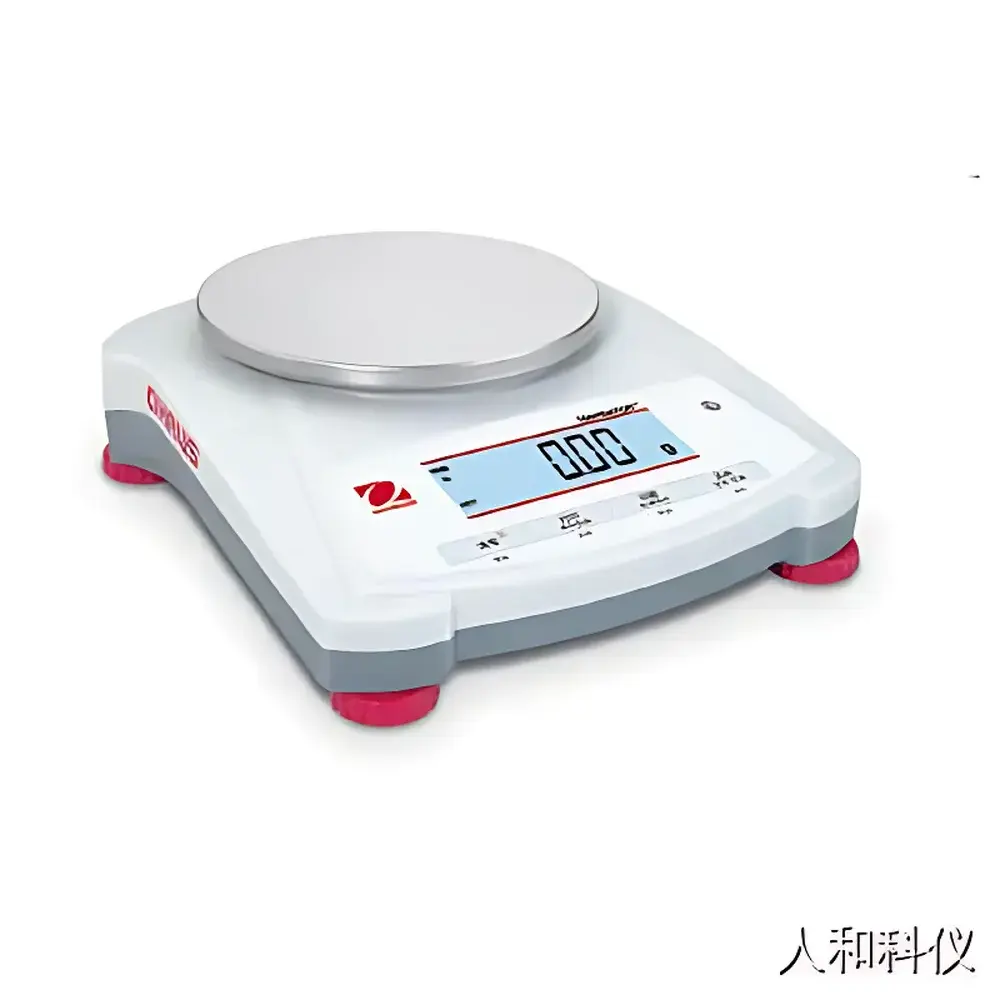
OHAUS Navigator Portable Precision Balance
| Brand | OHAUS |
|---|---|
| Origin | USA |
| Model | NAVIGATOR |
| Instrument Type | Precision Balance |
| Maximum Capacity | 620 g |
| Readability | 0.01 g |
| Repeatability | 0.01 g |
| Calibration | Internal |
| Overload Protection | Up to 400% of maximum capacity |
| Stabilization Time | As fast as 1 second |
| Construction | High-strength ABS housing with SUS 304 stainless steel pan |
| Power | AC adapter (included) or 4 × AA batteries (270-hour battery life) |
| Operating Environment | 10–40 °C, 10–85% RH (non-condensing) |
| Communication Options | Optional RS232, USB, or Ethernet interface |
| Display | Backlit LCD with 20 mm digit height |
| Dimensions (W×D×H) | 204 × 230 × 70 mm |
| Net Weight | 1.0 kg |
Overview
The OHAUS Navigator Portable Precision Balance is an engineered solution for routine weighing tasks requiring high repeatability, rapid stabilization, and robust field or lab deployment. Built upon a proven electromagnetic force restoration (EMFR) sensing architecture, the Navigator delivers consistent performance across diverse environments—from quality control labs and educational institutions to production floors and field service operations. Its core design prioritizes mechanical resilience without compromising metrological integrity: the integrated 400% overload protection system safeguards the load cell against accidental overloading, while the internal transport lock secures the sensor during shipment and relocation. With readability down to 0.01 g and capacities spanning 220 g to 22,000 g across multiple configurations, the Navigator series serves as a scalable platform for general-purpose precision weighing under ISO/IEC 17025-aligned workflows.
Key Features
- Electromagnetic force restoration (EMFR) sensor technology ensures long-term stability and minimal drift across temperature fluctuations.
- Internal overload protection rated to 400% of maximum capacity—enabling safe handling in dynamic industrial settings.
- Stabilization time as fast as 1 second for 0.01 g models, reducing throughput bottlenecks in high-volume QC processes.
- Dual power operation: includes universal AC adapter; optional 4 × AA battery configuration supports >270 hours of continuous use.
- High-contrast backlit LCD display with 20 mm digits ensures legibility in low-light or ambient-variable environments.
- Full-range tare functionality and multi-unit support (g, kg) simplify unit conversion without recalibration.
- IP54-rated enclosure (per IEC 60529) provides resistance to dust ingress and incidental water splashes during daily operation.
Sample Compatibility & Compliance
The Navigator accommodates a broad spectrum of sample types—including powders, granules, solids, and packaged goods—via its corrosion-resistant SUS 304 stainless steel pan (145 mm or 230 × 174 mm variants). Its modular design supports integration into regulated environments compliant with GLP and GMP frameworks. While not inherently 21 CFR Part 11–compliant, the optional RS232/USB/Ethernet interfaces enable traceable data export to validated LIMS or ELN systems when paired with audit-trail-enabled software. The balance meets international metrological standards including OIML R76-1 (Class II) and ASTM E898–22 for laboratory balances, supporting calibration verification per ISO/IEC 17025 requirements using certified test weights.
Software & Data Management
Data capture is facilitated through optional communication modules (RS232, USB, or Ethernet), enabling seamless transfer to PCs, printers, or networked databases. When connected via USB or RS232, the Navigator transmits real-time weight values in ASCII format—compatible with Microsoft Excel, LabArchives, and custom SCADA integrations. Firmware updates are performed via USB flash drive, ensuring maintainability without third-party service intervention. Though the device does not feature onboard data logging, its deterministic output protocol supports timestamp-synchronized acquisition when interfaced with external acquisition software meeting FDA 21 CFR Part 11 electronic record requirements.
Applications
- Quality assurance laboratories performing raw material verification, in-process checks, and finished product release testing.
- Educational institutions conducting analytical chemistry, pharmacology, and materials science experiments requiring repeatable mass measurement.
- Manufacturing facilities executing piece-counting, formulation batching, and checkweighing operations.
- Field service technicians performing on-site calibration verification, equipment commissioning, and maintenance reporting.
- Pharmaceutical packaging lines implementing weight-based rejection logic for blister packs and vials.
FAQ
Does the Navigator require external calibration weights for routine operation?
No—the Navigator features internal calibration capability, eliminating dependency on external weights for daily verification. However, periodic external calibration using traceable Class M2 or better weights is recommended per ISO/IEC 17025 and internal QA protocols.
Can the Navigator be used in environments with significant vibration or air currents?
Yes—its adaptive filtering algorithm and mechanical damping reduce sensitivity to environmental disturbances. For optimal performance, place on a stable, non-resonant surface away from HVAC vents and heavy machinery.
Is the Navigator compatible with Windows, macOS, and Linux operating systems?
Yes—when connected via USB virtual COM port or RS232, it functions as a standard serial device. No proprietary drivers are required; terminal emulation software (e.g., PuTTY, Tera Term) or custom Python/Node.js scripts can parse ASCII output.
What is the warranty coverage for the Navigator series?
OHAUS provides a 2-year limited warranty covering parts and labor for defects in materials and workmanship, excluding consumables and damage from misuse or unauthorized modification.
How is traceability maintained during calibration?
Each Navigator ships with a factory calibration certificate referencing NIST-traceable standards. Users may generate internal calibration records documenting date, operator, reference weights used, and deviation results—supporting audit readiness under ISO 9001 and ISO/IEC 17025.