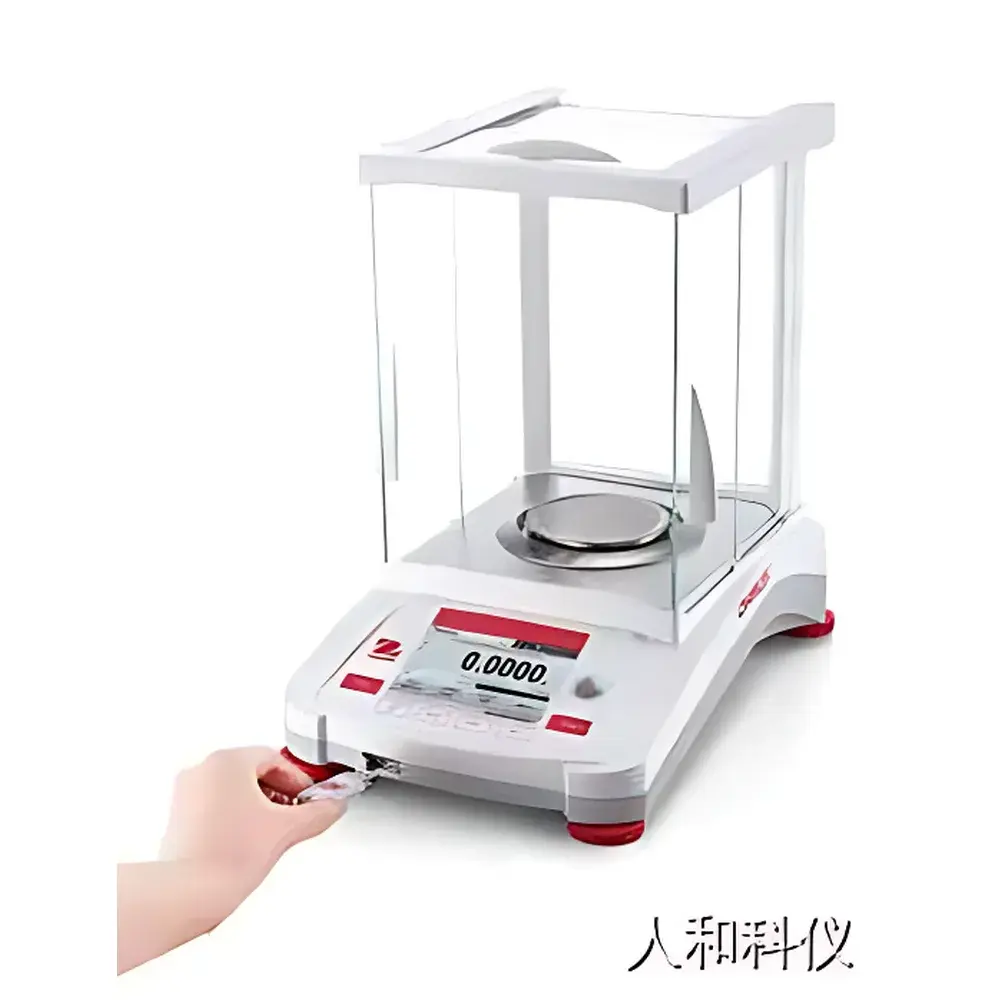
OHAUS Pioneer PX Series Precision Analytical Balance
| Brand | OHAUS |
|---|---|
| Origin | USA |
| Model | Pioneer PX |
| Instrument Type | Precision Balance |
| Maximum Capacity | 120 g |
| Readability | 0.1 mg |
| Repeatability | 0.1 mg |
| Linearity Error | ±0.0001 g |
| Stabilization Time | 2 s |
| Typical Minimum Weight (USP <em>K</em>=2, <em>U</em>=0.10%) | 20 mg |
| Operating Temperature Range | 10–30 °C (5–40 °C operational) |
| Humidity Range | ≤80% RH at ≤30 °C, linearly decreasing to 50% RH at 40 °C |
| Pan Size | Ø120 mm |
| Power Supply | 12 VDC 0.5 A adapter (100–240 VAC, 50–60 Hz) |
| Dimensions (W × D × H) | 209 × 321 × 339 mm |
| Net Weight | 4.5 kg |
| Communication Interfaces | RS232, USB |
Overview
The OHAUS Pioneer PX Series Precision Analytical Balance is an engineered solution for laboratories requiring high-resolution mass measurement with robust repeatability and regulatory-ready functionality. Designed and manufactured in the United States, this analytical balance operates on electromagnetic force compensation (EMFC) principle—ensuring stable, drift-resistant performance across variable ambient conditions. With a maximum capacity of 120 g and readability down to 0.1 mg (100 µg), it meets the technical requirements for quantitative analysis in pharmaceutical QC, academic research, materials science, and industrial quality assurance workflows. Its internal calibration system—activated via front-panel key or scheduled auto-calibration—maintains traceable accuracy without external weights, supporting compliance with ISO/IEC 17025, USP General Chapter 41, and FDA 21 CFR Part 11 when integrated into validated software environments.
Key Features
- Electromagnetic force compensation (EMFC) sensor architecture delivering high reproducibility (SD ≤ 0.1 mg) and low temperature coefficient (±3 ppm/K).
- Internal calibration mechanism with automatic temperature-triggered recalibration and user-initiated verification—fully documented in audit trail logs.
- Dual-line graphical LCD display: top line shows real-time mass value; bottom line provides contextual operation prompts—including multilingual interface support (English, Spanish, French, German, Chinese) without requiring reference manuals.
- Integrated electrostatic discharge (ESD) control bar positioned above the weighing chamber, actively neutralizing surface charges on samples and containers to prevent measurement drift from static interference.
- Visual capacity indicator (“weight bar”) dynamically displays loading progress relative to full scale—enhancing operator awareness during incremental additions.
- Full-range tare function with zero-tracking capability and automatic zero stabilization upon pan stabilization.
- Aluminum die-cast base and stainless-steel weighing pan ensure mechanical rigidity, corrosion resistance, and long-term stability under routine laboratory use.
Sample Compatibility & Compliance
The Pioneer PX accommodates diverse sample forms—including powders, granules, liquids in tared vessels, and small solid components—within its Ø120 mm stainless-steel pan. Its draft shield (sold separately as optional accessory) enables stable operation in non-laminar airflow environments. The balance conforms to international metrological standards including OIML R 76-1 (Class I), EN 45501, and ANSI/NCSL Z540-1. For regulated industries, it supports GLP/GMP documentation requirements through configurable data export protocols and time-stamped event logging (e.g., calibration events, overload detection, door open/close). When paired with OHAUS Logger Pro™ or third-party LIMS-compatible software, full 21 CFR Part 11 compliance—including electronic signatures, audit trails, and role-based access control—is achievable.
Software & Data Management
Equipped with native RS232 and USB-B interfaces, the Pioneer PX enables direct connection to PCs, printers, or laboratory networks without additional hardware. ASCII-compatible output format ensures seamless integration with Excel, LabArchives, Empower, or custom Python/MATLAB scripts. Optional OHAUS AutoPrint™ software allows automated report generation—including date/time stamps, operator ID, gross/net/tare values, and statistical summaries (mean, SD, CV%). All communications are timestamped and logged locally on the balance’s non-volatile memory for up to 1,000 entries—supporting retrospective review during internal audits or regulatory inspections.
Applications
- Pharmaceutical formulation: active pharmaceutical ingredient (API) dispensing, excipient ratio verification, and content uniformity testing per USP Chapter 905.
- Academic teaching labs: stoichiometric calculations, gravimetric analysis, and calibration of volumetric glassware.
- Materials characterization: density determination (with auxiliary kit), moisture content estimation (via loss-on-drying protocols), and particulate mass distribution profiling.
- Quality control in electronics manufacturing: precise weighing of solder paste, conductive inks, and micro-components prior to SMT placement.
- Environmental testing labs: filter weighing for PM2.5/PM10 analysis and gravimetric quantification of extractables from polymer matrices.
FAQ
What calibration standards does the Pioneer PX support?
It supports internal calibration using built-in reference masses traceable to NIST. External calibration with certified weights (Class E2 or better) is also supported via the external calibration mode—required for ISO/IEC 17025 accredited calibrations.
Is the balance compliant with USP General Chapter 41?
Yes—the repeatability (≤0.1 mg), linearity (±0.0001 g), and minimum weight (20 mg at U = 0.10%, K = 2) meet USP Chapter 41 criteria for analytical balances used in pharmaceutical applications.
Can the Pioneer PX be integrated into a networked LIMS environment?
Yes—via USB-to-Ethernet adapters or RS232-to-TCP/IP gateways, it supports standard SCPI command sets and can transmit data directly to LIMS platforms with proper middleware configuration.
Does the balance offer overload protection?
Yes—mechanical and electronic overload safeguards activate at 150% of maximum capacity (180 g), preventing sensor damage and triggering audible/visual alerts.
What is the recommended warm-up time before first use?
A minimum of 30 minutes is advised after power-on to achieve thermal equilibrium of the EMFC sensor and internal reference system—critical for achieving specified repeatability and linearity.