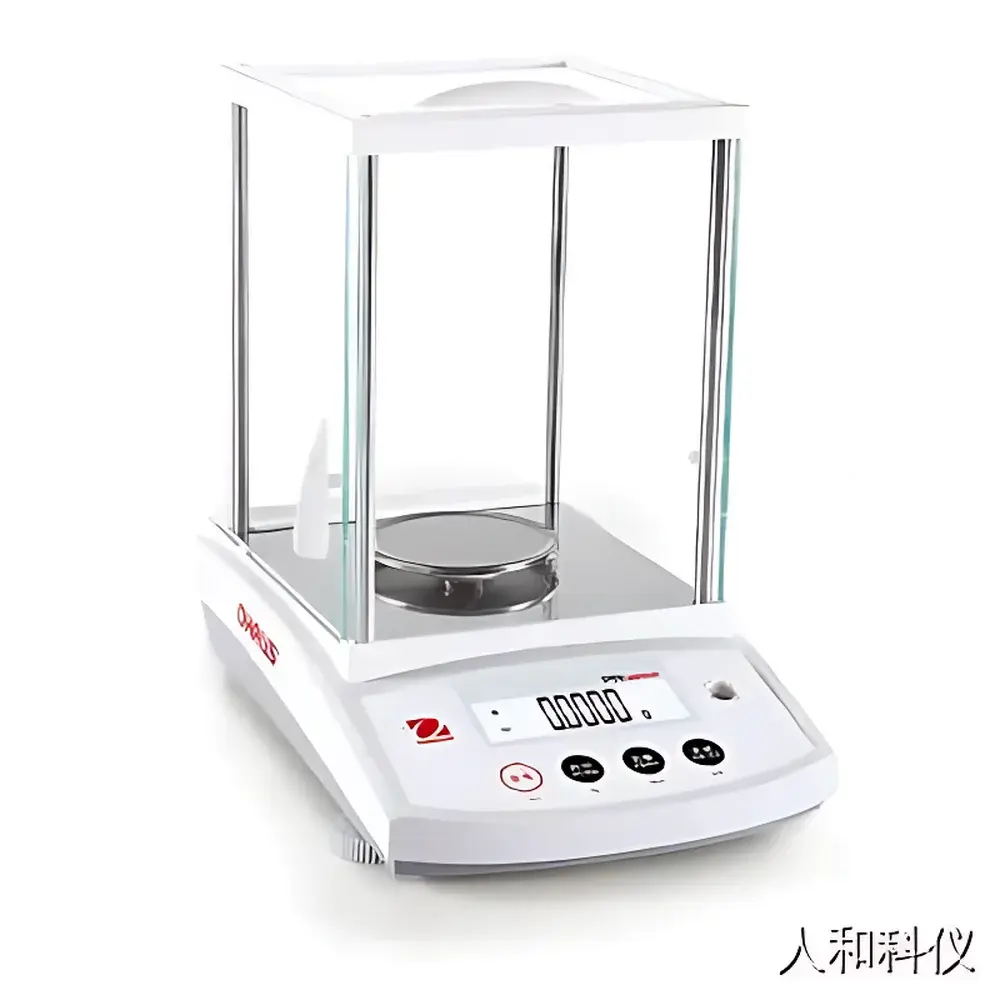
OHAUS PR Series PR Precision Analytical Balance
| Brand | OHAUS |
|---|---|
| Origin | USA |
| Model | PR Series PR |
| Instrument Type | Analytical Balance |
| Maximum Capacity | 120 g |
| Readability | 0.1 mg |
| Repeatability | 0.1 mg |
| Linearity Error | ±0.2 mg |
| Internal Calibration | Yes |
| Stabilization Time | 3 s |
| Operating Temperature Range | 10–30 °C |
| Operating Humidity Range | ≤80% RH at ≤30 °C, linearly decreasing to 50% RH at 40 °C |
| Pan Size | Ø90 mm |
| Dimensions (W × D × H) | 201 × 317 × 333 mm |
| Net Weight | 4.5 kg |
| Power Input | 100–240 V AC, 50–60 Hz, 12–18 VA |
| Output | 12 V DC, 0.5 A |
| Interface | RS232 |
Overview
The OHAUS PR Series PR Precision Analytical Balance is an entry-level analytical balance engineered for consistent, traceable mass measurement in regulated and non-regulated laboratory environments. Based on electromagnetic force restoration (EMFR) transduction technology, it delivers high reproducibility and long-term stability under routine use conditions. Designed for compliance with fundamental metrological requirements, the PR Series supports Good Laboratory Practice (GLP) workflows through built-in internal calibration, real-time environmental monitoring (temperature and time-stamped stabilization), and audit-ready data output via RS232. Its 0.1 mg readability and ±0.2 mg linearity error meet the performance thresholds required for USP general chapter applications involving minimum weight verification (e.g., typical minimum sample weight = 200 mg at K=2, U=0.10%), making it suitable for quality control testing, reagent preparation, and educational quantitative analysis.
Key Features
- Electromagnetic force restoration (EMFR) sensor architecture ensures high sensitivity, low drift, and mechanical robustness across daily operation cycles.
- Internal calibration system with automatic temperature-triggered recalibration maintains measurement integrity without external weights or operator intervention.
- Backlit LCD display (128 × 64 pixels) provides clear visibility of mass values, units, status icons, and mode indicators—even under variable ambient lighting.
- Three standard weighing modes: Standard (gross/net/tare), Piece Counting (with user-defined reference piece weight), and Percentage Weighing (relative to a stored reference mass).
- Full-range tare function enables rapid zeroing across the entire capacity span, supporting multi-step formulation protocols.
- Stainless steel weighing pan (Ø90 mm) and reinforced ABS housing provide chemical resistance and mechanical durability in shared lab environments.
- RS232 serial interface enables direct connection to PCs, printers, or LIMS systems for automated data logging—compatible with ASCII-based command protocols for integration into custom software environments.
Sample Compatibility & Compliance
The PR Series accommodates solid, granular, and powdered samples within its 120 g capacity and 90 mm pan diameter. Its compact footprint and vertical design minimize bench space usage while maintaining ergonomic access. The balance complies with international metrological standards including OIML R76-1 (Class I), and meets essential criteria for ISO/IEC 17025 accredited laboratories when used within specified environmental limits (10–30 °C, ≤80% RH at ≤30 °C). While not pre-certified for FDA 21 CFR Part 11, its RS232 output supports validated third-party data capture systems with full audit trail functionality. Temperature coefficient of ±3 ppm/K ensures minimal thermal influence during short-duration measurements typical of QC release testing.
Software & Data Management
Data export is performed via ASCII-formatted RS232 transmission using standard OHAUS protocol (e.g., “S” command for stable weight output). Each transmitted record includes timestamp (if enabled via connected PC), unit identifier, and stability flag (“S” = stable, “U” = unstable). No onboard memory or USB interface is included; however, the balance supports seamless integration with OHAUS Logger Pro™ (v3.x+) and third-party tools such as LabX Lite, Excel-based macros, or Python-driven serial loggers. All outputs are human-readable and machine-parsable, facilitating alignment with GLP documentation requirements—including raw data retention, reviewer sign-off, and version-controlled SOP execution.
Applications
- Pharmaceutical QC: Weighing active pharmaceutical ingredients (APIs) and excipients for tablet formulation, dissolution testing, and assay validation per USP .
- Academic Teaching Labs: Introducing students to precision mass measurement principles, uncertainty estimation, and statistical process control (SPC) fundamentals.
- Materials Science: Quantifying catalyst loadings, polymer additives, and nanomaterial dispersions where sub-milligram resolution is critical.
- Food & Beverage Testing: Preparing standard solutions for titration, moisture content determination, and nutritional labeling compliance.
- Environmental Labs: Weighing filter papers pre- and post-gravimetric analysis for total suspended solids (TSS) and particulate matter (PM) assays.
FAQ
Does the PR Series support external calibration?
No—the PR Series models described here are internal calibration only (designated by “ZH” suffix). External calibration-capable variants (e.g., PR124ZH/E) require manual application of certified weights and are listed separately in the product matrix.
Is the RS232 interface compatible with modern Windows/macOS systems?
Yes—when paired with a USB-to-RS232 adapter (e.g., FTDI-based), the interface functions reliably with terminal emulators (PuTTY, Tera Term) and scripting environments (Python pySerial, MATLAB Serial Port Toolbox).
What is the recommended warm-up time before first use?
A minimum 30-minute stabilization period is advised after power-on to allow internal thermal equilibrium, particularly in environments with fluctuating ambient temperatures.
Can this balance be used for dynamic weighing (e.g., filling or dosing operations)?
It is not optimized for continuous dynamic operation. The 3-second stabilization time and lack of vibration compensation make it best suited for static, single-point measurements rather than real-time mass flow monitoring.
How is traceability maintained during internal calibration?
Internal calibration uses a factory-characterized reference mass traceable to NIST standards. Calibration events are logged internally with date/time stamps (when connected to a host system), supporting ISO/IEC 17025 clause 6.5.2 requirements for equipment verification records.