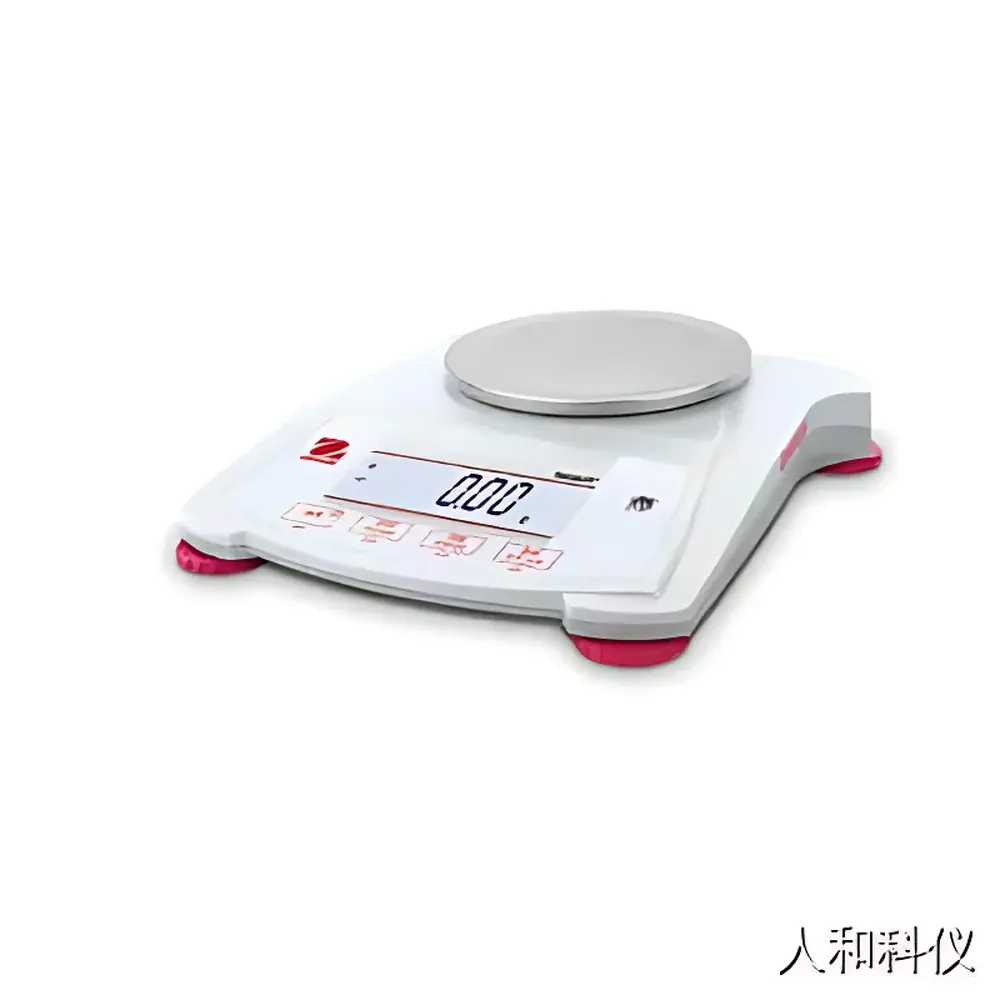
OHAUS SCOUT SPX Portable Precision Balance
| Brand | OHAUS |
|---|---|
| Origin | USA |
| Model | SCOUT SPX |
| Instrument Type | Precision Balance |
| Maximum Capacity | 220 g |
| Readability | 1 mg |
| Repeatability | 1 mg |
| Overload Protection | 10× full scale |
| Stabilization Time | 1 s |
| Weighing Pan | Stainless Steel (120 mm diameter) |
| Housing Material | High-Strength ABS Plastic |
| Operating Temperature | 10–40 °C |
| Relative Humidity | 10–80% RH (non-condensing) |
| Power Supply | AC adapter (included) or 4 × AA batteries (optional) |
| Interface Options | RS232, USB Host/Device, Ethernet (optional) |
| Display | Backlit LCD (20 mm character height) |
| Dimensions (W×H×D) | 202 × 54 × 224 mm |
| Net Weight | 1.0 kg |
Overview
The OHAUS SCOUT SPX Portable Precision Balance is an engineered solution for demanding laboratory, quality control, and light industrial weighing applications where accuracy, speed, and rugged portability are critical. Based on electromagnetic force restoration (EMFR) transduction technology, the SCOUT SPX delivers high reproducibility and long-term stability under variable environmental conditions. Its 1 mg readability and sub-second stabilization time—achieved through adaptive filtering and optimized damping algorithms—support rapid throughput in routine analytical workflows, including formulation, sample preparation, and in-process checks. Designed for global deployment, the balance complies with international metrological requirements for Class II precision balances per OIML R 76-1 and meets essential performance criteria outlined in ISO/IEC 17025 for accredited testing laboratories.
Key Features
- 1-second stabilization time across all capacities, enabling high-throughput operations without compromising measurement integrity.
- Internal calibration system with automatic temperature-triggered recalibration, reducing manual intervention and ensuring traceable accuracy over time.
- 10× overload protection and impact-resistant stainless-steel weighing pan (120 mm Ø), validated for durability in non-laboratory environments such as production floors and field service labs.
- Backlit LCD display with 20 mm character height for legibility under low ambient light or at extended viewing distances—critical for shared workspaces and glove-compatible operation.
- Four tactile mechanical keys for intuitive navigation of menus, unit switching (g, kg, ct, oz, etc.), tare, and application mode selection—designed to minimize operator error and training overhead.
- Stackable form factor (202 × 54 × 224 mm) with optional stacking cover, optimizing benchtop footprint in space-constrained settings such as mobile labs or modular QC stations.
- Multi-interface connectivity (RS232, USB Host/Device, Ethernet) supports integration into LIMS, MES, and electronic lab notebook (ELN) systems with configurable data output formats (e.g., ASCII, CSV).
Sample Compatibility & Compliance
The SCOUT SPX accommodates a broad range of sample types—from powders and granules to small components and pre-weighed vials—within its 220 g capacity and 120 mm pan diameter. Its absence of draft shield makes it unsuitable for microgram-level measurements but ideal for applications requiring rapid gross or net weight acquisition in controlled or semi-controlled environments. The balance conforms to key regulatory expectations for documented weighing processes: internal calibration logs are timestamped and stored in non-volatile memory; optional audit trail functionality (via OHAUS SmartLink software) satisfies FDA 21 CFR Part 11 requirements for electronic records and signatures. It also supports GLP/GMP-aligned workflows through user-accessible calibration history, password-protected configuration locks, and customizable print/export templates compliant with ISO 17025 clause 7.8.3.
Software & Data Management
OHAUS SmartLink software provides bidirectional communication for configuration, real-time data streaming, and automated report generation. Users can define custom weighing protocols—including pass/fail thresholds for checkweighing, batch-specific tare sequences, and statistical summaries for count mode—and export results directly to Excel or PDF. All data transmissions are timestamped, user-attributed, and optionally encrypted. When connected via Ethernet, the SCOUT SPX supports remote firmware updates and centralized device management through enterprise-grade network administration tools. Raw data output adheres to ASTM E1967-21 formatting standards for interoperability with third-party analytics platforms.
Applications
- Pharmaceutical: Raw material receipt inspection, tablet/capsule counting, excipient dispensing, and USP compounding support.
- Academic Research: General-purpose mass determination in chemistry, materials science, and biology teaching labs.
- Food & Beverage: Portion control verification, ingredient batching, and HACCP-mandated process checks.
- Manufacturing QA: Component verification, solder paste dispensing validation, and SMT line setup checks.
- Environmental Testing: Filter paper weighing pre/post-extraction in gravimetric particulate analysis (per EPA Method 201A).
FAQ
What calibration standards are required for routine verification?
A 200 g Class M2 weight is recommended for daily verification per ISO 9001 Annex B and USP Chapter <41>. Linearity verification requires two weights (e.g., 100 g + 200 g) per OIML R 76-1 Annex C.
Is the SCOUT SPX suitable for use in regulated GxP environments?
Yes—when configured with SmartLink audit trail, password protection, and electronic signature modules, it meets baseline requirements for ALCOA+ data integrity principles and supports 21 CFR Part 11 compliance when deployed with validated IT infrastructure.
Can the balance operate on battery power during transport?
Yes—four AA alkaline batteries provide up to 7 hours of continuous operation, with low-battery warning and auto-shutdown to preserve calibration stability.
Does the SCOUT SPX support dynamic weighing or motion compensation?
No—it is designed for static, stable-load weighing only. Vibration isolation is recommended if used near centrifuges, HVAC units, or heavy machinery.
How is repeatability verified during installation qualification (IQ)?
Repeatability testing must be performed using ≥10 consecutive weighings of a single test weight (preferably 50–100% of max capacity) under identical environmental conditions; standard deviation must not exceed the published 1 mg specification.