
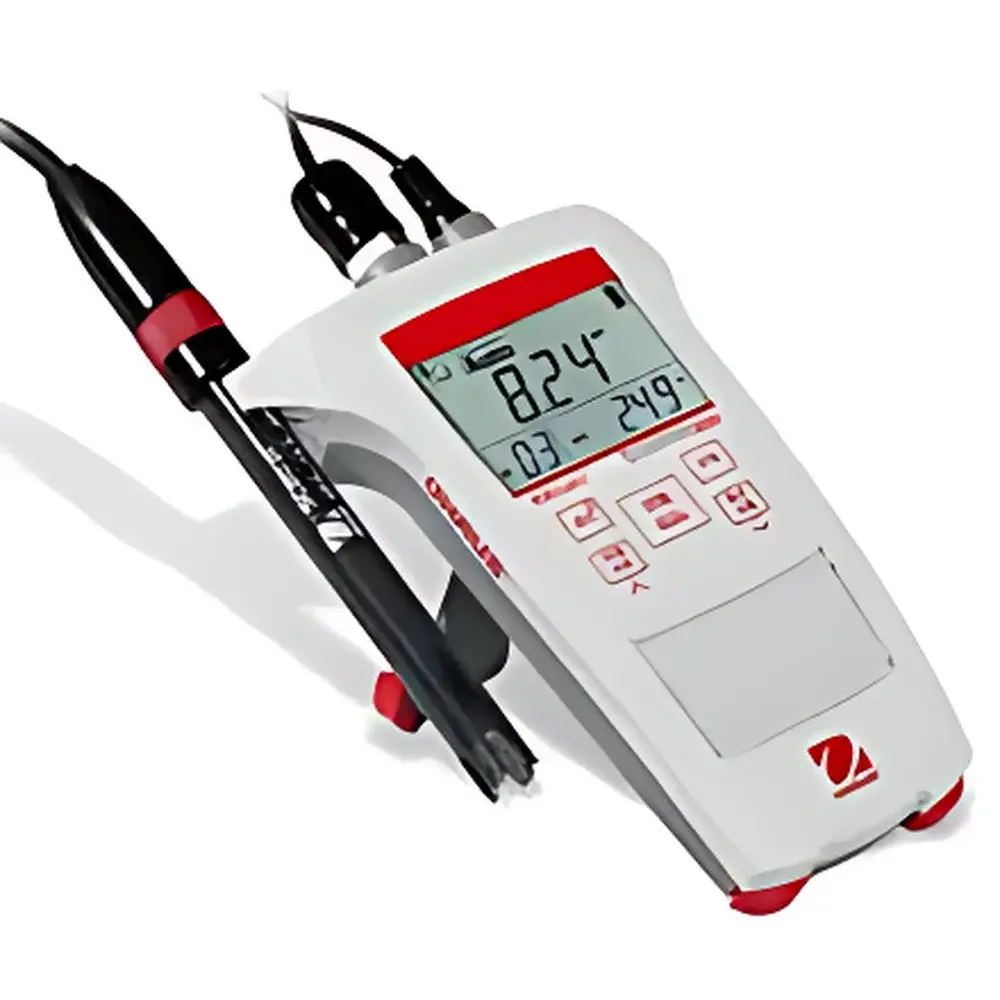
OHAUS Starter 300 Portable pH Meter
| Brand | OHAUS |
|---|---|
| Origin | USA |
| Model | Starter 300 |
| pH Range | 0.00–14.00 |
| mV Range | −1999 to +1999 mV |
| Temperature Range | 0.0–100.0 °C |
| Resolution | 0.01 pH / 1 mV / 0.1 °C |
| Accuracy | ±0.01 pH / ±1 mV / ±0.5 °C |
| Calibration | Up to 3-point with user-defined buffer sets |
| Temperature Compensation | Automatic or manual (NTC 3 kΩ) |
| Input Impedance | >5 × 10¹² Ω |
| IP Rating | IP54 |
| Display | Backlit LCD |
| Power | 9 V DC adapter (AC 220 V/50 Hz input) |
| Dimensions | 160 × 200 × 65 mm |
| Weight | 0.65 kg |
| Housing Material | ABS |
Overview
The OHAUS Starter 300 Portable pH Meter is a rugged, field-deployable electrochemical instrument engineered for reliable pH and redox potential (mV) measurements in non-laboratory environments. Built upon a conventional potentiometric measurement principle—where the potential difference between a pH-sensitive glass electrode and a stable reference electrode is converted into a pH value via the Nernst equation—the Starter 300 delivers traceable, repeatable results across diverse sample matrices. Its compact form factor, IP54-rated enclosure, and integrated ergonomic features make it suitable for routine quality control in food processing lines, environmental field sampling, educational laboratory instruction, and industrial process monitoring where mobility and operational simplicity are critical. The device complies with fundamental metrological requirements for Class 0.01 pH instruments per IEC 60746-1 and supports traceable calibration practices aligned with ISO/IEC 17025–accredited workflows.
Key Features
- Intuitive electrode health feedback: Real-time visual indicators (smiley, neutral, and frowning face icons) reflect calibration status and electrode response stability—reducing operator dependency on interpretation of slope and offset values.
- Ergonomic single-hand operation: Textured anti-slip housing surface and balanced weight distribution enable confident handling during extended field use or glove-compatible operation.
- Flexible placement design: Integrated fold-out support feet allow stable upright positioning on workbenches or flat surfaces—or horizontal placement for tabletop measurements without additional stands.
- User-customizable identification: Dedicated label area supports asset tagging, departmental coding, or calibration due-date marking—facilitating equipment tracking under GLP or internal QA protocols.
- Embedded self-diagnostic system: Continuously monitors electrode impedance, signal noise, and temperature sensor integrity; displays context-specific error codes (e.g., “E12: Low Slope”, “E21: Open Circuit”) with actionable guidance.
- Streamlined menu architecture: Hierarchical navigation avoids nested submenus; all primary functions—including calibration, temperature compensation mode selection, and data recall—are accessible within two button presses.
Sample Compatibility & Compliance
The Starter 300 accepts standard BNC-compatible pH electrodes and reference electrodes with high-impedance inputs (>5 × 10¹² Ω), ensuring compatibility with most commercially available combination and refillable electrodes. It supports automatic or manual temperature compensation using integrated NTC 3 kΩ sensors, enabling accurate pH readings across aqueous samples from 0 °C to 100 °C. While not certified for hazardous locations or intrinsically safe operation, its IP54 rating provides protection against limited dust ingress and water splashes from any direction—making it appropriate for controlled outdoor use, production floors, and classroom laboratories. Device firmware and calibration logs meet foundational data integrity expectations for non-regulated environments; for FDA 21 CFR Part 11–governed applications, external audit-trail-enabled software solutions are recommended.
Software & Data Management
The Starter 300 stores the most recent calibration record—including date/time stamp, buffer pH values used, measured mV offsets, and calculated slope (%)—directly in non-volatile memory. No onboard USB or Bluetooth interface is provided; data retrieval is limited to manual transcription or optional third-party serial-to-USB adapters (RS-232 TTL level, not included). Calibration history supports internal verification cycles and satisfies basic record-keeping requirements under ISO 9001 Clause 7.1.5. For laboratories requiring electronic records with audit trails, integration with OHAUS’s optional StarLab™ PC software (via compatible interface cable) enables export of calibration metadata and measurement logs in CSV format—supporting trend analysis and documentation for internal audits.
Applications
- Food & beverage QC: Rapid spot-checking of brine pH in pickling tanks, dairy product acidity verification, and rinse-water monitoring in sanitation validation.
- Environmental fieldwork: On-site pH profiling of surface water, soil leachates, and wastewater effluents prior to lab submission.
- Academic instruction: Undergraduate chemistry and biology labs utilize the Starter 300 for teaching electrode theory, calibration fundamentals, and buffer chemistry principles—its visual feedback system enhances conceptual retention.
- Industrial maintenance: Routine verification of cleaning-in-place (CIP) solution pH, boiler feedwater alkalinity checks, and electroplating bath monitoring.
- Pharmaceutical manufacturing support: Non-GMP auxiliary testing of purified water distribution loop samples during periodic system checks (not for release testing).
FAQ
What calibration buffers are supported by the Starter 300?
The meter allows user-defined 1-, 2-, or 3-point calibration using standard NIST-traceable buffers (e.g., pH 4.01, 7.00, and 10.01 at 25 °C); custom buffer sets can be programmed for non-standard media.
Does the Starter 300 support automatic temperature compensation with all electrode types?
Yes—provided the connected electrode includes an integrated NTC 3 kΩ temperature sensor or a separate temperature probe is attached via the Cinch port.
Can measurement data be exported electronically?
Not natively; the device lacks built-in connectivity. Data export requires an optional RS-232 serial interface and compatible terminal software or StarLab™ PC application.
Is the Starter 300 compliant with ISO/IEC 17025 requirements?
It meets the performance specifications referenced in ISO/IEC 17025 Annex A.3 for pH meters but does not include automated uncertainty calculation or certificate generation—these must be implemented externally by the accredited laboratory.
What is the expected service life of the internal battery backup?
The unit operates solely on external 9 V DC power; no internal rechargeable battery is present. Clock and calibration memory retain settings during brief power interruptions via capacitor-based hold-up circuitry.





