
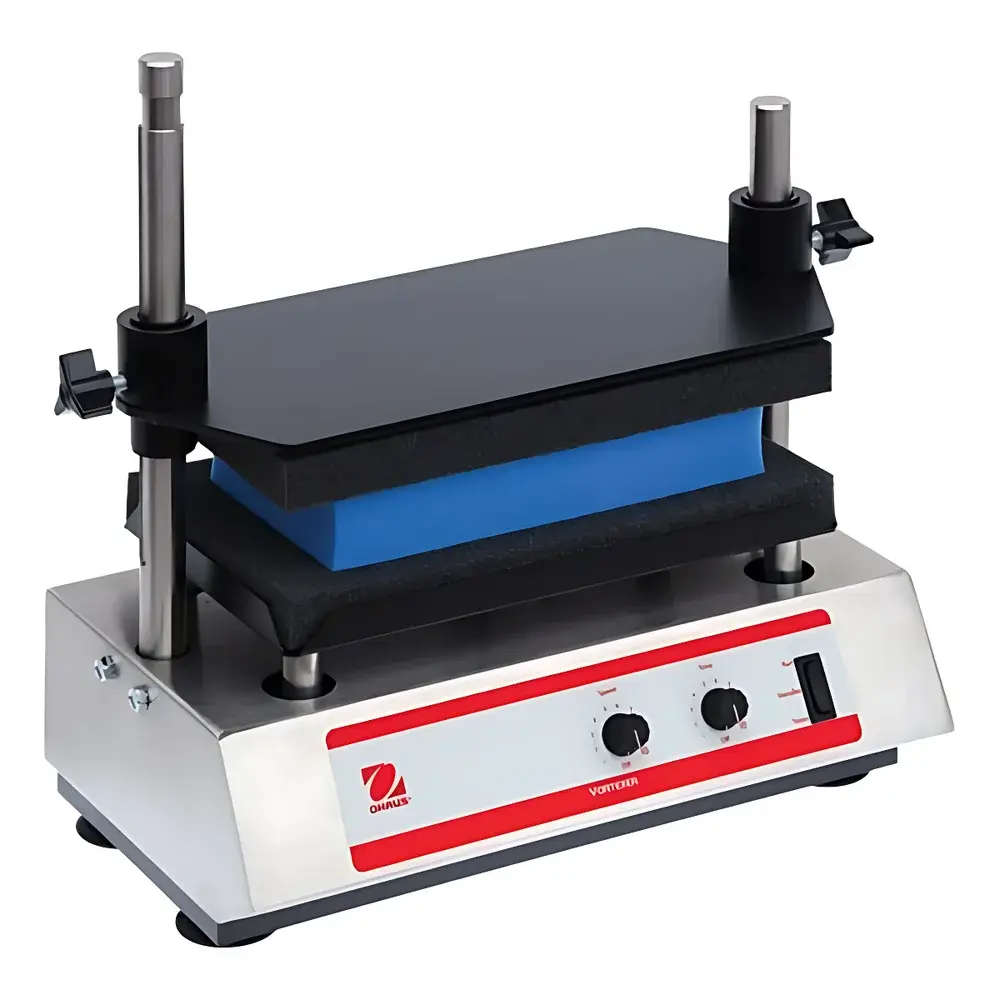
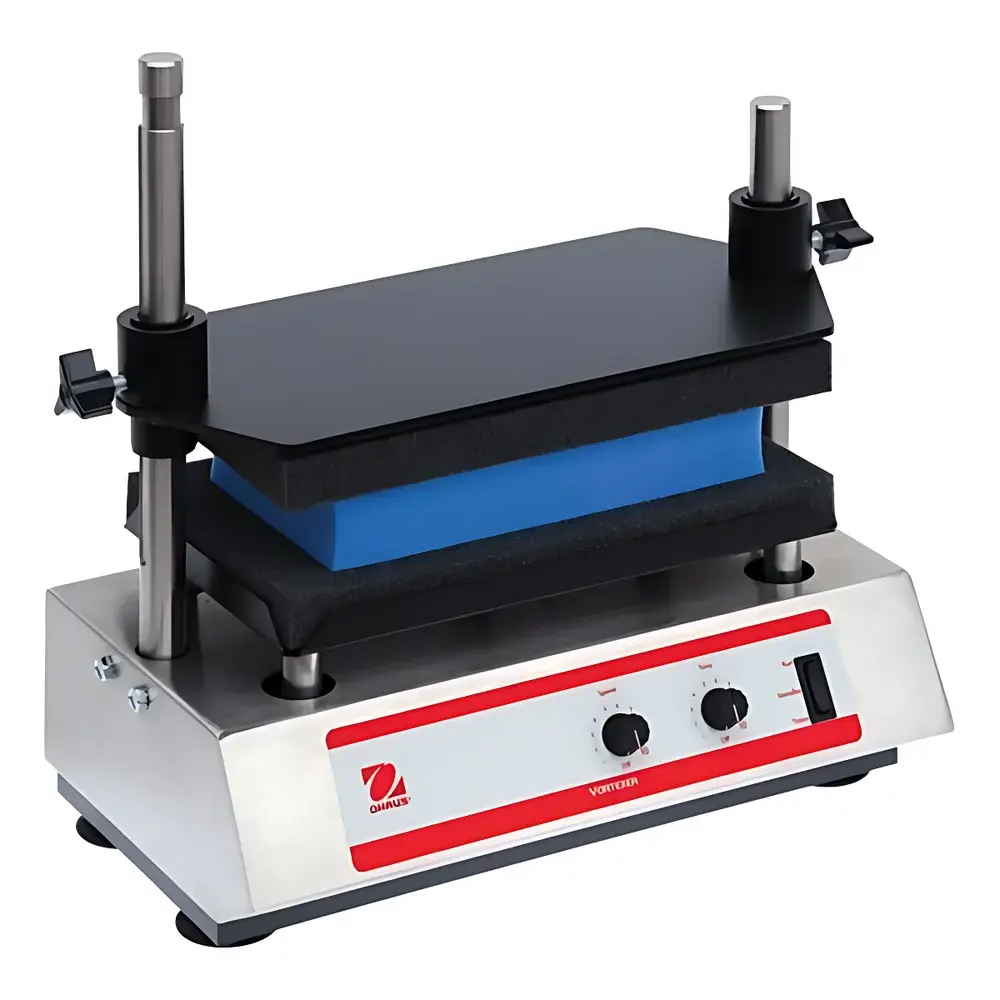
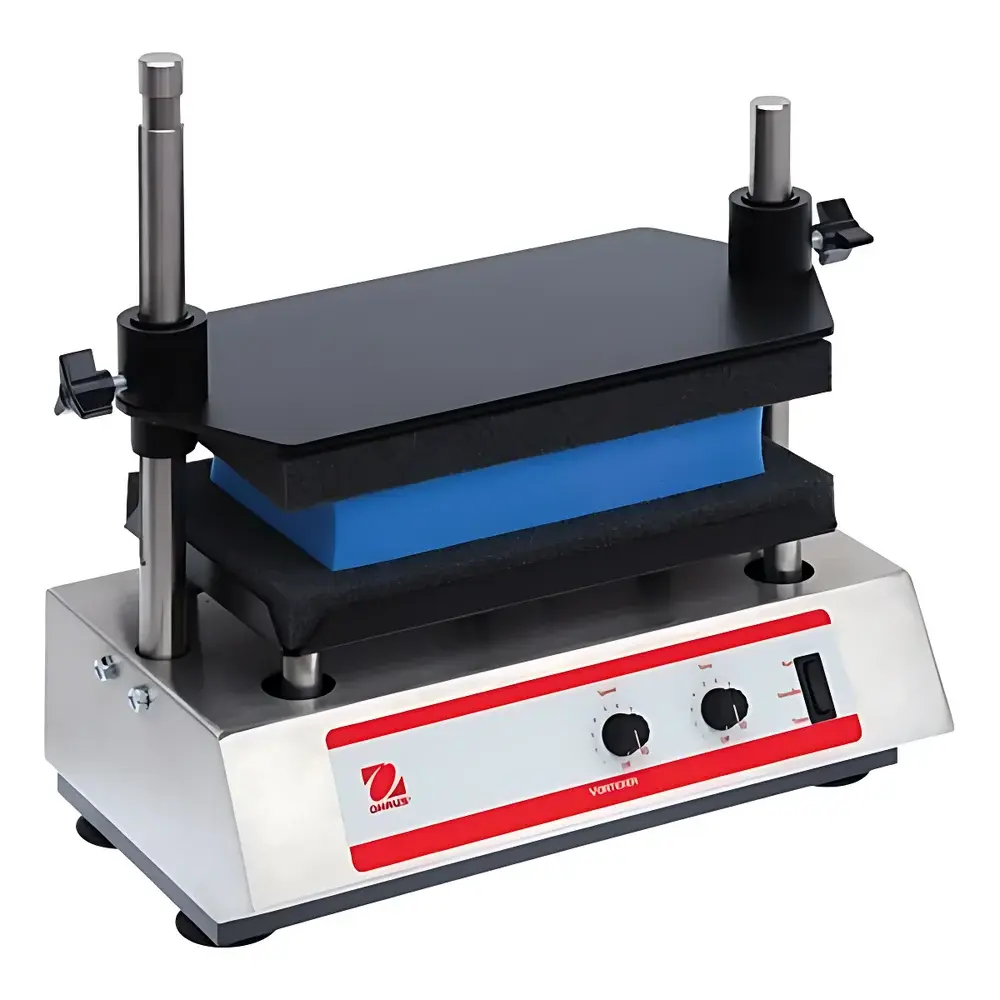
OHAUS VXMTAL Analog-Controlled Multi-Tube Vortex Mixer
| Brand | OHAUS |
|---|---|
| Origin | Shanghai, China |
| Manufacturer Type | Authorized Distributor |
| Product Category | Domestic |
| Model | VXMTAL |
| Pricing | Upon Request |
| Operation Mode | Continuous or Timed (0–60 s) |
| Speed Range | 1200–2400 rpm |
| Oscillation Type | Circular Orbit |
| Amplitude | 3.6 mm |
| Construction Material | Integrated Stainless Steel Base |
| Speed Indication | Analog Dial (1–10 Scale) |
| Operating Ambient Temperature | 4–40 °C |
| Relative Humidity | 20–85% RH (non-condensing) |
| Max Load Capacity | 4.5 kg |
| Tray Dimensions | 18.4 × 31.1 cm |
| Unit Dimensions (W×D×H) | 24.1 × 38.4 × 40.6 cm |
| Shipping Weight | 19.1 kg |
| Sample Tube Compatibility | 10–29 mm diameter (with interchangeable foam inserts) |
Overview
The OHAUS VXMTAL Analog-Controlled Multi-Tube Vortex Mixer is engineered for high-throughput sample homogenization in regulated laboratory environments. It operates on the principle of orbital vortex motion—where sample tubes are secured at the top while the base rotates along a precise 3.6 mm circular path—generating consistent shear forces across multiple vessels simultaneously. Unlike single-tube vortexers, the VXMTAL accommodates up to 50 tubes per run using standardized foam inserts, making it suitable for applications requiring parallel processing without cross-contamination risk. Its integrated stainless steel base provides structural rigidity, chemical resistance, and compliance with cleaning protocols required in GLP- and GMP-aligned workflows. Designed for reliability under continuous operation, the unit meets mechanical stability requirements for ISO/IEC 17025-accredited laboratories conducting routine suspension, lysis, or reagent resuspension tasks.
Key Features
- Stable orbital mixing at 1200–2400 rpm with fixed 3.6 mm amplitude ensures reproducible energy transfer across all tube positions.
- Integrated stainless steel platform minimizes surface porosity, facilitating decontamination between batches and supporting cleanroom-compatible usage.
- Non-slip suction feet prevent lateral displacement during operation—even at maximum speed—reducing vibration transmission to adjacent instrumentation.
- Analog control interface features dual calibrated dials (speed: 1–10 scale; timer: 0–60 s), enabling rapid parameter adjustment without software dependency or calibration drift concerns.
- Modular foam insert system supports tubes from 10 mm to 29 mm in diameter; standard configuration includes 50-position 12 mm insert; six additional insert options available for specialized tube formats.
- Microprocessor-based timing circuitry enables repeatable short-duration pulses (e.g., 5–30 s) or indefinite continuous operation—critical for enzymatic reactions, cell resuspension, or serial dilution workflows.
Sample Compatibility & Compliance
The VXMTAL accepts conical, round-bottom, and flat-bottom tubes within the specified diameter range, including common formats such as 1.5 mL microcentrifuge tubes, 15 mL and 50 mL conical tubes, and PCR strip tubes when used with appropriate adapters. All foam inserts are non-pyrogenic and free of detectable RNase/DNase activity, validated per ISO 13485 manufacturing controls. The device complies with IEC 61010-1:2010 for electrical safety in laboratory equipment and meets EMC requirements per EN 61326-1:2013. While not certified for use in explosion-proof environments, its low-power design (≤30 W) and absence of spark-generating components allow safe deployment in general chemistry and clinical labs operating under CLIA, CAP, or ISO 15189 frameworks.
Software & Data Management
As an analog-controlled instrument, the VXMTAL does not incorporate embedded firmware, network connectivity, or digital data logging. This architecture eliminates cybersecurity risks associated with IoT-enabled devices and ensures long-term operational consistency without firmware updates or driver dependencies. For laboratories subject to FDA 21 CFR Part 11 or EU Annex 11 requirements, manual logbook entries—including operator ID, date/time, speed setting, duration, and batch number—are sufficient for audit trails. Optional external timers or programmable power controllers may be integrated to support SOP-defined sequence execution, though such configurations fall outside OHAUS’s validation scope.
Applications
The VXMTAL serves critical roles in molecular biology (DNA/RNA extraction, library prep, bead-beating adjunct mixing), clinical diagnostics (urine sediment resuspension, immunoassay plate priming), environmental testing (soil extract homogenization, waterborne pathogen recovery), and dental research (cement powder-liquid mixing, biofilm dispersion assays). Its ability to process heterogeneous sample sets—e.g., varying viscosities or densities—within a single run supports QC/QA workflows where inter-sample variability must remain below ±3% CV (coefficient of variation) for turbidity or fluorescence endpoint detection. The unit is routinely deployed in high-volume core facilities performing >200 sample runs per day under documented maintenance schedules aligned with ISO/IEC 17025 clause 6.4.10.
FAQ
Is the VXMTAL suitable for use with volatile organic solvents?
Yes—the stainless steel base and chemically inert foam inserts resist degradation from acetone, ethanol, chloroform, and dilute acids/bases; however, prolonged exposure to strong oxidizers (e.g., concentrated HNO₃) is not recommended.
Can the timer function be disabled for uninterrupted operation?
Yes—rotating the timer dial to the “CONT” position bypasses the countdown circuit, enabling continuous mixing until manually stopped.
What maintenance is required to ensure long-term performance?
Monthly inspection of suction feet adhesion, visual verification of foam insert integrity, and cleaning of the stainless steel surface with 70% isopropanol constitute the full preventive maintenance protocol.
Does OHAUS provide IQ/OQ documentation for this model?
OHAUS supplies factory test reports and mechanical performance verification data; site-specific Installation Qualification (IQ) and Operational Qualification (OQ) protocols must be developed internally or by third-party validation specialists per GAMP 5 guidelines.
Are replacement foam inserts traceable to lot numbers?
Yes—each foam insert package includes a label with manufacturing lot code and expiration date (shelf life: 36 months from production), supporting material traceability per ISO 9001:2015 clause 8.5.2.



