
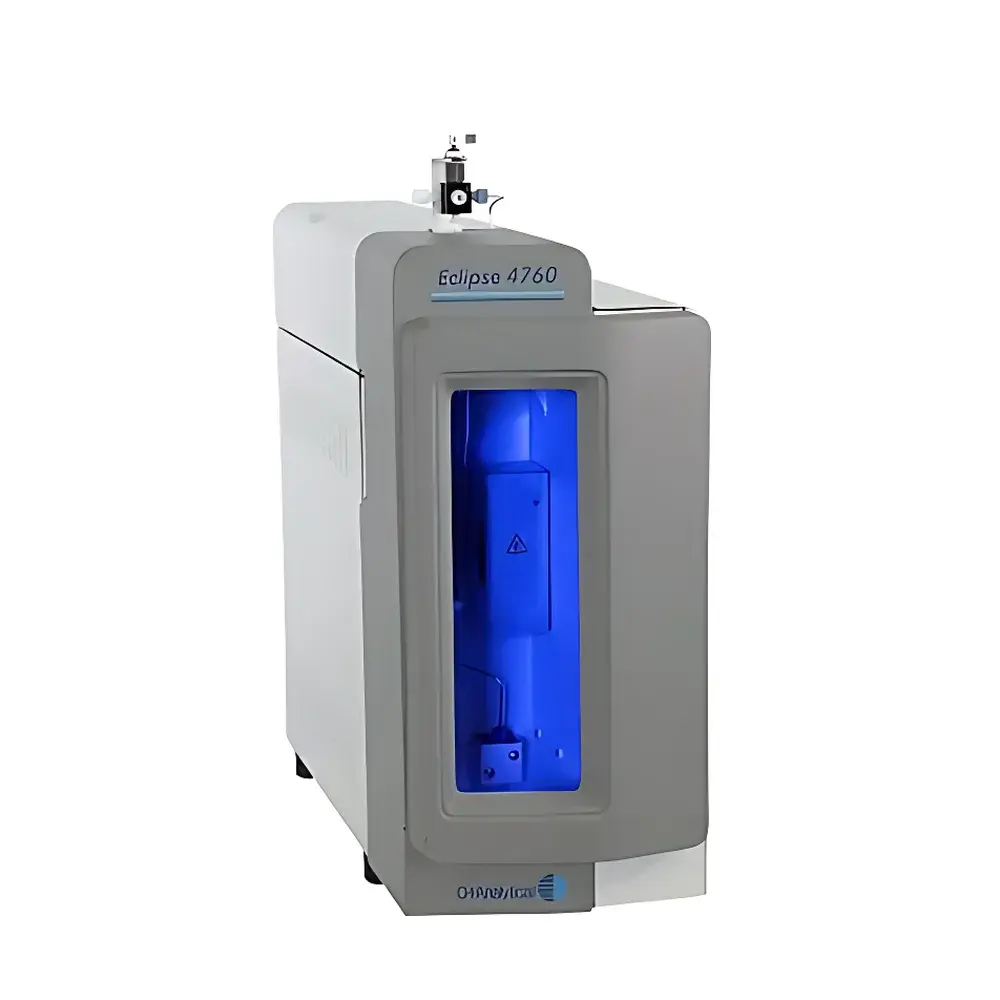
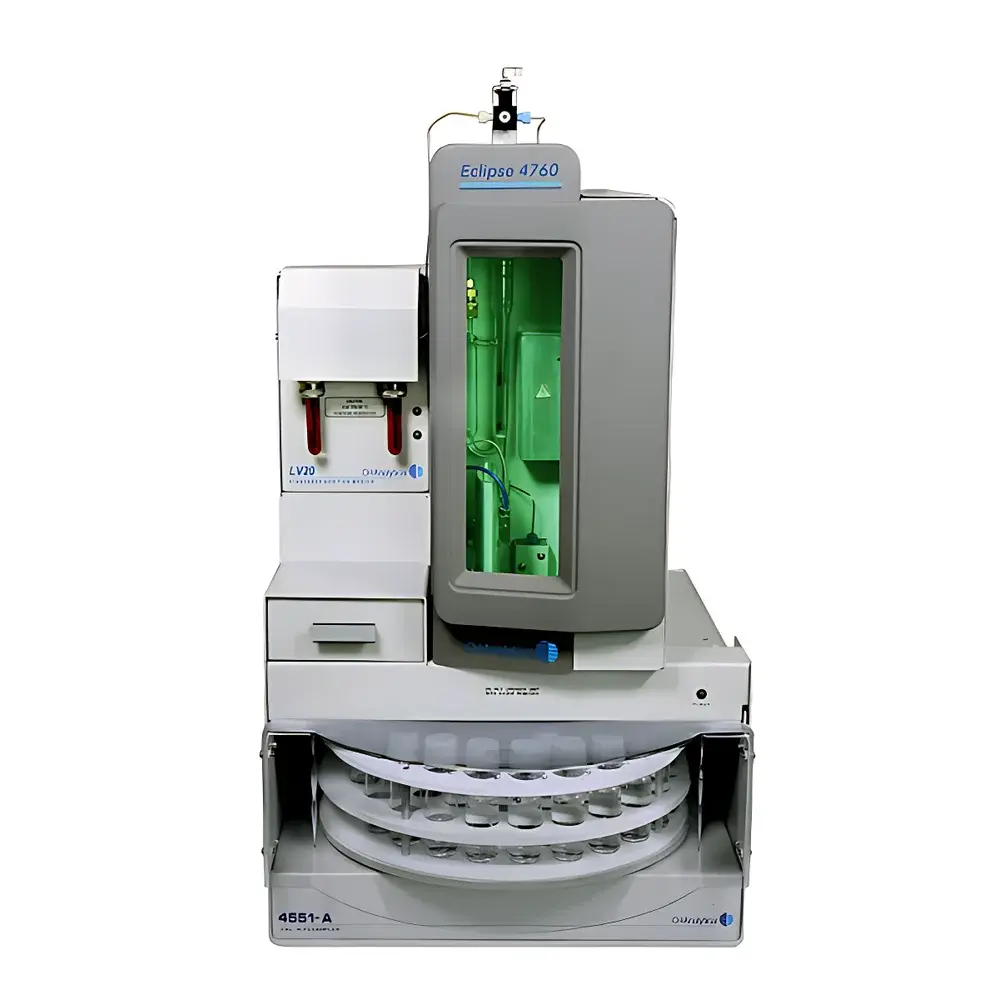
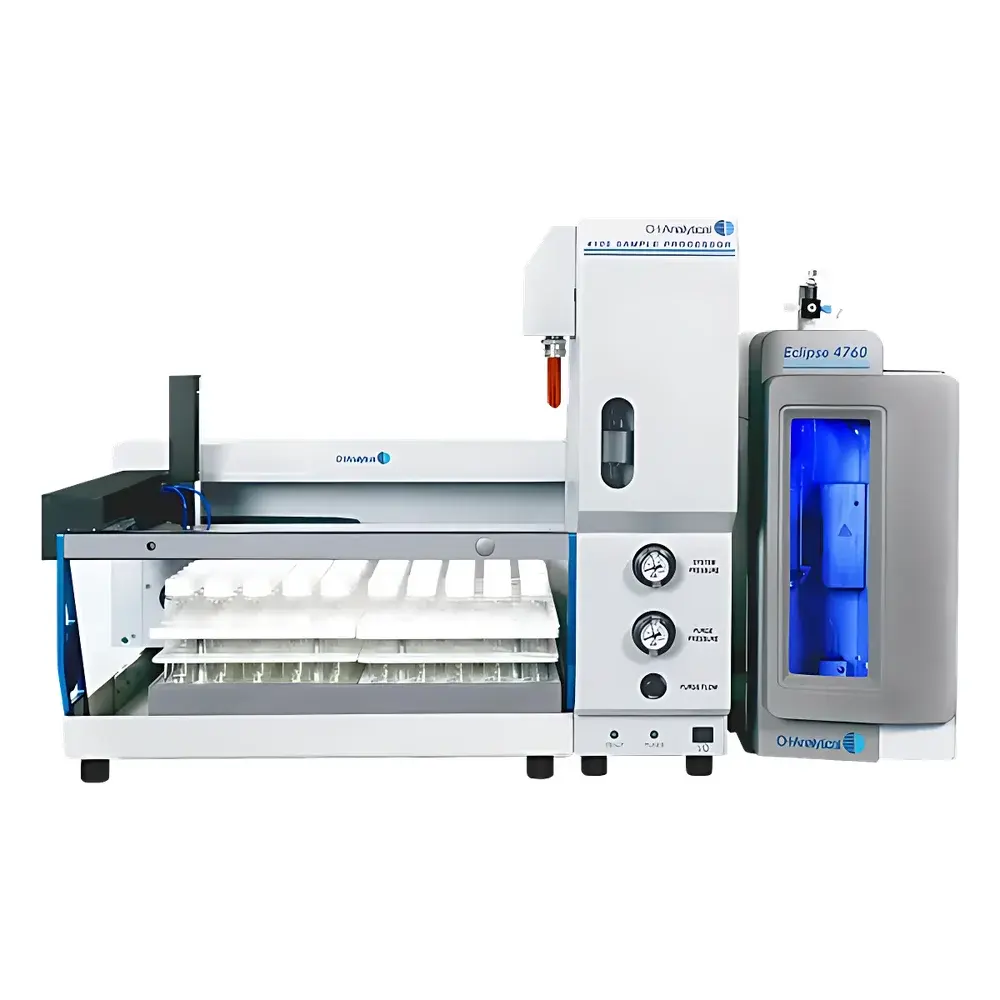
OI Analytical 4760 Purge and Trap Concentrator
| Brand | OI Analytical |
|---|---|
| Origin | USA |
| Model | 4760 |
| Sample Tray Capacity | 100 positions |
| Injection Precision | RSD ≤ 15% |
| Trap Temperature Range | 20–450 °C |
| Purge Heater Temperature | up to 150 °C |
| Sample Vial Cooling Temperature | 4–10 °C |
Overview
The OI Analytical 4760 Purge and Trap Concentrator is a high-performance, laboratory-grade volatile organic compound (VOC) preconcentration system engineered for seamless integration with gas chromatography (GC) and GC/mass spectrometry (GC/MS) platforms. Based on the well-established purge-and-trap principle—where inert gas purges VOCs from aqueous or solid-phase samples into a sorbent trap, followed by thermal desorption into the analytical instrument—the 4760 delivers robust, reproducible quantitation of trace-level VOCs across environmental, regulatory, and compliance-driven workflows. Developed over decades of field-proven deployment since OI’s pioneering 4460 platform in the mid-1980s, the 4760 represents the culmination of iterative engineering focused on analytical fidelity, operational reliability, and regulatory traceability. Its architecture supports both aqueous and solid-phase matrices—including water, soil, sediment, and wastewater—making it a true water-and-soil-capable P&T system compliant with U.S. EPA, ISO, and Chinese national standard methodologies.
Key Features
- Patented cyclonic water management system: removes moisture efficiently without compromising recovery of polar or labile VOCs—critical for maintaining quantitative accuracy across diverse analyte classes.
- Direct resistive heating of the trap: enables rapid, uniform thermal desorption and eliminates cold-spot-related peak broadening or breakthrough, significantly improving chromatographic resolution and sensitivity.
- Integrated infrared sample heater (optional): provides non-contact, radiant heating for uniform temperature distribution throughout the sample vial—minimizing thermal gradients and enhancing purge efficiency for heterogeneous or viscous matrices.
- Triple-stage foam suppression (optional): prevents foam-induced carryover and cross-contamination during purge cycles, especially critical for high-solids or surfactant-rich samples.
- Electronic pressure control (EPC) with automated leak diagnostics: performs real-time pressure monitoring, full-system leak testing, and precise localization of leak points—reducing downtime and supporting GLP/GMP audit readiness.
- Intuitive graphical user interface (GUI): icon-driven navigation, real-time status visualization, and context-sensitive prompts reduce operator training time and minimize procedural errors.
Sample Compatibility & Compliance
The 4760 accommodates standardized 40-mL EPA vials and supports direct analysis of liquid samples (e.g., drinking water, groundwater, wastewater) as well as solid-phase samples via methanol extraction or static headspace equilibration per EPA Method 5035A. It meets stringent requirements for method-defined precision (RSD ≤ 15% for replicate injections), thermal stability (trap heating up to 450 °C for high-boiling compounds), and low-temperature sample conditioning (4–10 °C vial cooling to suppress analyte volatility prior to purge initiation). The system is validated for full compliance with U.S. EPA Methods 502.2, 524.2, 524.3, 601, 602, 624, 8010B, 8020, 8021B, 8240, 8260B, and 5030C/5035A, as well as Chinese national standards GB/T 5750.8-2006, GB 11890-89, HJ 639-2012, and HJ 605-2011. All hardware and software components are designed to support 21 CFR Part 11-compliant data integrity frameworks when paired with validated LIMS or chromatography data systems.
Software & Data Management
The 4760 operates via OI’s proprietary Windows-based control software, featuring full method configuration, sequence scheduling, real-time event logging, and audit-trail-enabled operation. All method parameters—including purge time, trap desorption ramp profiles, bake-out conditions, and carrier gas flow rates—are programmable and stored with timestamped version control. Software-generated reports include system suitability checks, calibration verification logs, and QC summary tables aligned with ISO/IEC 17025 documentation requirements. Raw data files are exported in vendor-neutral formats (e.g., CSV, XML) compatible with third-party data review tools and electronic lab notebooks (ELNs). Optional software modules provide automated compliance reporting for EPA and HJ-series method validation packages.
Applications
The 4760 is routinely deployed in environmental testing laboratories performing routine VOC monitoring in municipal water supplies, industrial effluents, contaminated site investigations, and regulatory compliance screening. Its dual capability for aqueous and solid-phase analysis makes it suitable for EPA-required analyses of chlorinated solvents (e.g., PCE, TCE), benzene-toluene-ethylbenzene-xylene (BTEX) compounds, trihalomethanes (THMs), and emerging contaminants such as 1,4-dioxane. In research settings, it supports method development for complex matrices including landfill leachate, sludge extracts, and polymer-degradation volatiles. Its consistent performance under variable ambient conditions ensures long-term repeatability across multi-lab collaborative studies and proficiency testing programs.
FAQ
What sample types can the 4760 process?
It supports aqueous samples (drinking water, surface water, wastewater) and solid-phase samples (soil, sediment, sludge) using EPA-approved extraction protocols.
Does the 4760 meet U.S. EPA Method 8260B requirements?
Yes—the system is fully validated for Method 8260B, including all specified calibration, QC, and reporting criteria for 108 target VOCs.
Is the software 21 CFR Part 11 compliant?
When configured with electronic signatures, audit trails, and role-based access controls, the software meets core 21 CFR Part 11 requirements for regulated environments.
Can the 4760 be integrated with third-party GC/MS systems?
Yes—it features standard GC interface outputs (TTL, analog, RS-232) and is compatible with major OEM instruments including Agilent, Thermo Fisher, and Shimadzu.
What maintenance intervals are recommended for routine operation?
Trap replacement every 500–1000 injections; quarterly EPC calibration; annual full-system leak verification and thermal validation per ISO/IEC 17025 guidelines.
Related Products






