
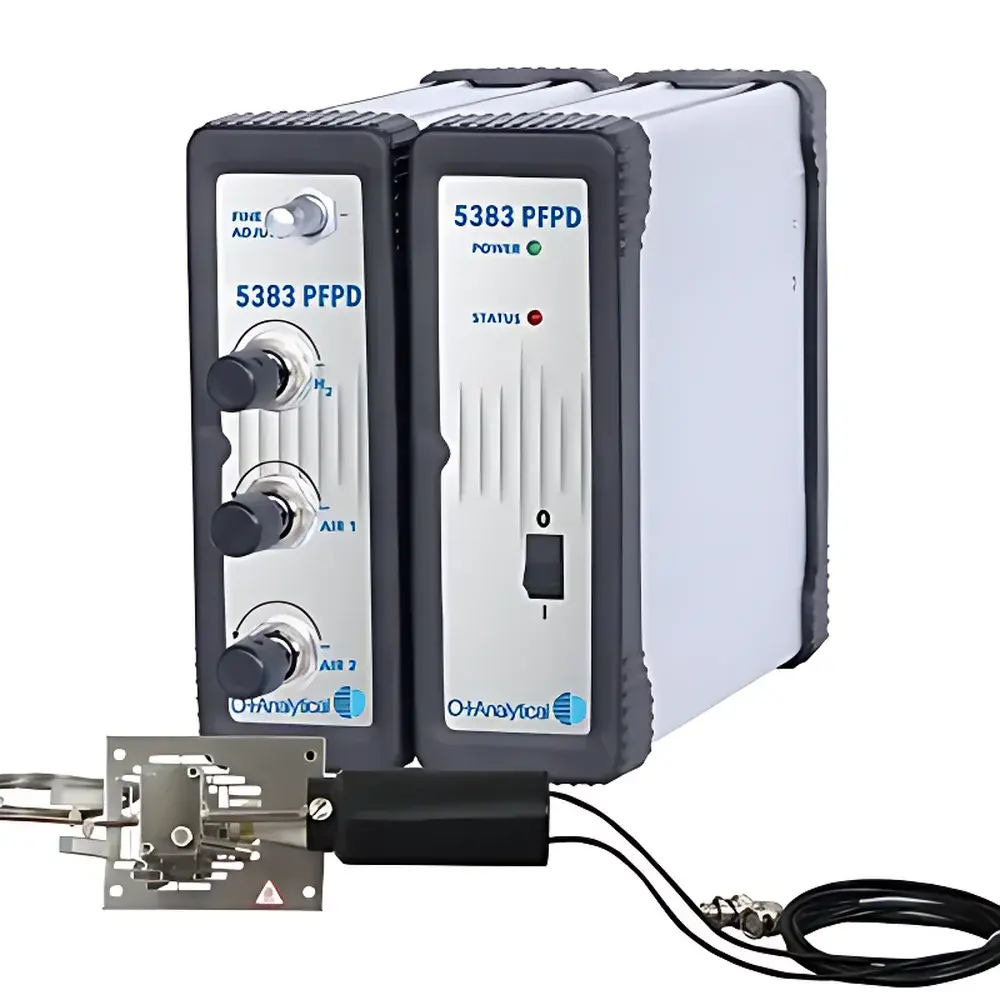
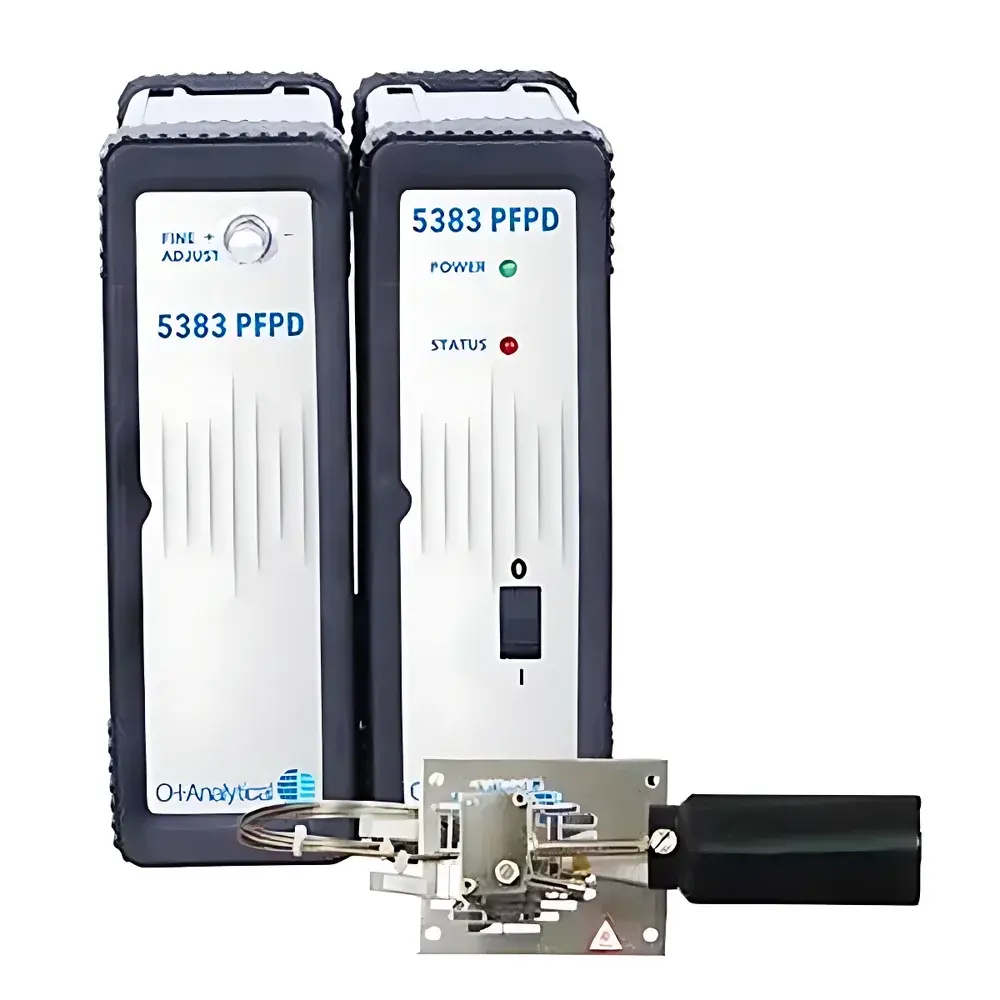
OI Analytical PFPD 5383 Pulsed Flame Photometric Detector
| Brand | OI Analytical |
|---|---|
| Origin | USA |
| Model | PFPD 5383 |
| Detection Principle | Pulsed Flame Photometry |
| Element Specificity | S, P, N, Cl, Sn, As, Se, Te, and other heteroatoms |
| Dual-Channel Simultaneous Output | Yes |
| Self-Cleaning Combustion Chamber | Yes |
| Modular Electronics & Gas Path Architecture | Yes |
| Compliance | Designed for GC integration per ASTM D5291, EPA Method 1664/1671, USP <621>, ISO 8573-5 |
Overview
The OI Analytical PFPD 5383 Pulsed Flame Photometric Detector is a high-performance, element-selective detector engineered for integration with gas chromatography (GC) systems. It operates on the principle of pulsed flame photometry—where analyte-containing effluent from the GC column is introduced into a hydrogen–air flame under precisely controlled, time-modulated combustion conditions. This pulsing regime enhances photon emission yield from excited atomic species (e.g., S* at 394 nm, P* at 526 nm), while suppressing background continuum radiation and thermal noise. Unlike conventional continuous-flame FPDs, the PFPD 5383 achieves up to 10× improved signal-to-noise ratio for sulfur and phosphorus compounds, enabling sub-picomole detection limits without sacrificing robustness or reproducibility. Its design meets the analytical demands of environmental testing labs (EPA-compliant wastewater and soil analysis), petrochemical QA/QC (sulfur speciation in fuels per ASTM D5453), pharmaceutical impurity profiling (phospholipid degradation products), and agrochemical residue screening.
Key Features
- Pulsed combustion architecture: Delivers superior selectivity and sensitivity for S, P, N, Cl, Sn, As, Se, and Te by temporally isolating analyte-specific chemiluminescent emission from flame background.
- Dual-channel simultaneous acquisition: Independent optical filtering and photomultiplier tube (PMT) circuits allow concurrent monitoring of two elemental emissions—e.g., S + P, S + C, or P + Cl—without hardware switching or signal crosstalk.
- Self-cleaning combustion chamber: Integrated thermal cycling and optimized flame geometry prevent carbonaceous deposit accumulation, eliminating routine manual cleaning and ensuring long-term baseline stability over >2000 injection cycles.
- Modular hardware design: Separation of electronics module (analog/digital signal processing, pulse timing control) and gas path module (flame jet assembly, PMT housing, purge gas manifolds) enables field-replaceable component service and simplified maintenance logistics.
- Linear, near-equimolar response: Provides stoichiometric proportionality across compound classes (e.g., thiols, sulfones, phosphates), reducing calibration burden and improving quantitation accuracy without compound-specific response factors.
Sample Compatibility & Compliance
The PFPD 5383 is compatible with standard capillary GC columns (0.1–0.53 mm ID) and supports split/splitless, on-column, and PTV injection techniques. It accepts carrier gases including helium, hydrogen, and nitrogen, with optional hydrogen purity monitoring for flame stability assurance. The detector complies with method requirements for EPA Methods 1664 (petroleum hydrocarbons), 1671 (organophosphorus pesticides), and 8081B (organophosphorus compounds); ASTM D5453 (total sulfur in light hydrocarbons), D5291 (elemental analysis of petroleum products); and USP chromatographic system suitability criteria. Its firmware supports audit-trail logging and user-access controls aligned with FDA 21 CFR Part 11 expectations for regulated environments operating under GLP or GMP frameworks.
Software & Data Management
The PFPD 5383 interfaces natively with industry-standard GC data systems (Agilent OpenLab CDS, Thermo Chromeleon, Shimadzu GC Solutions) via analog voltage output (0–1 V full scale) and digital RS-232/USB communication. Embedded firmware includes real-time flame status diagnostics, pulse parameter optimization wizards (frequency, dwell time, ignition delay), and automatic gain calibration routines traceable to NIST-traceable sulfur standards. All operational parameters—including PMT voltage, H2/air flow ratios, pulse timing, and dual-channel weighting coefficients—are stored with each data file, ensuring full method traceability and facilitating regulatory review.
Applications
- Ultra-trace sulfur speciation in gasoline, diesel, and jet fuel per ISO 20846 and ASTM D7039
- Quantification of organophosphorus nerve agents and metabolites in forensic toxicology matrices
- Monitoring phosphine fumigant residues in stored grains (AOAC 2012.01)
- Speciation of volatile selenium and tellurium compounds in geothermal water effluents
- Multi-element screening of halogenated flame retardants (e.g., TCPP, TDCPP) in polymer leachates
FAQ
What GC systems is the PFPD 5383 compatible with?
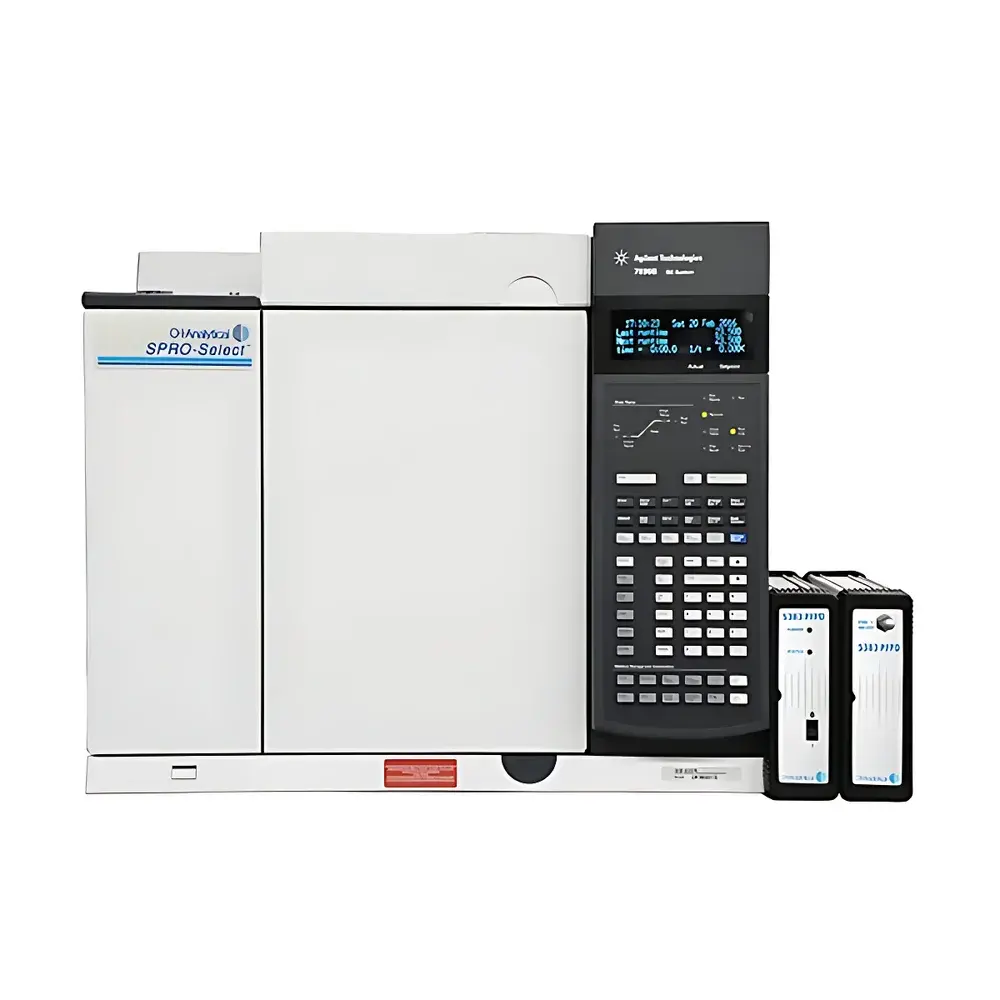
It integrates with all major vendor GC platforms via analog output and RS-232/USB; mechanical mounting kits are available for Agilent, Thermo, Shimadzu, and PerkinElmer instruments.
Does the PFPD 5383 require special gas supplies beyond standard H₂ and air?
No—standard laboratory-grade hydrogen (99.999% purity recommended) and zero-air are sufficient; no auxiliary gases (e.g., oxygen, argon) are required.
How often does the detector require preventive maintenance?
Under typical use (≤50 injections/day), PMT alignment verification and burner nozzle inspection are recommended every 6 months; the self-cleaning design eliminates weekly cleaning protocols associated with conventional FPDs.
Can the PFPD 5383 be used for quantitative analysis under GLP conditions?
Yes—its embedded audit trail, electronic signature support, and method parameter retention comply with ALCOA+ data integrity principles and facilitate FDA/EMA inspection readiness.
Is calibration traceable to national standards?
Calibration is performed using NIST-traceable dibutyl sulfide and triethyl phosphate standards; certificate of analysis includes uncertainty budget per ISO/IEC 17025 guidelines.





