
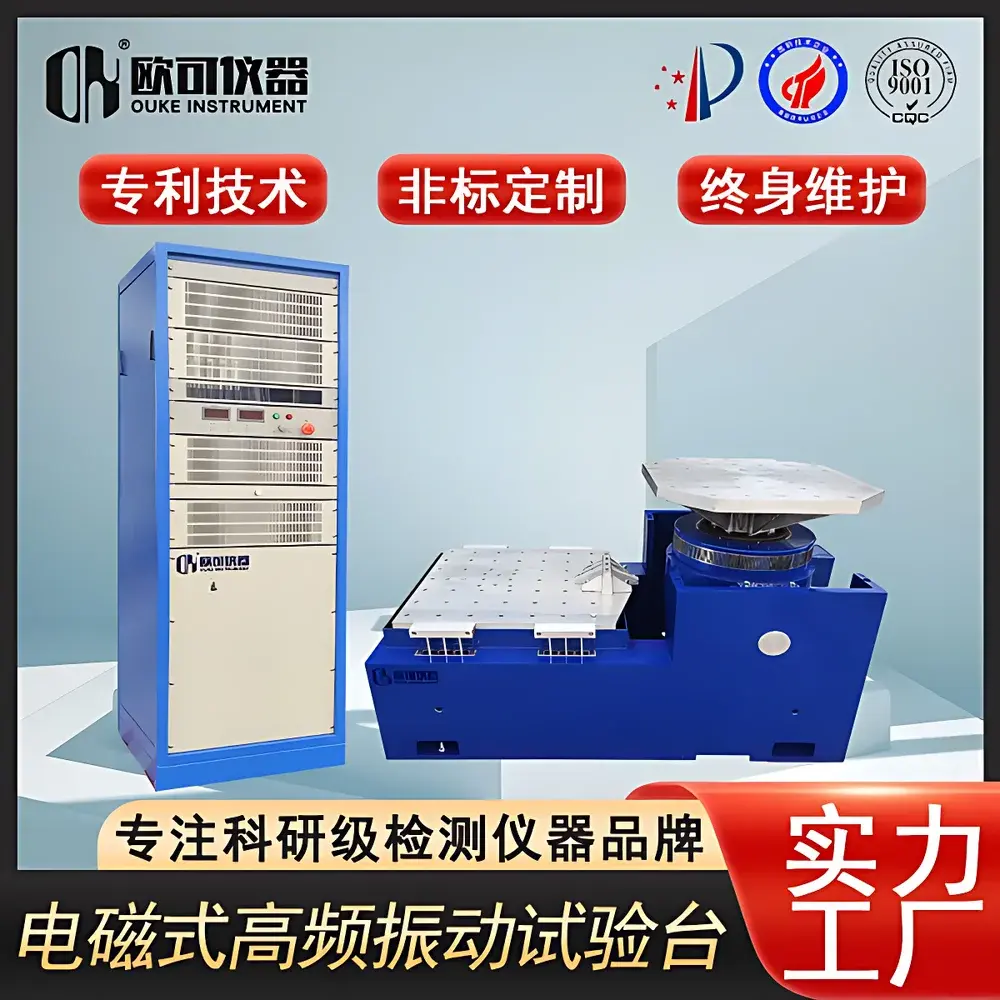
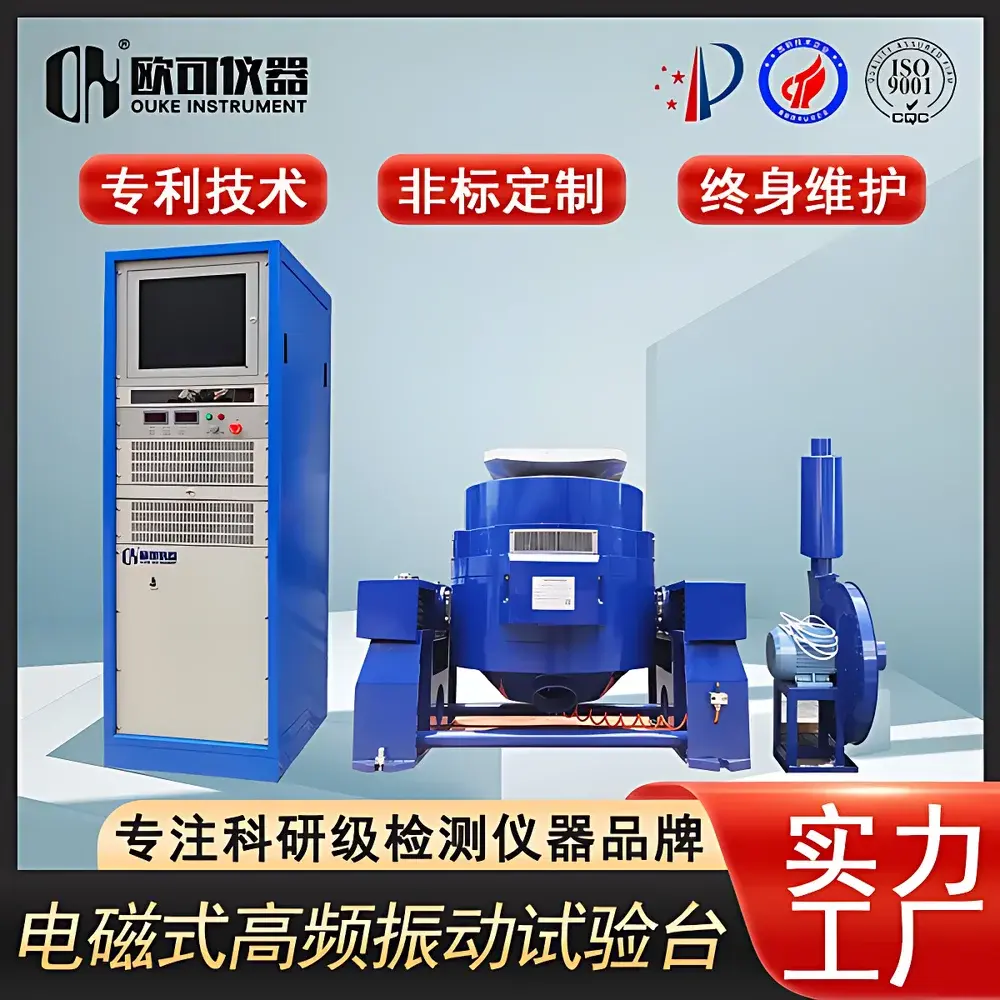
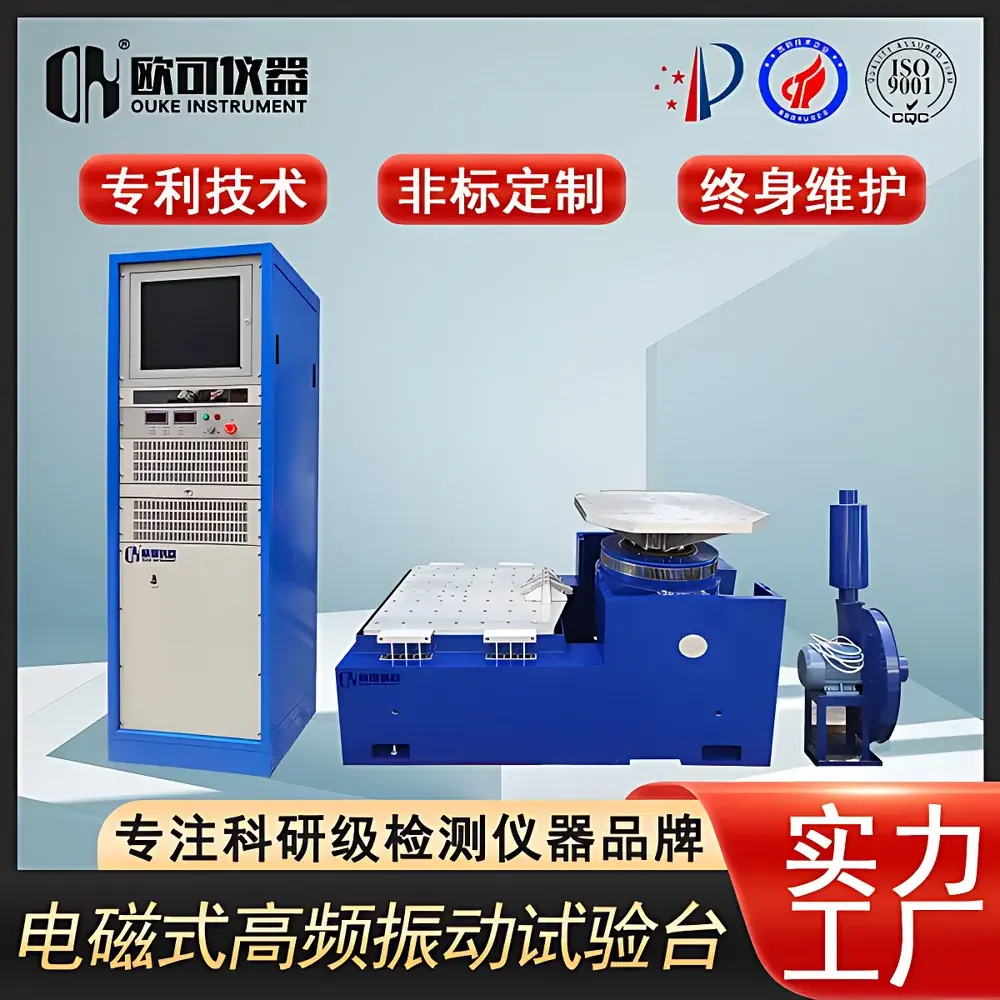
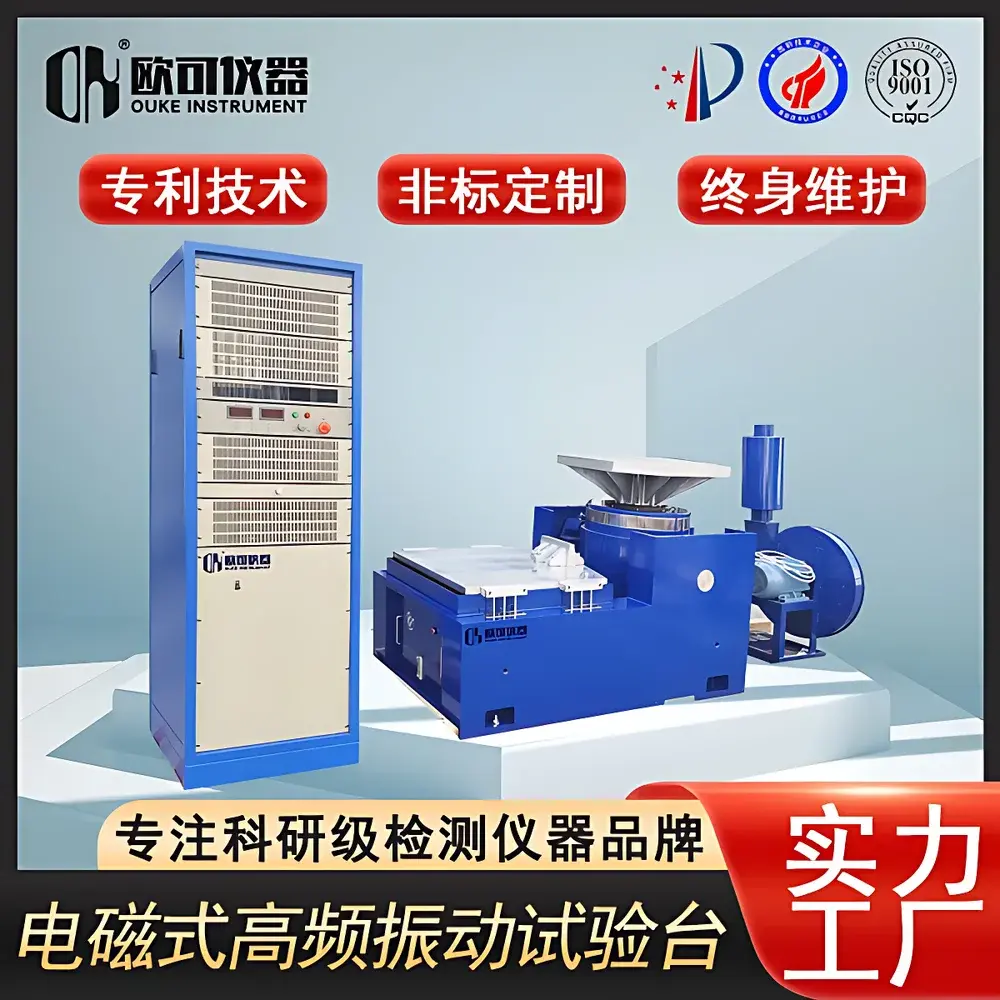
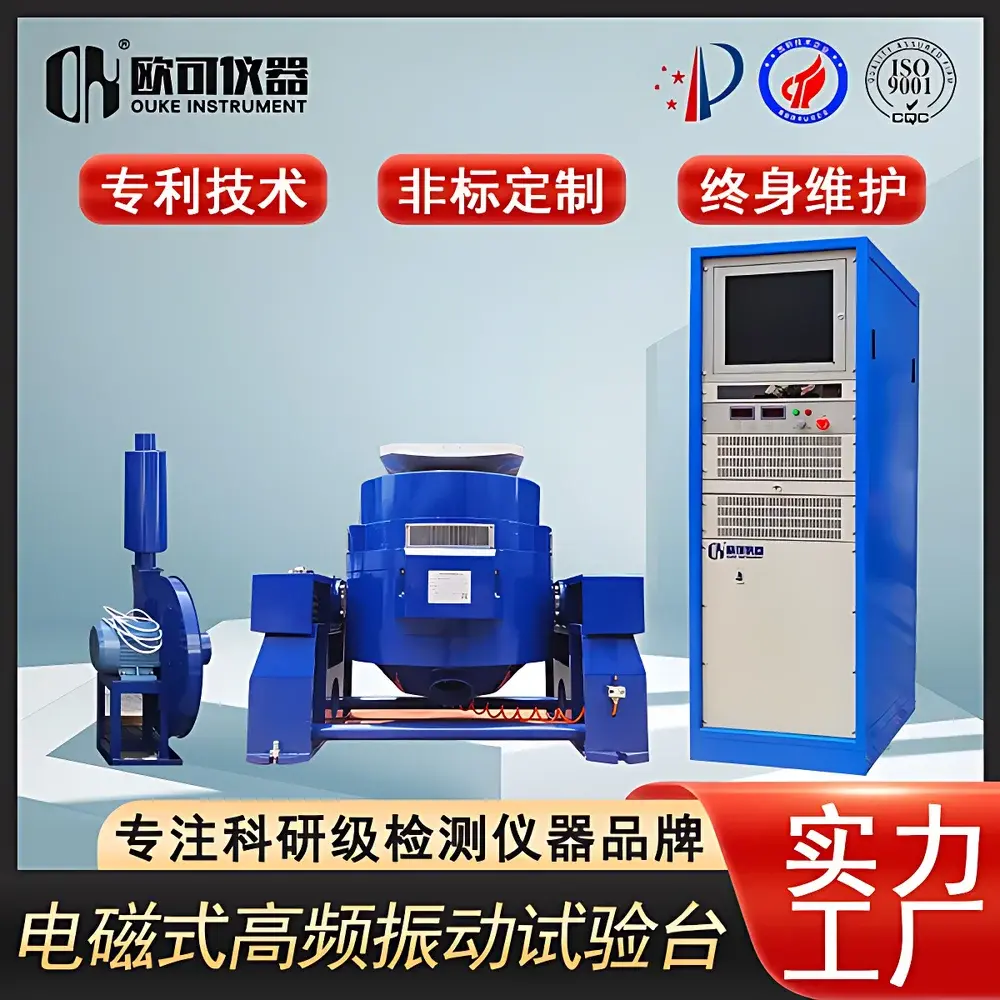
OK-ES Series 333 Electromagnetic Triaxial Vibration Testing System
| Brand | OK Instruments |
|---|---|
| Origin | Guangdong, China |
| Manufacturer Type | Direct Manufacturer |
| Country of Origin | China |
| Model | OK-ES Series 333 |
| Price | USD 21,000 (FOB Guangdong) |
| Frequency Range | 5–4000 Hz |
| Motion Modes | Sinusoidal & Random Vibration |
| Maximum Displacement | 25 mm P-P (at rated load) |
| Axis Configuration | Vertical + Horizontal (90° rotatable) |
| Drive Type | Electromagnetic Shaker |
| Guidance System | Rocker-arm suspension with axial air springs |
| Mounting | Floor-standing, no anchor bolts required |
| Noise Control | Synchronous silent belt drive |
| Sample Interface | Linear rail-mounted fixture system |
| Timing Control | Digital programmable timer |
| Compliance | ASTM D999, ISO 2247, ISTA 3A/3E, MIL-STD-810H Section 514.8 |
Overview
The OK-ES Series 333 Electromagnetic Triaxial Vibration Testing System is an engineered solution for simulating real-world transport-induced mechanical stress on packaged goods, electronic assemblies, automotive components, and industrial subassemblies. Based on electromagnetic shaker technology, the system operates on Lorentz force principles—where current-driven voice coils interact with a static magnetic field to generate controlled inertial motion. Its triaxial capability enables sequential or independent excitation along vertical (Z-axis) and horizontal (X- or Y-axis) directions, with the shaker head mounted on a precision ear-axis pivot mechanism allowing rapid 90° reorientation between axes without mechanical disassembly. This configuration satisfies rigorous international transport simulation standards—including ASTM D999 (vibration testing of shipping containers), ISO 2247 (sinusoidal vibration of packaged products), and ISTA 3-series protocols—while maintaining high waveform fidelity and low harmonic distortion across its full 5–4000 Hz operational bandwidth.
Key Features
- Electromagnetic actuation architecture delivering high-force density and exceptional acceleration linearity up to 100 gpeak (load-dependent)
- Rocker-arm guidance system combined with axial air spring suspension ensures minimal cross-axis coupling and maintains ±0.5% waveform distortion even at maximum 25 mm peak-to-peak displacement under rated payload
- Rotatable ear-axis mounting allows tool-free switching between vertical and horizontal vibration orientations—critical for replicating multi-directional road transport dynamics
- Integrated silent synchronous belt transmission eliminates gear mesh noise, achieving acoustic emission <65 dB(A) at 1 m distance—enabling operation in shared laboratory environments without dedicated acoustic enclosures
- Heavy-duty C-channel base frame with integrated vibration-damping elastomeric pads provides stable dynamic support without floor anchoring or concrete foundations
- Linear rail-mounted fixture interface enables repeatable, ergonomic sample loading/unloading with mechanical locking and quick-release clamping mechanisms
- Digital timer module supports programmable test duration from 1 second to 99 hours, with auto-hold and end-of-test signal output for integration into automated QA workflows
Sample Compatibility & Compliance
The OK-ES Series 333 accommodates payloads ranging from 0.5 kg to 100 kg (dependent on frequency and amplitude settings), with standard 400 × 400 mm aluminum slip-table surface and optional custom fixture plates (M6/M8 tapped patterns). It meets essential regulatory and industry validation requirements for transport simulation: compliance with ASTM D999 Method B (sine sweep), ISO 2247:2017 Clause 6.2 (fixed-frequency sinusoidal), and ISTA 3E (e-commerce parcel delivery simulation). While not certified to IEC 60068-2-64 for random vibration qualification per se, its control electronics support power spectral density (PSD) profile execution aligned with MIL-STD-810H Method 514.8, enabling user-defined random spectra for military-grade environmental stress screening. All mechanical interfaces adhere to ISO 5344:2021 mounting interface specifications.
Software & Data Management
The system operates via embedded firmware with USB and Ethernet connectivity, supporting remote configuration through OK-VibControl™ desktop software (Windows 10/11 compatible). Software features include real-time FFT spectrum monitoring, closed-loop amplitude regulation, preloaded test templates (ASTM, ISTA, ISO), and export of time-history waveforms in CSV and MATLAB .mat formats. Audit trail functionality records operator ID, test parameters, start/stop timestamps, and system calibration status—supporting GLP-compliant documentation practices. For regulated environments, optional 21 CFR Part 11 compliance package includes electronic signatures, role-based access control, and immutable event logs.
Applications
- Package integrity assessment for e-commerce logistics (drop + vibration sequence validation)
- Vibration fatigue analysis of PCB assemblies, connectors, and solder joints prior to automotive AEC-Q200 qualification
- Verification of mounting hardware robustness in aerospace avionics enclosures
- Accelerated life testing of consumer electronics subjected to rail/road transport profiles
- Material damping characterization using resonant dwell and transmissibility sweeps
- Pre-shipment verification per customer-specific technical agreements (e.g., Amazon FBA, Walmart DC requirements)
FAQ
What is the maximum payload capacity at 2000 Hz?
At 2000 Hz, the recommended maximum payload is 35 kg to maintain ≤5% total harmonic distortion and ensure thermal stability of the voice coil assembly.
Does the system support closed-loop acceleration control?
Yes—integrated accelerometer feedback (IEPE type, 100 mV/g sensitivity) enables real-time amplitude correction during both sine and random tests.
Can the horizontal axis be used simultaneously with the vertical axis?
No—the OK-ES Series 333 performs sequential single-axis excitation only; simultaneous dual-axis operation requires a separate multi-shaker controller platform.
Is factory calibration traceable to national standards?
Calibration certificates are provided with NIST-traceable accelerometer and laser vibrometer verification, valid for 12 months under normal operating conditions.
What maintenance intervals are recommended?
Biannual inspection of air spring pressure, belt tension, and rail lubrication is advised; electromagnetic coil resistance and insulation resistance testing should be performed annually by authorized service personnel.



