
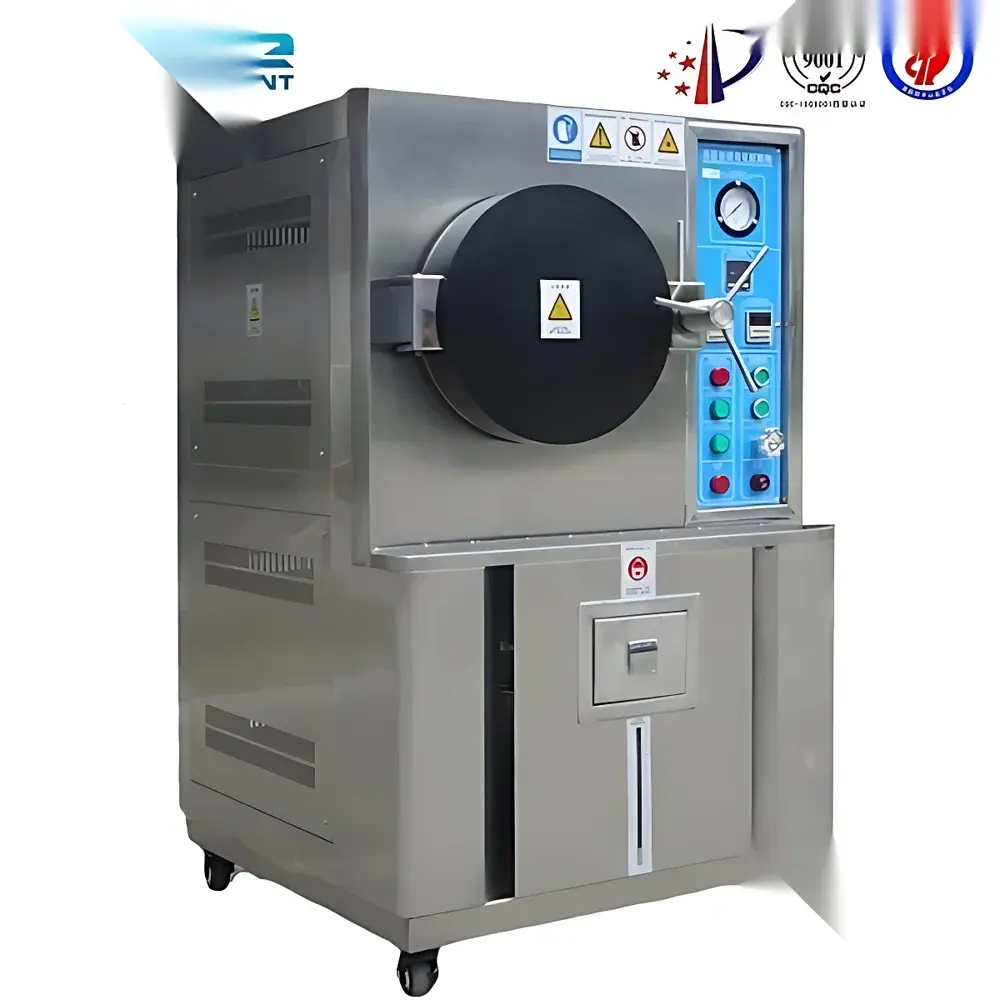
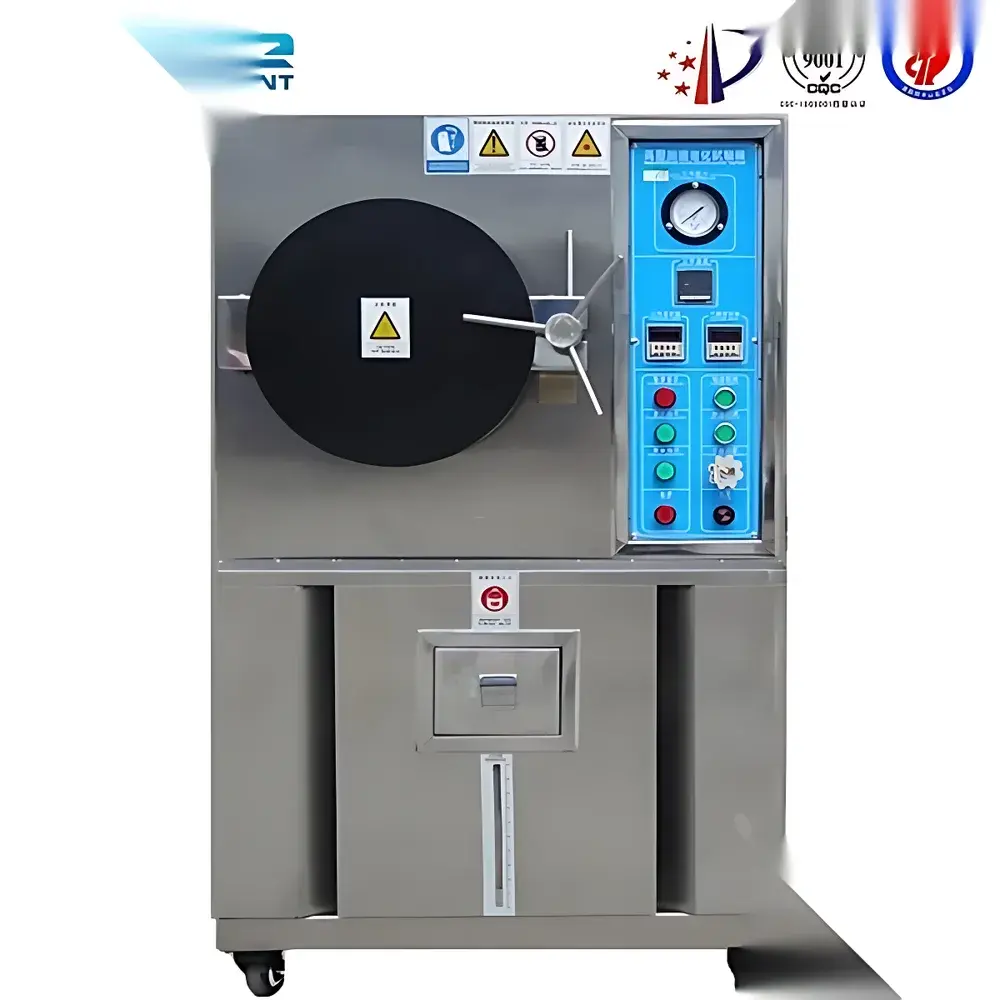
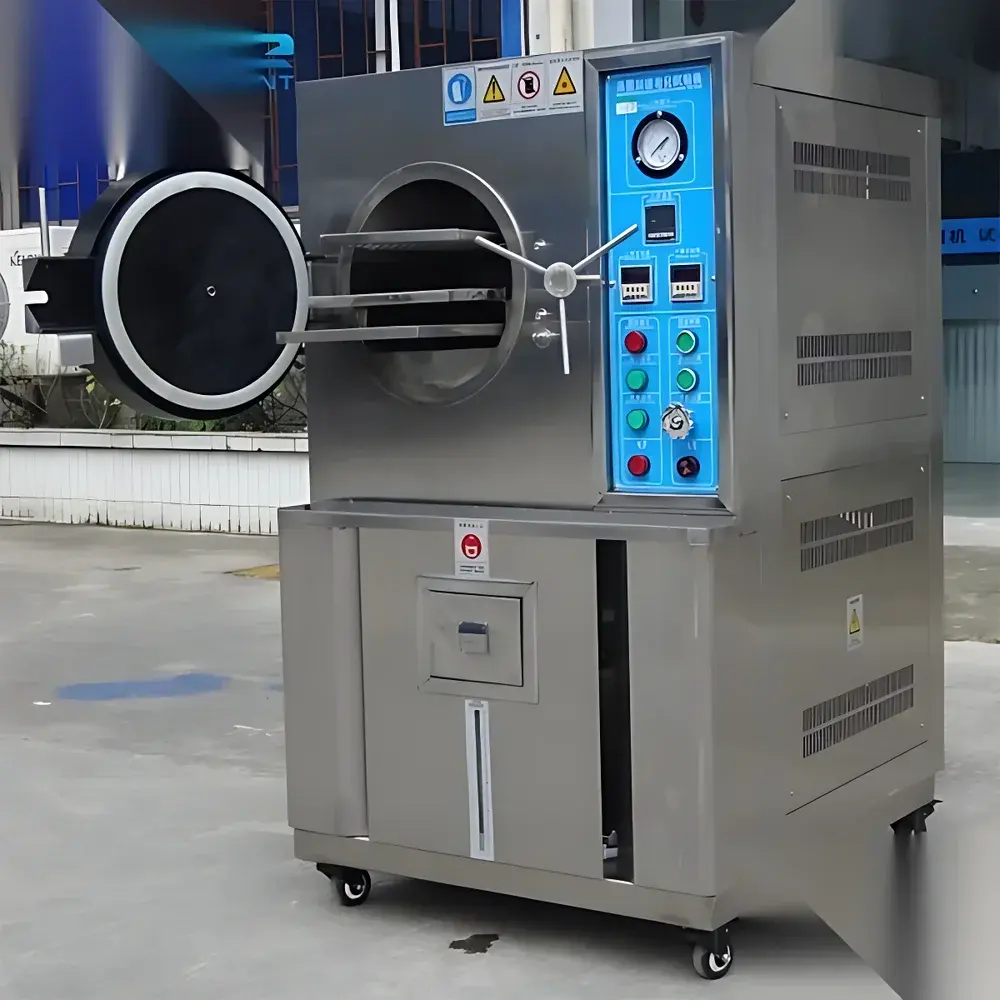
OKE High-Pressure Accelerated Aging Test Chamber
| Brand | Other Brands |
|---|---|
| Origin | Imported |
| Manufacturer Type | Authorized Distributor |
| Temperature Range | +110°C to +132°C |
| Temperature Uniformity | ±1.5°C |
| Temperature Stability | ±0.5°C |
| Humidity Range | 75–100% RH (saturated steam) |
| Humidity Uniformity | ±3.0% RH |
| Humidity Stability | ±1.5% RH |
| Pressure Range (gauge) | 0–2 kg/cm² (optional up to 3 kg/cm²) |
| Absolute Pressure Range | 1.0–3.0 kg/cm² |
| Pressure Capacity | 4 kg/cm² (1 atm + 3 kg/cm²) |
| Heating Time (ambient to +132°C, no load) | ~30 min |
| Pressurization Time (0 → 2 kg/cm²) | ~30 min |
| Test Duration Setting | 0–999 h |
| Internal Volume | Configurable (standard models available) |
| Air Circulation | Natural convection of saturated steam |
| Compliance | GB/T 10586–1989, GB/T 2423.3–2016 (IEC 60068-2-3), MIL-STD-810D Method 502.2, GJB 150.9–2009, GB/T 2423.34–2012 (MIL-STD-883C Method 1004.2) |
Overview
The OKE High-Pressure Accelerated Aging Test Chamber is an engineered environmental stress test system designed for accelerated reliability evaluation of hermetic and semi-hermetic components under combined high-temperature, high-humidity, and elevated-pressure conditions. Operating on the principle of saturated steam pressurization, it subjects test specimens to thermodynamically accelerated moisture ingress—enabling rapid simulation of long-term aging effects observed in real-world service environments. Unlike conventional damp heat chambers, this system achieves significantly higher effective acceleration factors by maintaining a controlled super-atmospheric vapor environment (up to 3.0 kg/cm² absolute pressure), thereby increasing the partial pressure of water vapor and driving diffusion kinetics beyond standard IEC/GB-defined humidity stress levels. The chamber is widely deployed in qualification testing for automotive electronics, aerospace avionics, medical device packaging, LED modules, PCB assemblies, and semiconductor encapsulants where moisture barrier integrity and long-term sealing performance are mission-critical.
Key Features
- Robust 304 stainless steel outer enclosure and seamless cylindrical inner chamber conforming to ASME BPVC Section VIII Div. 1 industrial pressure vessel design standards.
- Cylindrical internal geometry with radial stainless steel lining minimizes thermal shock and prevents direct impingement of latent heat from condensing steam onto test samples.
- Integrated anti-drip condensate management system with sloped chamber ceiling and dedicated drainage pathways ensures zero dripping onto DUTs during extended saturation cycles.
- Automated safety interlock system: door remains mechanically locked when internal pressure exceeds ambient by >0.05 kg/cm²; dual redundant pressure and temperature sensors verify safe access conditions prior to unlocking.
- High-efficiency steam generation and containment architecture reduces water consumption—typical refill interval exceeds 200 hours under continuous operation at 132°C/2.0 kg/cm².
- Precision-controlled natural convection circulation eliminates forced-air turbulence that could compromise thermal/hygrometric uniformity or induce mechanical stress on delicate assemblies.
- Calibration-ready sensor ports located at chamber outlet duct and geometric center per GB/T 5170.2 and GB/T 5170.5 verification protocols.
Sample Compatibility & Compliance
The chamber accommodates a broad range of sample types—including molded plastic housings, ceramic packages, metal-sealed relays, multi-layer PCBs, flexible printed circuits (FPC), OLED display modules, and pharmaceutical blister packaging—without requiring custom fixtures. All operational parameters meet or exceed requirements defined in key international and military standards: GB/T 2423.34–2012 (combined temperature/humidity/pressure testing), MIL-STD-883C Method 1004.2 (moisture resistance of microcircuits), and GJB 150.9–2009 (military environmental engineering). Its pressure-rated construction satisfies Class I, Group D hazardous location considerations when installed in certified utility rooms. Traceable calibration documentation supports GLP-compliant validation, and optional audit-trail-enabled controllers comply with FDA 21 CFR Part 11 data integrity requirements for regulated industries.
Software & Data Management
Standard configuration includes a programmable touchscreen HMI with embedded logging capability (1 Hz sampling, 30-day buffer), supporting user-defined ramp-soak profiles, multi-step pressure/temperature/humidity sequences, and automatic alarm escalation via relay outputs. Optional Ethernet-enabled controllers integrate with enterprise LIMS and MES platforms using Modbus TCP or OPC UA protocols. All logged data—including timestamped pressure transducer readings, PT100 sensor traces, door status, and safety interlock events—are exportable in CSV or XML format with SHA-256 hash integrity verification. Firmware updates follow ISO/IEC 17025-aligned change control procedures, and full audit trails record operator actions, parameter modifications, and calibration interventions.
Applications
- Accelerated moisture sensitivity level (MSL) qualification per J-STD-020 and IPC/JEDEC standards.
- Hermeticity validation of MEMS sensors, RF shielding cans, and laser diode packages.
- Corrosion acceleration testing of solder joints, wire bonds, and copper traces under high-partial-pressure H₂O environments.
- Stability assessment of adhesive bonds, potting compounds, and conformal coatings used in automotive ECUs and ADAS modules.
- Life-cycle screening for medical-grade connectors, implantable housing seals, and sterilizable device enclosures.
- Qualification of LED phosphor degradation mechanisms under thermo-hygro-pressurized stress.
FAQ
What pressure units does the chamber use—and how do they relate to SI units?
The system displays pressure in kg/cm² (gauge and absolute), which is equivalent to approximately 98.0665 kPa per unit. Conversion to MPa or bar is supported via software scaling; absolute pressure values include local atmospheric baseline (typically ~1.033 kg/cm² at sea level).
Can the chamber operate continuously for 999 hours without maintenance?
Yes—under stable setpoint conditions (e.g., 132°C / 100% RH / 2.0 kg/cm²), the integrated water reservoir and low-evaporation-loss design enable unattended operation for up to 999 hours. Routine visual inspection of water level and drain line integrity is recommended every 200 hours.
Is third-party calibration certification available?
Factory-calibrated sensors include NIST-traceable certificates per ISO/IEC 17025. On-site calibration services with accredited providers can be arranged globally through authorized distributors.
Does the chamber support automated pass/fail decision logic based on real-time sensor thresholds?
Yes—customizable alarm triggers (e.g., “pressure deviation > ±0.1 kg/cm² for >60 s”) can activate shutdown sequences, email alerts, or PLC handshake signals. Logic rules are configurable without firmware modification.
How is temperature uniformity verified across the working volume?
Uniformity is measured per GB/T 5170.2 using nine calibrated PT100 probes placed at specified geometric locations (center + eight corners) after 30-minute stabilization under no-load conditions. Reported uniformity reflects maximum deviation from chamber setpoint across all probe locations.



