
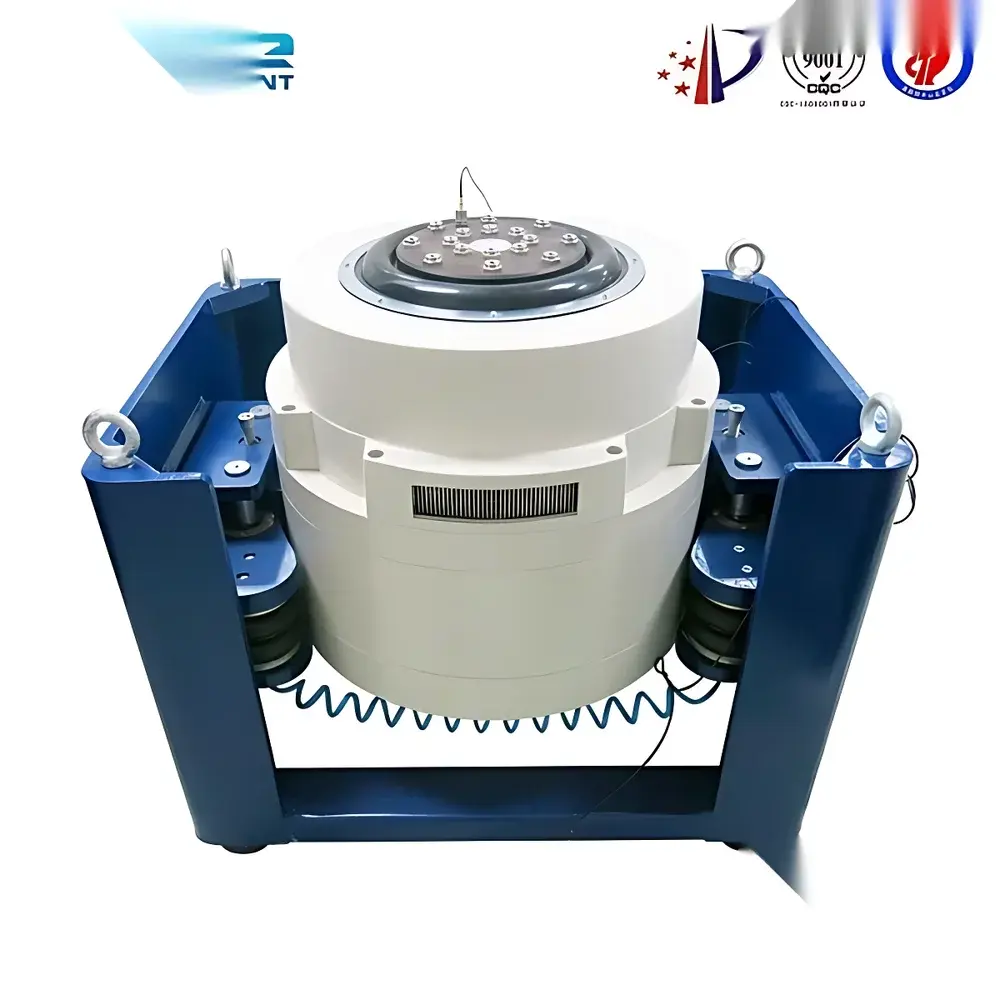
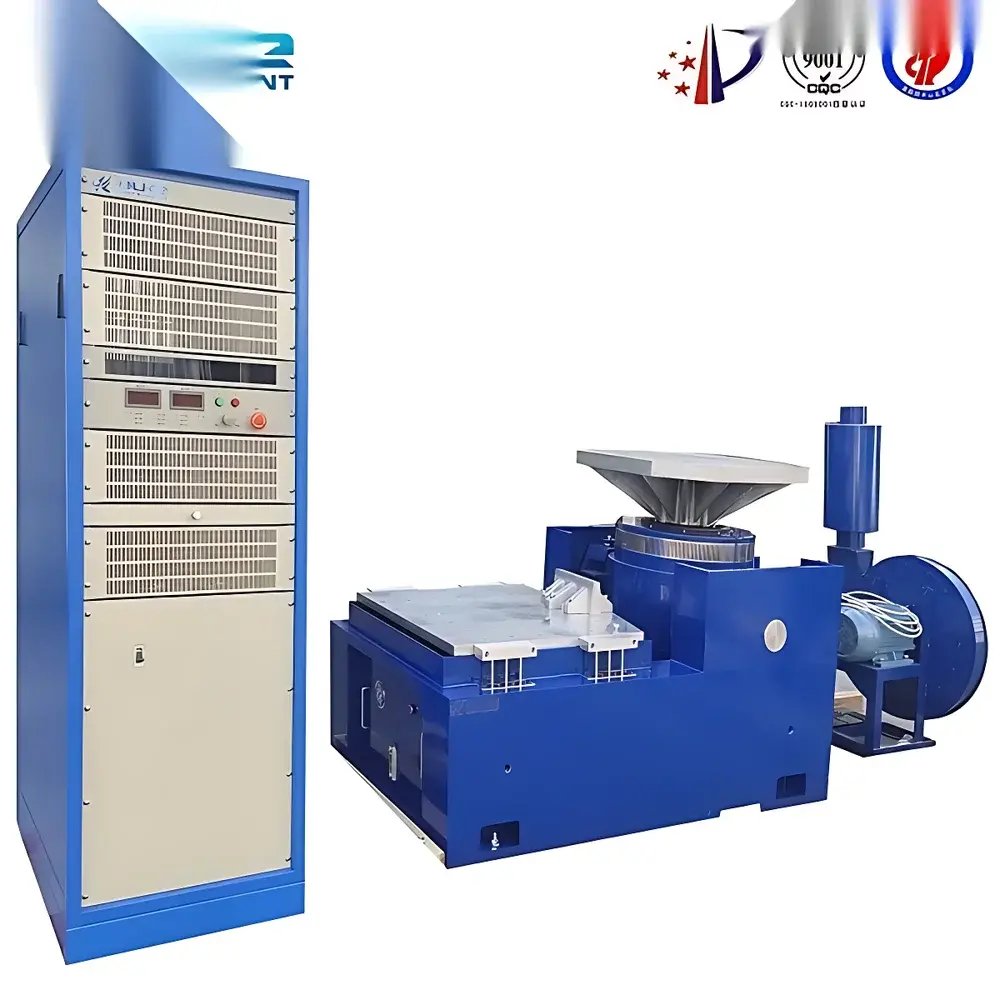
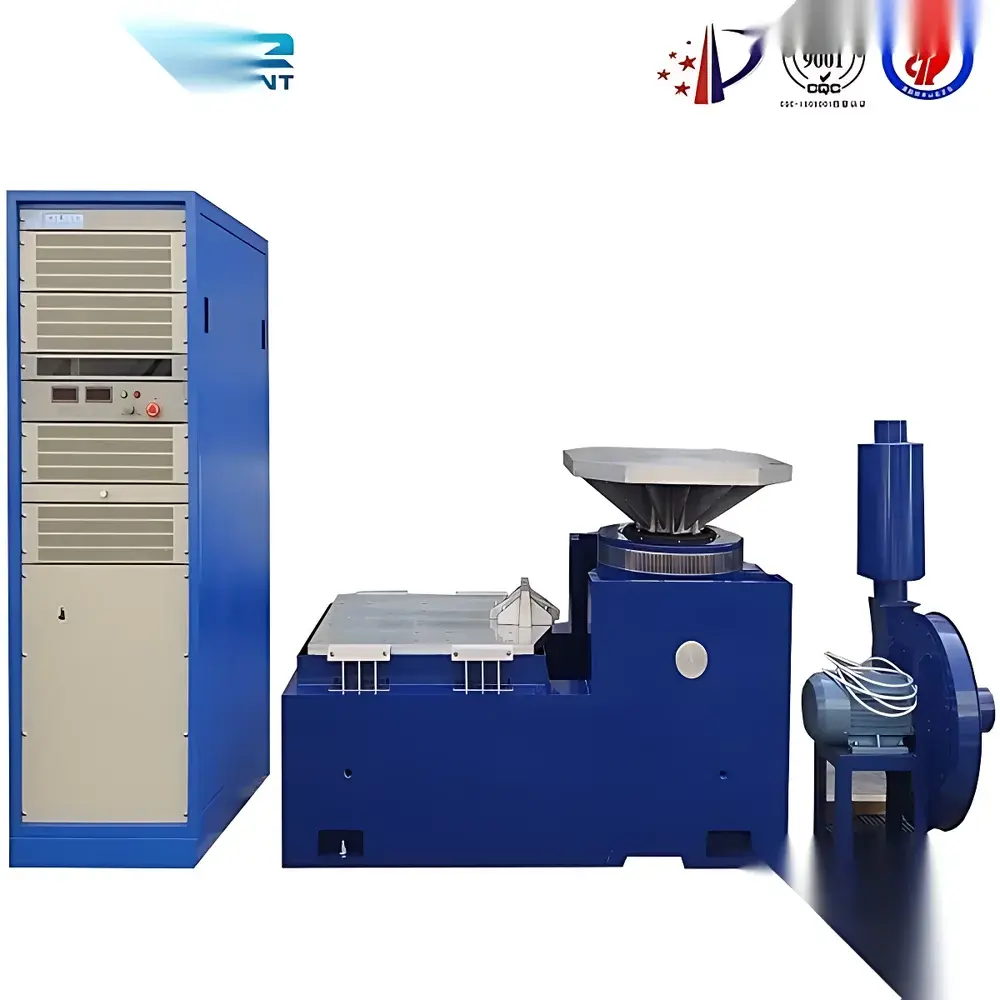
OKO-ES-10 Planar Impact Vibration Test System
| Brand | Other Brands |
|---|---|
| Origin | Imported |
| Manufacturer Type | Authorized Distributor |
| Sinusoidal Force | 300 kgf |
| Random Force | 300 kgf |
| Shock Force | 600 kgf |
| Frequency Range | 2–3000 Hz |
| Continuous Displacement | 25 mm |
| Shock Displacement | 25 mm |
| Maximum Velocity | 2 m/s |
| Maximum Acceleration | 981 m/s² |
| Armature Diameter | Φ110 mm |
| First-Order Resonant Frequency | 2400 Hz |
| Allowable Eccentric Moment | >196 N·m |
| Load Mounting Points | 6 |
| Moving Mass | 2 kg |
| Table Thread Pattern | M8 × 6 on Φ60 mm circle |
| Axial Isolation Frequency | <3 Hz |
| Maximum Payload | 120 kg |
| Stray Magnetic Field | <1 mT |
| Dimensions (L×W×H) | 780 × 537 × 662 mm |
| Net Weight | 320 kg |
| Rotational Speed Range | 150–300 RPM |
| Speed Resolution | 0.1 RPM |
| Peak-to-Peak Amplitude | 25.4 mm |
| Effective Table Area | 1.0 × 1.0 m |
| Timing Range | 0 s to 99 h |
| Motor Power | 1 HP |
| Drive Type | DC Speed Control |
| Supply Voltage | 380 V, 50 Hz |
| Compliance Standards | EN 60068-2-6, ANSI S2.18, ASTM D999, UL 60068-2-27, ISTA 3A/3B/3E |
Overview
The OKO-ES-10 Planar Impact Vibration Test System is an electrodynamic shaker engineered for controlled mechanical excitation of test specimens under sinusoidal, random, and transient shock conditions. Its design follows classical Lorentz-force actuation principles, where a current-carrying armature interacts with a high-intensity magnetic field to generate precise, repeatable motion. Unlike rotary or unbalanced-mass exciters, this system delivers true planar vibration—orthogonal displacement without rotational coupling—enabling accurate simulation of real-world dynamic loads encountered during transportation, operational service, or environmental stress screening. The unit integrates a rigid, low-resonance base structure with optimized electromagnetic circuitry and active thermal management to sustain high-force output across its full 2–3000 Hz bandwidth. It is purpose-built for laboratories conducting structural integrity validation, early-life failure detection, and qualification testing in accordance with international reliability engineering protocols.
Key Features
- Tri-mode excitation capability: programmable sinusoidal, Gaussian-distributed random, and half-sine/terminal-peak shock profiles
- High-force density architecture: 600 kgf shock thrust enabled by reinforced voice coil assembly and dual-stage suspension
- Low-distortion motion control: armature mass of only 2 kg ensures minimal inertial loading and improved phase fidelity up to 2400 Hz first-mode resonance
- Modular mounting interface: six M8 threaded inserts arranged on a Φ60 mm pitch circle support symmetrical load distribution and multi-axis fixturing
- DC speed-regulated drive system with 0.1 RPM resolution, supporting sweep-rate stability critical for resonant dwell and fatigue profiling
- Integrated axial isolation (<3 Hz natural frequency) minimizes energy transmission to supporting structures, ensuring measurement integrity during high-g testing
- Stray magnetic field suppression (<1 mT at 300 mm distance) permits co-location with sensitive instrumentation such as laser Doppler vibrometers or EMF sensors
Sample Compatibility & Compliance
The OKO-ES-10 accommodates payloads up to 120 kg with uniform mass distribution across its 1.0 × 1.0 m effective table surface. Specimens are secured via standard M8 fasteners; custom fixture plates with T-slots or vacuum ports may be retrofitted without mechanical modification. The system conforms to the mechanical testing requirements of multiple international standards, including EN 60068-2-6 (vibration), EN 60068-2-27 (shock), ASTM D999 (shipping container vibration), and ISTA 3-series transport simulation protocols. Its force and displacement linearity, acceleration flatness (±1.5 dB from 10–2000 Hz), and spectral purity meet GLP-compliant validation criteria for QC labs operating under ISO/IEC 17025 accreditation. All firmware and controller logic are traceable to NIST-traceable calibration references.
Software & Data Management
Control and analysis are performed via PC-based software compliant with IEEE 1588 Precision Time Protocol for synchronized multi-channel acquisition. The platform supports real-time closed-loop control using accelerometer feedback, with configurable PID parameters and notch filtering to suppress spurious resonances. Data logging includes time-history waveforms, PSD spectra, kurtosis-controlled random profiles, and shock response spectra (SRS). Audit trails record operator actions, parameter changes, and calibration events in accordance with FDA 21 CFR Part 11 requirements. Export formats include CSV, UFF58, and MATLAB .mat files for post-processing in third-party tools such as LMS Test.Lab or DIAdem.
Applications
- Transportation simulation: replication of road, rail, and air cargo vibration signatures per ISTA 3A/3B/3E and MIL-STD-810H Method 514.7
- Structural durability assessment: modal survey support, resonant dwell testing, and fatigue life prediction for automotive ECUs, avionics enclosures, and consumer electronics assemblies
- Early defect screening: identification of solder joint cracks, loose connectors, or adhesive bond degradation through accelerated stress profiling
- Shock qualification: terminal-peak and trapezoidal pulse generation for drop-test correlation and pyroshock simulation
- Material damping characterization: forced vibration decay analysis of composite laminates and polymer-based substrates
FAQ
What is the maximum payload capacity when operating at 3000 Hz?
At frequencies above 1000 Hz, payload must not exceed 40 kg to maintain specified acceleration flatness and avoid excessive armature heating.
Does the system support closed-loop control using external accelerometers?
Yes—the controller accepts analog ±10 V input from IEPE or charge-mode accelerometers and implements real-time feedback compensation with user-adjustable loop gain and phase margin.
Is calibration documentation provided with shipment?
Each unit ships with a factory calibration certificate traceable to NPL (UK) or PTB (Germany), covering force, displacement, velocity, and acceleration channels over the full operational range.
Can the shaker be integrated into an environmental chamber?
The armature and suspension are rated for operation at ambient temperatures from 5 °C to 40 °C and relative humidity ≤80 % non-condensing; chamber integration requires optional thermal shielding and feedthrough-rated cabling.
What maintenance intervals are recommended for long-term reliability?
Annual inspection of suspension compliance, voice coil centering, and cooling duct integrity is advised; bearing replacement is scheduled every 10,000 operational hours under nominal load conditions.



