
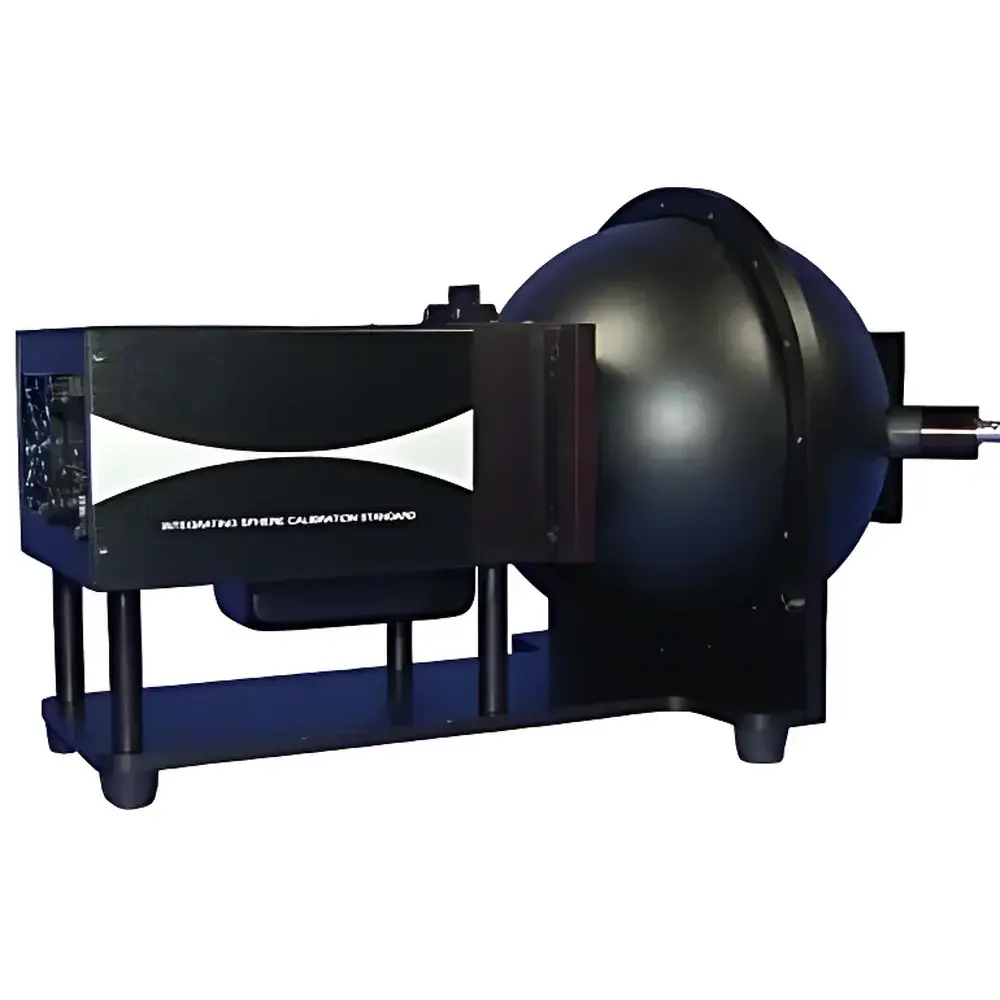
OL 440-8 UV Uniform Integrating Sphere Standard Source
| Brand | Optronic Laboratories |
|---|---|
| Origin | USA |
| Model | OL 440-8 |
| Spectral Range | 200–400 nm |
| Configuration | Source Head + OL 46D Controller + Power Supply |
| Calibration Traceability | NIST-traceable |
| Optional | Uncertified Source Only |
Overview
The OL 440-8 UV Uniform Integrating Sphere Standard Source is a primary radiometric calibration reference engineered for high-accuracy spectral radiance measurements in the ultraviolet (UV) spectrum. Designed and manufactured by Optronic Laboratories—a U.S.-based leader in optical radiation metrology since 1970—the OL 440-8 employs a precisely characterized, temperature-stabilized deuterium or quartz-tungsten-halogen (QTH) lamp source coupled to a high-reflectance, spectrally neutral integrating sphere (coated with Spectralon® or equivalent PTFE-based diffuse material). The system operates on the principle of uniform spatial radiance distribution within the sphere cavity, enabling repeatable, geometry-independent irradiance and radiance transfer standards. It serves as a fundamental tool for calibrating UV-sensitive detectors—including radiometers, photometers, imaging spectroradiometers, and intensified UV cameras—where traceable, low-uncertainty spectral radiance values between 200 nm and 400 nm are required per ISO/IEC 17025-accredited laboratory practices.
Key Features
- Stable, NIST-traceable spectral radiance output across 200–400 nm, with full uncertainty budgets documented per NIST SP 250 series guidelines
- Integrating sphere with >99% Lambertian reflectance over UV-VIS range, minimizing angular dependence and spatial nonuniformity (< ±0.3% over central 50% aperture area)
- Modular architecture: detachable source head (OL 440-8-OH) interfaces with the OL 46D digital controller for real-time intensity monitoring, shutter control, and lamp stabilization feedback
- Thermal management system ensures lamp spectral stability (< ±0.5% drift over 30 min at constant current), critical for long-duration calibration protocols
- Compliant with ANSI/NIST Handbook 150-2B (Calibration Laboratory Accreditation) and supports GLP/GMP validation workflows requiring audit-ready calibration records
- Optional configuration available without formal calibration certificate—suitable for internal reference use or secondary standard transfer applications
Sample Compatibility & Compliance
The OL 440-8 is compatible with collimated and non-collimated UV measurement geometries, including f/2 to f/10 input optics typical of spectroradiometers (e.g., Ocean Insight QE Pro-UV, Avantes AvaSpec-ULS2048CL-EVO) and radiance-calibrated imaging systems. Its output port meets ISO 13406-2 and CIE S 023/E-2013 definitions for uniform exitance. All certified units include full spectral radiance data tables (at 1-nm intervals), expanded uncertainties (k=2), and NIST-traceability statements aligned with ISO/IEC 17025:2017 Clause 6.5.2. The system conforms to electromagnetic compatibility requirements per FCC Part 15 Class B and IEC 61326-1 for laboratory instrumentation.
Software & Data Management
While the OL 440-8 operates autonomously via its dedicated OL 46D controller (with front-panel LCD, analog/digital I/O, and RS-232 interface), it integrates seamlessly into automated calibration workflows via SCPI-compliant serial commands. Optronic Laboratories provides calibration data in standardized ASCII format (.csv), fully compatible with MATLAB, Python (NumPy/Pandas), and commercial radiometric analysis platforms such as LightMachinery’s LightTouch or Labsphere’s SpectraSuite. Audit trails—including lamp operating hours, calibration date, technician ID, and environmental conditions (ambient T, RH)—are embeddable in metadata headers to satisfy FDA 21 CFR Part 11 electronic record requirements when paired with validated LIMS environments.
Applications
- Primary calibration of UV broadband radiometers and spectroradiometers used in solar UV index monitoring and atmospheric ozone profiling
- Validation of UV LED and excimer lamp spectral power distributions in semiconductor photolithography process control
- Reference standard for UV fluorescence quantification in pharmaceutical QC labs (per USP and EP 2.2.17)
- Characterization of UV-transmissive optical materials (e.g., fused silica, CaF₂ windows) and anti-reflective coatings
- Ground-truth reference for satellite-based UV sensor pre-launch calibration (e.g., OMI, TROPOMI heritage programs)
- Interlaboratory comparison studies under CCPR-K1.a (Radiance) and EURAMET.QM-S1 key comparisons
FAQ
Is the OL 440-8 supplied with a NIST-traceable calibration certificate by default?
Yes—standard delivery includes a full calibration report with spectral radiance values, expanded uncertainties (k=2), and direct traceability to NIST SRMs (e.g., SRM 2065, SRM 2067).
Can the OL 440-8 be used for absolute irradiance calibration?
No—it is configured and certified exclusively for spectral radiance (W·sr⁻¹·m⁻²·nm⁻¹); irradiance calibration requires additional cosine correctors and geometric characterization.
What maintenance is required for long-term stability?
Lamp replacement every 1,000–1,500 hours; annual verification of sphere coating integrity and photodetector linearity using Optronic’s recommended check standards (e.g., OL 754 Reference Detector).
Does the OL 440-8 support automated wavelength scanning?
Not natively—the source emits broadband UV continuum; spectral selection must be performed externally using monochromators or tunable filters synchronized via TTL triggers from the OL 46D.
Is firmware or driver software provided for third-party DAQ integration?
Yes—Optronic Laboratories supplies documented SCPI command sets, Windows/Linux-compatible DLLs, and Python example scripts upon request under standard support terms.
Related Products






