
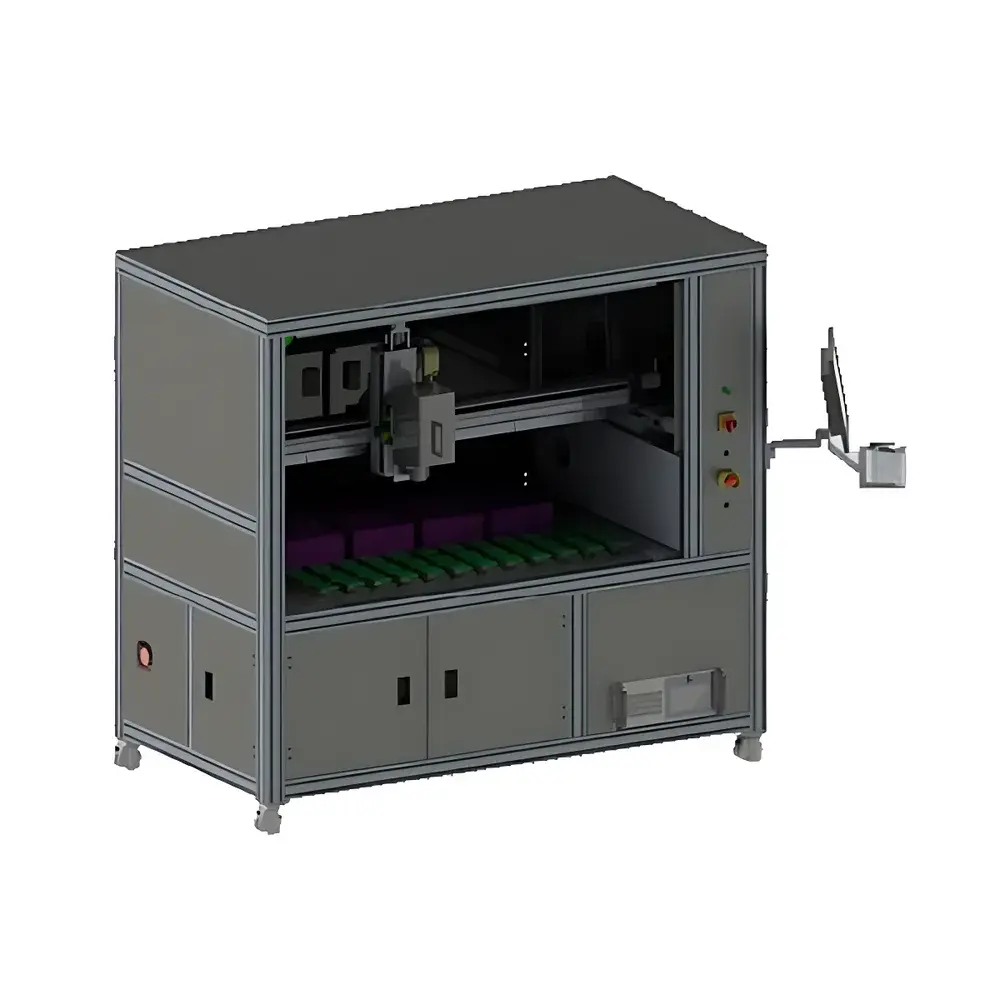
OLED Aging Lifetime Automated Measurement System (Flat-Lay Configuration)
| Brand | ZOLIX |
|---|---|
| Origin | Shanghai, China |
| Manufacturer Type | Authorized Distributor |
| Regional Classification | Domestic (China) |
| Price Range | USD 7,000 – 70,000 |
| Motion Accuracy | ±0.01 mm (X/Y/Z) |
| Configuration | Flat-lay modular architecture with motorized XYZ brightness probe positioning |
| Power Supply | Multi-channel programmable DC source integrated |
| Imaging Alignment | CCD-based automated optical registration |
| Environmental Options | Optional temperature-controlled chamber (−40 °C to +85 °C) |
| Compliance | Designed for ISO/IEC 17025-aligned lab environments and GLP-compliant OLED reliability testing workflows |
Overview
The ZOLIX OLED Aging Lifetime Automated Measurement System (Flat-Lay Configuration) is a purpose-built, turnkey instrumentation platform engineered for high-throughput, traceable operational lifetime evaluation of organic light-emitting diode (OLED) devices under accelerated stress conditions. Unlike conventional point-measurement setups, this system implements a flat-lay mechanical architecture wherein the device under test (DUT) remains stationary on a thermally stabilized stage while a calibrated luminance meter—mounted on a precision XYZ translation stage—sequentially scans emissive areas with sub-10-µm positional repeatability. The system operates on the fundamental principle of photometric degradation tracking: luminance (cd/m²) decay over time at constant current or constant voltage bias is recorded to derive key lifetime metrics including LT₅₀ (time to 50% initial luminance), LT₉₀, and voltage rise rate (dV/dt). All measurements conform to established OLED reliability protocols referenced in IEC 62341-6-2 (Organic LED displays — Part 6-2: Measuring methods for lifetime) and JEDEC JESD22-A114 (Failure Mechanism Based Qualification).
Key Features
- Flat-lay modular design minimizes mechanical vibration and thermal drift during long-duration tests (up to 10,000+ hours), ensuring measurement stability across multi-day aging cycles.
- Motorized XYZ motion stage with ground stainless-steel lead screws and closed-loop stepper control achieves positional accuracy better than ±0.01 mm—critical for repeatable pixel-level luminance mapping on RGB stripe or white+CF OLED panels.
- Integrated multi-channel programmable DC power supply supports independent biasing of up to 16 DUTs simultaneously, enabling parallel lifetime comparison across material stacks, encapsulation variants, or drive schemes.
- CCD-based real-time optical alignment module enables automatic centroid detection and spatial registration of emission zones prior to each measurement cycle—eliminating manual setup error and reducing operator dependency.
- Industrial-grade embedded controller (IPC) runs deterministic real-time acquisition firmware with hardware-triggered synchronization between luminance sampling, voltage/current logging, and environmental chamber feedback signals.
- Modular thermal integration allows seamless coupling with optional climatic chambers compliant with IEC 60068-2-1 (cold), -2 (dry heat), and -14 (change of temperature) standards.
Sample Compatibility & Compliance
The system accommodates rigid and flexible OLED substrates ranging from 0.5″ to 12.3″ diagonal, including bottom-emission, top-emission, and transparent OLED configurations. Substrate thickness tolerance spans 0.3–2.0 mm, with vacuum chuck or edge-clamp mounting options. All photometric calibrations are NIST-traceable via factory-certified luminance standards (e.g., calibrated reference LEDs and integrating sphere sources). Data integrity meets audit requirements for GLP and GMP-regulated R&D labs: full electronic records include timestamped raw luminance values, bias parameters, ambient temperature/humidity logs, and instrument calibration status—all stored with immutable metadata per ICH M7 and FDA 21 CFR Part 11 Annex 11 principles.
Software & Data Management
ZOLIX OLED LifeSuite™ v3.2 provides unified control, visualization, and reporting. The software features synchronized multi-parameter acquisition (luminance, voltage, current, temperature), real-time curve fitting using exponential decay models (L(t) = L₀·e−kt), and automated LTx extrapolation with confidence intervals. Export formats include CSV, HDF5, and XML for integration with LIMS or statistical analysis platforms (e.g., JMP, MATLAB). Audit trail functionality logs all user actions, parameter changes, and calibration events with digital signature support. Raw data files are SHA-256 hashed and archived with version-controlled metadata per ISO/IEC 17025 Clause 7.5.2.
Applications
- Accelerated lifetime validation of novel host/emitter materials in academic and industrial OLED R&D laboratories.
- Encapsulation barrier performance benchmarking under thermal-humidity stress (85°C/85% RH) per JEDEC JESD22-A101.
- Drive circuit co-design verification—correlating pixel-level luminance decay with TFT threshold voltage shift.
- Quality assurance screening for production lots, supporting AQL-based sampling plans aligned with ISO 2859-1.
- Standardized reporting for OLED display qualification submissions to regulatory bodies (e.g., ENERGY STAR, TÜV Rheinland OLED Lifetime Certification).
FAQ
What luminance measurement standard does the system follow?
The system complies with CIE 127:2007 recommendations for luminance measurement geometry and uses a Class L photometer calibrated against NIST SRM 2241.
Can the system measure chromaticity shift (CIE x,y) alongside luminance decay?
Yes—when equipped with an optional integrated spectroradiometer module (e.g., ZOLIX Omni-λ300 + USB4000), full spectral power distribution (SPD) acquisition is supported at user-defined intervals.
Is remote monitoring and unattended operation supported?
Fully supported via secure TLS-enabled web interface; system status, live curves, and alarm notifications (e.g., temperature excursion, motion timeout) are accessible through enterprise authentication.
How is data integrity ensured during extended 24/7 testing campaigns?
All acquired data undergoes cyclic redundancy check (CRC32), automatic backup to redundant NAS storage, and daily SHA-256 hash verification—meeting ALCOA+ (Attributable, Legible, Contemporaneous, Original, Accurate, Complete, Consistent, Enduring, Available) data governance criteria.
Does the system support custom test protocols beyond standard constant-current aging?
Yes—users may define scripted sequences including pulsed current stress, dynamic luminance ramping, and conditional triggers (e.g., pause test if ΔL/L₀ exceeds 5% within 1 hour).






