
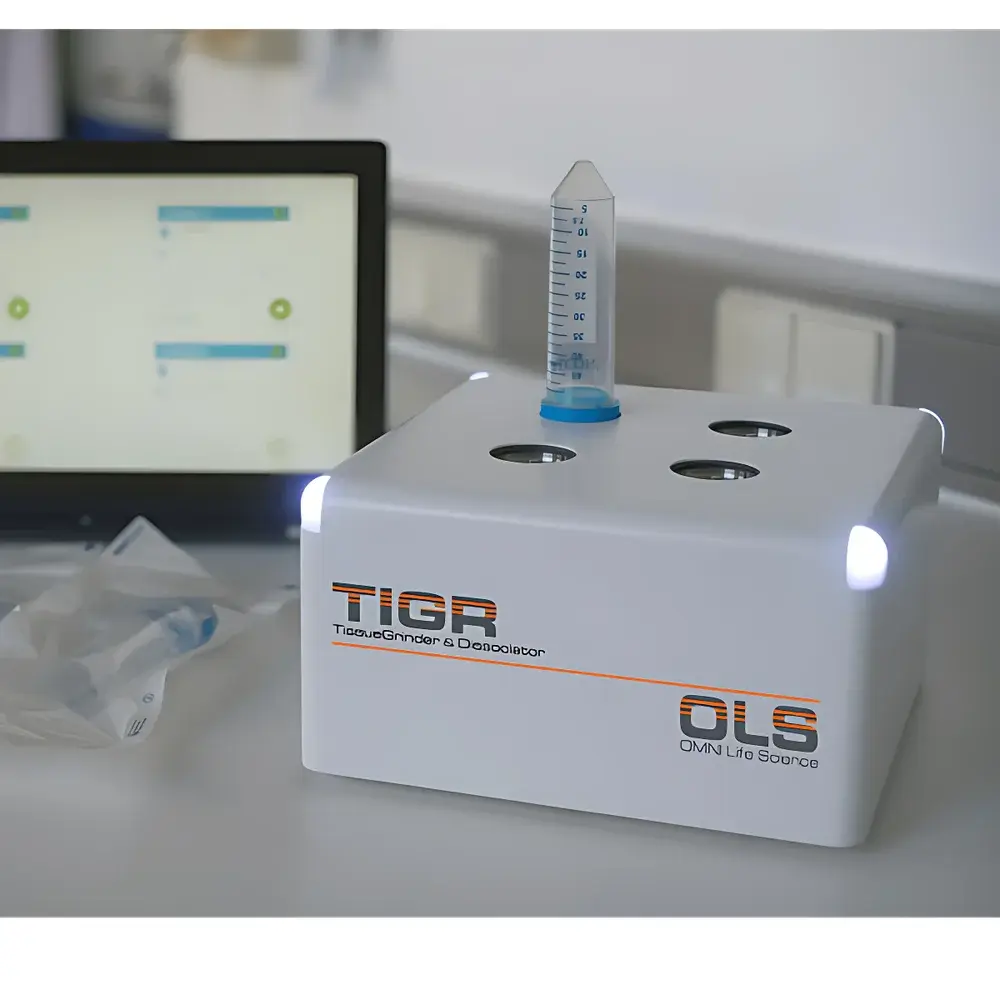
OLS TIGR Enzyme-Free Tissue Grinder & Single-Cell Preparation System
| Brand | OLS |
|---|---|
| Origin | Germany |
| Type | Fully Automated |
| Model | TIGR |
| Channels | 4 (independently controlled) |
| Sample Capacity per Tube | 5–400 mg |
| Rotation Speed | 10–100 rpm |
| Processing Time | 2–5 min |
| Grinding Mechanism | Integrated micro-pore grinding column in tube cap |
| Filtration | Built-in cell strainer (100 µm, 70 µm, 40 µm options) |
| Tube Format | Standard 50 mL conical tubes |
| Software Interface | Graphical control software with ≥10 pre-validated protocols and custom protocol programming |
Overview
The OLS TIGR Enzyme-Free Tissue Grinder & Single-Cell Preparation System is an automated, mechanical dissociation platform engineered for reproducible, enzyme-free generation of high-viability single-cell suspensions from fresh or cryopreserved mammalian tissues. Unlike enzymatic digestion methods—which introduce variability due to lot-dependent protease activity, incubation time sensitivity, and residual reagent interference—the TIGR system relies on controlled mechanical shear and precision rotary grinding within sealed, standardized 50 mL conical tubes. Its core principle leverages Couette-type fluid dynamics combined with micro-structured grinding surfaces embedded in the tube cap, enabling simultaneous cutting and abrasive milling under low-shear rotational motion (10–100 rpm). This architecture ensures minimal thermal buildup, consistent mechanical energy delivery, and preservation of native surface epitopes, membrane integrity, and transcriptional fidelity—critical parameters for downstream single-cell RNA sequencing, flow cytometry, functional assays, and 3D model derivation.
Key Features
- Fully automated 4-channel design with independent operation per channel—enabling parallel processing of heterogeneous tissue types or experimental replicates without cross-contamination.
- Integrated grinding column housed directly in the tube cap—eliminating external grinders, transfer steps, or open handling that compromise sterility and cell viability.
- On-tube filtration via interchangeable stainless-steel mesh strainers (40 µm, 70 µm, 100 µm)—ensuring immediate separation of intact single cells from debris, stromal fragments, and undigested aggregates directly into the tube base.
- Standard 50 mL conical tube compatibility—allowing seamless transition from grinding to centrifugation, washing, staining, or cryopreservation without intermediate pipetting or tube transfer.
- Graphical control software with intuitive drag-and-drop protocol builder—supporting both pre-validated tissue-specific workflows (e.g., murine spleen, human liver, porcine neural tissue) and user-defined parameters including speed ramping profiles, dwell times, and multi-phase rotation sequences.
- No consumable enzymes, chelators, or chemical dissociation reagents—removing batch-to-batch variability, endotoxin risk, and regulatory constraints associated with GMP-compliant primary cell manufacturing.
Sample Compatibility & Compliance
The TIGR system has been validated across a broad spectrum of soft and semi-fibrous tissues—including spleen, lymph node, colon, heart, kidney, liver, brain, and tumor biopsies—from human, murine, non-human primate, and porcine sources. It accommodates input masses ranging from 5 mg (e.g., microdissected tumor foci) to 400 mg (e.g., whole murine kidneys), maintaining >85% cell viability (measured by AO/PI staining and CASY® counter validation) and >90% single-cell yield (vs. aggregated counts) across all tested matrices. The system complies with ISO 13485 design controls for medical device-related research instrumentation and supports audit-ready electronic records when paired with OLS’s 21 CFR Part 11–enabled software suite. All grinding tubes are certified DNase/RNase-free and sterile-filtered, meeting GLP-grade requirements for preclinical cell therapy development.
Software & Data Management
The embedded graphical control interface runs on a dedicated industrial-grade controller with real-time motor torque monitoring, temperature logging, and protocol execution verification. Each run generates a timestamped metadata file containing speed profile, duration, channel ID, selected strainer size, and operator annotation. Protocol libraries include tissue-specific SOPs aligned with ASTM E3196-21 (standard guide for single-cell suspension preparation) and USP (cellular and gene therapy product characterization). Custom protocols can be exported/imported as XML files and version-controlled via networked deployment—facilitating lab-wide standardization and method transfer between sites. Integration with LIMS platforms is supported via HL7 and RESTful API endpoints.
Applications
The TIGR system serves as a foundational tool in translational and discovery workflows requiring high-fidelity primary cell inputs: isolation of immune subsets for adoptive cell therapy screening; generation of organoid-initiating cells from patient-derived tumor digests; preparation of nuclei for ATAC-seq or snRNA-seq; production of feeder-layer-free neural progenitor suspensions; and scalable dissociation for high-throughput drug response profiling in 3D co-cultures. Its enzyme-free output is particularly advantageous for surface receptor quantification (e.g., PD-1, CTLA-4), phospho-flow cytometry, and live-cell imaging where enzymatic cleavage artifacts confound epitope detection.
FAQ
Does the TIGR system require calibration or routine maintenance?
No routine recalibration is required; the system uses factory-trimmed stepper motors and optical position feedback. Annual preventive maintenance includes inspection of grinding column wear and strainer integrity—documented in the service log.
Can I use non-standard tube formats or third-party consumables?
Only OLS-certified 50 mL grinding tubes with integrated strainers and cap-mounted grinding columns are supported. Non-OEM tubes lack dimensional tolerances and mechanical coupling necessary for consistent torque transmission and filtration performance.
Is the system compatible with biosafety cabinets or cold rooms?
Yes—the footprint (W320 × D540 × H410 mm) and ambient operating range (10–30 °C, 30–80% RH non-condensing) allow installation inside Class II A2 cabinets or refrigerated environments, provided condensation on electronics is mitigated.
How is data integrity ensured during long-term protocol deployment?
All software operations generate SHA-256–hashed audit trails compliant with ALCOA+ principles. Electronic signatures, role-based access control, and automatic backup to network storage are configurable per institutional IT policy.
What validation documentation is provided with the instrument?
Each unit ships with a Factory Acceptance Test (FAT) report, IQ/OQ documentation templates aligned with ISO/IEC 17025, and a tissue-specific performance qualification matrix covering viability, yield, and debris index across ≥5 tissue types.




