
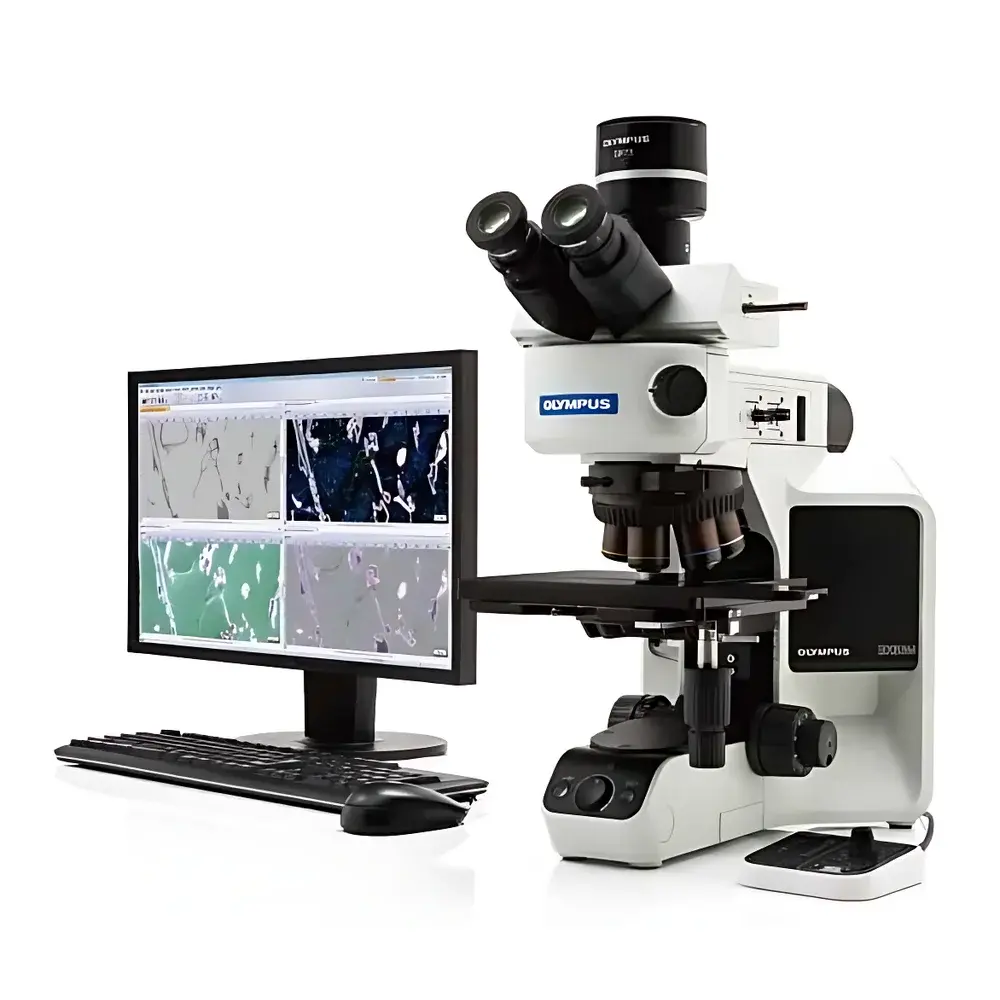
OLYMPUS BX53M Upright Metallurgical Microscope
| Brand | OLYMPUS |
|---|---|
| Origin | Japan |
| Model | BX53M |
| Configuration | Upright |
| Total Magnification | 1000× |
| Eyepiece Port | Dual (2-position) |
| Objective Turret | 6-position |
| Compliance | ISO 9001, JIS B 7711 (Metallographic Microscopy), ASTM E3, ASTM E407, ISO 643, ISO 6506, ISO 6892 |
Overview
The OLYMPUS BX53M Upright Metallurgical Microscope is an engineered optical platform designed for rigorous industrial metallurgy, materials science, and quality control laboratories. Built upon Olympus’ legacy of precision optics and mechanical stability, the BX53M employs a parfocal, infinity-corrected optical system with high numerical aperture (NA) objectives optimized for reflected-light illumination—essential for examining polished metallographic sections, heat-treated alloys, weld zones, coating interfaces, and ceramic composites. Its upright configuration accommodates large, heavy, or irregularly shaped specimens—up to 76 mm in height and 200 mm × 200 mm in footprint—without requiring sample inversion or complex stage adapters. The microscope operates on fundamental contrast mechanisms including brightfield, darkfield, polarized light, and differential interference contrast (DIC), all supported by dedicated Köhler-illuminated epi-illumination paths with adjustable aperture and field diaphragms. This ensures consistent, quantitative image formation compliant with international metallographic standards such as ASTM E3 (Standard Guide for Preparation of Metallographic Specimens), ASTM E407 (Standard Practice for Microetching Metals and Alloys), and ISO 643 (Steels — Micrographic Determination of the Content of Non-Metallic Inclusions).
Key Features
- Robust, vibration-damped base and rigid Z-axis focusing mechanism engineered for long-term dimensional stability during extended imaging sessions and automated stage navigation.
- 6-position objective revolver with encoded position detection—enabling automatic magnification recognition and seamless integration with Stream software for metadata tagging and report generation.
- Dual (2-position) eyepiece tube with ergonomic inclination (0–30°) and interpupillary adjustment (55–75 mm), supporting both binocular observation and optional trinocular port for camera coupling.
- Reflected-light illumination system featuring LED-based epi-illuminator with stable color temperature (5700 K), flicker-free output, and ≥50,000-hour lifetime—fully compatible with fluorescence filter cubes (optional) and DIC prisms.
- Modular design architecture allowing field-upgradable components: motorized Z-drive, XY motorized stage, automated filter wheels, and hardware-triggered shutter control—all accessible via Stream software interface.
- Compliance-ready mechanical and optical calibration traceability aligned with ISO/IEC 17025 requirements for accredited testing laboratories.
Sample Compatibility & Compliance
The BX53M accommodates a broad range of specimen types common in metallurgical QA/QC and R&D workflows: cross-sectioned metallic samples (ferrous/non-ferrous), sintered powders, additive-manufactured parts, thermal spray coatings, and semiconductor packaging substrates. Its large-stage clearance (76 mm vertical working distance) and reinforced mechanical stage (100 mm × 100 mm travel) support specimens weighing up to 5 kg without compromising focus repeatability. All optical components—including objectives, condensers, and beam splitters—are certified to meet JIS B 7711 (Japanese Industrial Standard for Metallographic Microscopes) and calibrated per Olympus’ internal metrology protocol, which references NIST-traceable reference standards. The system supports GLP/GMP documentation workflows when paired with Stream software’s audit trail functionality and 21 CFR Part 11-compliant electronic signature modules (available as licensed options).
Software & Data Management
Olympus Stream software serves as the unified acquisition, measurement, and reporting engine for the BX53M. It provides real-time image optimization (auto-exposure, white balance, gamma correction), multi-focus stacking (Z-series acquisition), grain size analysis per ASTM E112, inclusion rating per ASTM E45, phase fraction quantification, and hardness indentation mapping (when integrated with microhardness testers). All measurements are stored with embedded metadata—including objective ID, magnification, illumination mode, date/time stamp, and user credentials—ensuring full traceability. Export formats include TIFF (16-bit), CSV (for statistical analysis), PDF reports (with customizable templates), and native .OIB project files compatible with Olympus’ cloud-based data repository (Stream Cloud, optional subscription). Data integrity is preserved through SHA-256 hash verification and write-once-read-many (WORM) archival support.
Applications
- Microstructural characterization of steels, aluminum alloys, titanium grades, and superalloys per ASTM E3 and ISO 643.
- Failure analysis of fractured surfaces, fatigue striations, and intergranular corrosion using polarized light and DIC enhancement.
- Coating thickness verification and delamination assessment in thermal barrier systems and PVD/CVD layers.
- Quality assurance of castings, forgings, and welded joints in aerospace and automotive manufacturing.
- Research-grade phase identification and crystallographic orientation mapping when combined with EBSD detectors (via third-party integration kits).
- Education and certification labs requiring ISO/IEC 17025-compliant documentation for accreditation audits.
FAQ
Is the BX53M compatible with third-party digital cameras?
Yes—the trinocular port features a standardized C-mount adapter (with optional 0.5× or 1.0× reduction lenses) and supports USB 3.0 and GigE Vision cameras from leading manufacturers including Basler, FLIR, and Teledyne DALSA.
Can the BX53M perform automated grain size analysis?
Yes—Stream software includes ASTM E112-compliant linear intercept and planimetric methods, with batch processing for multi-field datasets and configurable acceptance criteria per industry specification.
Does the system support regulatory compliance for pharmaceutical or medical device manufacturing?
While primarily deployed in materials labs, the BX53M—when configured with Stream’s 21 CFR Part 11 module, electronic signatures, and audit trail—meets foundational requirements for GxP environments where metallic component inspection is part of release testing.
What is the warranty coverage for the BX53M in international markets?
Olympus offers a standard 2-year limited warranty on optical and mechanical components, extendable to 3 years with service contract enrollment; calibration certificates are provided with initial installation.
Are objectives parfocal and color-corrected across the visible spectrum?
All BX53M objectives are fully apochromatic, parfocal (≤0.02 mm deviation), and corrected for chromatic aberration from 400–1000 nm—ensuring fidelity in multispectral imaging and quantitative reflectance measurements.




