
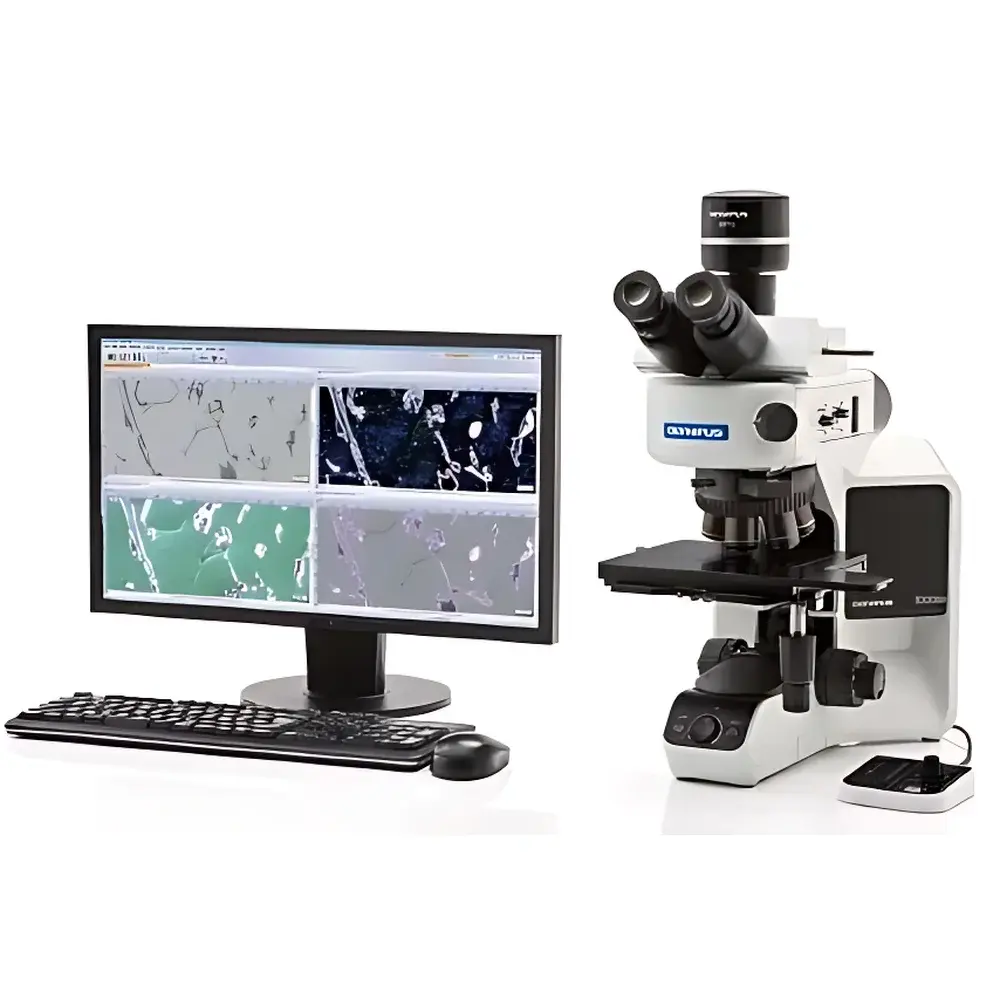
Olympus BX53M Upright Metallurgical Microscope
| Brand | Olympus |
|---|---|
| Origin | Japan |
| Manufacturer Type | Manufacturer |
| Origin Category | Imported |
| Model | BX53M |
| Pricing | Upon Request |
| Configuration | Upright |
| Integrated Imaging Analysis System | Yes |
| Total Magnification Range | 50×–1000× |
| Eyepieces | 10× |
| Objective Lenses | 5×–100× |
Overview
The Olympus BX53M Upright Metallurgical Microscope is a high-precision optical instrument engineered for quantitative microstructural analysis of polished, etched, or coated metallic and non-metallic specimens. Designed around Köhler illumination and infinity-corrected optical pathways, the BX53M delivers diffraction-limited resolution and chromatic fidelity across its full magnification range (50× to 1000×). Its upright configuration enables direct top-down observation of bulk samples—ideal for metallurgical laboratories performing ASTM E3, ISO 643, and USP particulate evaluation workflows. The system integrates seamlessly with Olympus Stream software, supporting GLP-compliant documentation, audit-trail-enabled image acquisition, and traceable measurement metadata generation—critical for quality control in aerospace, automotive, and additive manufacturing environments.
Key Features
- Modular optical platform with encoded nosepiece, focus mechanism, and filter turrets—enabling automatic parameter recall and reproducible setup across users and shifts.
- High-stability white LED illumination (6000 K color temperature) with intelligent light intensity management—ensuring consistent brightness and minimizing thermal drift during extended imaging sessions.
- Advanced contrast enhancement technologies: MIX (Multi-Illumination eXtended) for simultaneous brightfield/darkfield visualization, Extended Focal Image (EFI) for synthetic depth-of-field reconstruction, and High Dynamic Range (HDR) capture for balanced tonal rendering across reflective and shadowed specimen regions.
- Motorized XY stage with programmable coordinate mapping—supporting automated mosaic acquisition (MIA) and precise navigation across large-area samples such as weld cross-sections or heat-treated plates.
- Stream-compatible hardware calibration suite—including automatic objective lens recognition, stage position encoding, and real-time pixel-size calibration—ensuring metrological traceability per ISO/IEC 17025 requirements.
Sample Compatibility & Compliance
The BX53M accommodates specimens up to 76 mm in diameter and 30 mm in height, including metallographic mounts, ceramic substrates, semiconductor wafers, and composite laminates. Its rigid mechanical stage and vibration-damped base minimize parallax error during high-magnification inspection. All optical components meet JIS B 7153 standards for wavefront aberration control, while the LED illumination system complies with IEC 62471 photobiological safety Class 1 requirements. The microscope supports regulatory workflows under FDA 21 CFR Part 11 (when used with Stream software’s electronic signature and audit trail modules), ISO 9001 quality management systems, and ASTM E1558 guidelines for digital image-based grain size analysis.
Software & Data Management
Olympus Stream software serves as the central hub for acquisition, annotation, measurement, and reporting. It provides calibrated linear, area, and particle-count measurements with uncertainty estimation; supports multi-channel fluorescence overlay (when equipped with optional filter cubes); and exports data in CSV, TIFF, and PDF formats compliant with laboratory information management systems (LIMS). All image metadata—including objective ID, magnification, exposure time, stage coordinates, and user credentials—is embedded in EXIF headers and archived with timestamped audit logs. Optional Stream Premium modules enable automated ASTM E112 grain size classification, phase fraction quantification via threshold segmentation, and report generation with customizable templates aligned to internal SOPs or external standards.
Applications
- Quantitative metallography: grain size distribution analysis, inclusion rating (ASTM E45), phase identification, and carbide network assessment in steels and superalloys.
- Failure analysis: crack propagation mapping, fatigue striation measurement, and intergranular corrosion evaluation in turbine blades and pressure vessel materials.
- Coating and surface treatment verification: thickness uniformity of PVD/CVD layers, porosity analysis in thermal barrier coatings, and interface integrity in brazed joints.
- Quality assurance in additive manufacturing: pore morphology characterization, unmelted particle detection, and microstructure anisotropy assessment in Ti-6Al-4V and Inconel 718 builds.
- Research-grade microstructural correlation: correlative imaging with SEM-EDS datasets and digital twin model validation in computational materials science.
FAQ
What types of illumination modes does the BX53M support?
Brightfield, darkfield, differential interference contrast (DIC), polarized light, and MIX (combined brightfield/darkfield) are natively supported. Optional LED fluorescence modules extend capability to epifluorescence applications.
Is the BX53M compatible with third-party image analysis software?
Yes—the system outputs standard TIFF and JPEG files with embedded scale bars and metadata. While Stream provides native calibration and compliance features, exported images can be imported into MATLAB, ImageJ/Fiji, or commercial metrology platforms.
Can the BX53M be integrated into automated production line inspection?
With optional motorized Z-focus, stage control, and TTL-triggered camera synchronization, the BX53M supports semi-automated inline QC protocols when paired with custom PLC interfaces or machine vision middleware.
Does the BX53M require routine optical recalibration?
No—encoded hardware components retain calibration parameters across power cycles. However, annual verification of magnification accuracy and illumination uniformity is recommended per ISO/IEC 17025 accreditation requirements.
What maintenance intervals are recommended for long-term stability?
LED illumination requires no replacement (rated for >25,000 hours). Mechanical alignment checks are advised every 12 months; objective cleaning should follow ISO 10110-7 protocols using certified optical-grade solvents and lint-free wipes.



