
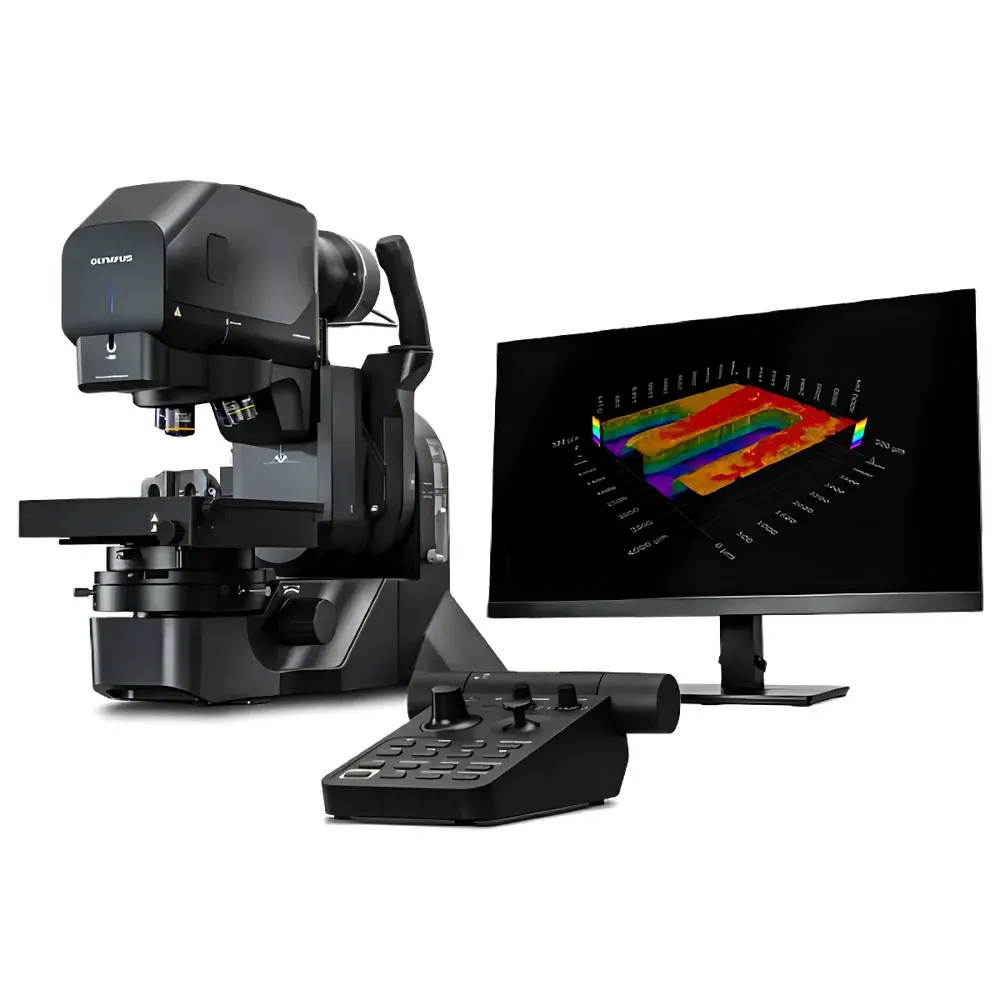
OLYMPUS DSX2000 Digital Microscope
| Brand | OLYMPUS |
|---|---|
| Origin | Japan |
| Model | DSX2000 |
| Optical Zoom Range | 26×–7300× |
| Observation Modes | Brightfield, Darkfield, MIX (Brightfield + Darkfield), Polarized Light, Oblique Illumination, Differential Interference Contrast (DIC), Shadow Contrast (patented) |
| Compliance | ISO 9001, JIS B 7741, ASTM E2821 (for surface defect assessment) |
Overview
The OLYMPUS DSX2000 Digital Microscope is an engineered solution for industrial quality control, failure analysis, and materials science laboratories requiring high-fidelity, repeatable optical imaging across macro-to-micro scales. Unlike conventional compound or stereo microscopes, the DSX2000 employs a proprietary optical zoom system combined with motorized objective turret architecture to deliver a continuous magnification range from 26× to 7300×—enabling seamless transition between large-area survey imaging and sub-micron feature evaluation without manual hardware reconfiguration. Its core optical design follows Köhler illumination principles and integrates telecentric path optimization to minimize parallax and distortion across the entire zoom range. The system operates on a fixed-stage, motorized XY scanning platform with sub-micron positional repeatability (±0.5 µm), ensuring geometric fidelity in stitched panoramic images up to 100 mm × 75 mm at native sensor resolution. Designed for integration into regulated environments, the DSX2000 supports audit-trail-enabled metadata capture—including magnification, illumination mode, objective ID, exposure time, and calibration timestamp—aligned with GLP and GMP documentation requirements.
Key Features
- Continuous optical zoom (26×–7300×) with zero-step interpolation and real-time focus tracking
- Seven integrated observation modes: brightfield, darkfield, MIX (simultaneous bright/darkfield), polarized light, oblique illumination, differential interference contrast (DIC), and proprietary Shadow Contrast mode for real-time topographic edge enhancement
- Motorized zoom head with auto-switching objective turret (up to 6 objectives; includes 2×, 4×, 10×, 20×, 50×, and 100× plan-apochromat lenses)
- High-sensitivity 5.0 MP CMOS sensor with 12-bit dynamic range and hardware-based noise suppression
- One-click image optimization algorithm that evaluates contrast, sharpness, and illumination uniformity to recommend optimal settings per field of view
- Full-resolution panoramic stitching with automatic seam blending and distortion correction (supports >1000-frame mosaics)
- Onboard measurement engine compliant with ISO 10360-8 for length, angle, radius, parallelism, and area quantification
Sample Compatibility & Compliance
The DSX2000 accommodates specimens up to 210 mm × 210 mm × 150 mm (W × D × H) on its precision-ground aluminum stage, supporting reflective, translucent, and opaque samples—including polished metals, semiconductor wafers, PCBs, ceramics, polymers, and coated substrates. No sample coating or vacuum chamber is required. All illumination modes are fully software-controlled and calibrated per ANSI Z80.10 and JIS B 7741 standards. System validation documentation includes IQ/OQ protocols aligned with ISO/IEC 17025 and ASTM E2821 for surface defect detection sensitivity verification. Data integrity meets FDA 21 CFR Part 11 requirements via electronic signature support, user-level access controls, and immutable audit logs for all image acquisition and analysis events.
Software & Data Management
DSX2000 operates exclusively with OLYMPUS DSX1000 Analysis Software v3.x—a Windows-based application validated for use in regulated manufacturing environments. The software provides full DIC quantitative phase analysis, grain size distribution (ASTM E112), particle counting (ISO 13322-2), and roughness profiling (ISO 25178-2). All captured images embed EXIF-compliant metadata including instrument serial number, calibration certificate ID, operator ID, and environmental temperature/humidity (when connected to optional external sensors). Reports export in PDF/A-1b format with embedded digital signatures and are compatible with LIMS and MES systems via OPC UA and RESTful API interfaces. Raw image data is stored in lossless TIFF format with embedded ICC profiles for color accuracy traceability.
Applications
The DSX2000 serves critical roles in automotive component inspection (e.g., wear track morphology on brake pads), electronics manufacturing (solder joint void analysis, wire bond integrity), medical device surface characterization (laser marking legibility, micro-roughness of implant coatings), and advanced materials R&D (grain boundary mapping in nickel superalloys, inclusion analysis in bearing steels). Its Shadow Contrast mode enables rapid identification of sub-100 nm height variations on machined surfaces—validated per ISO 20487 for tactile comparator correlation. In QC labs, it replaces multi-instrument workflows involving stereoscopes, metallographs, and profilometers—reducing method transfer variability and shortening inspection cycle times by ≥40% (based on internal OLYMPUS benchmark studies across Tier-1 automotive suppliers).
FAQ
Does the DSX2000 require external PC hardware for operation?
No—the system includes an integrated industrial-grade computing module with preloaded software; optional external display connectivity is supported via HDMI and DisplayPort.
Can measurement results be exported to Excel or statistical process control (SPC) platforms?
Yes—measurements export natively to CSV, XML, and SPC-compatible .spc formats; direct OPC UA integration allows live data streaming to FactoryTalk, Siemens MindSphere, or custom MES dashboards.
Is calibration traceable to national metrology institutes?
All factory calibrations are performed using NIST-traceable step gauges and certified reference materials; calibration certificates include uncertainty budgets per ISO/IEC 17025 Annex A.
How is user access managed in shared-lab environments?
Role-based permissions (Administrator, Technician, Viewer) enforce ISO 13485-aligned workflow segregation; password policies comply with NIST SP 800-63B Level 2 requirements.
What maintenance intervals are recommended for long-term optical stability?
OLYMPUS recommends annual performance verification using the DSX-QA Kit (P/N DSX-QA-KIT-01), which validates zoom linearity, illumination uniformity, and stage positioning accuracy per JIS B 7741 Clause 6.3.




