
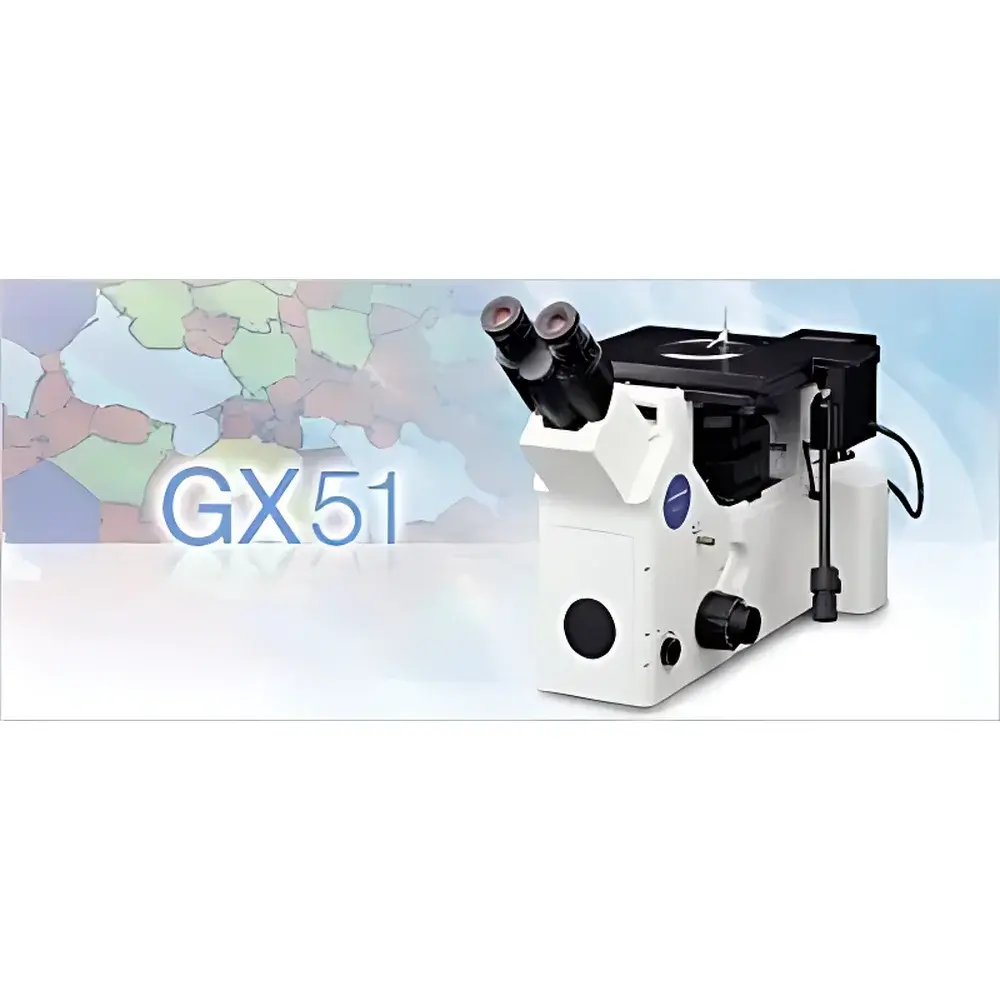
OLYMPUS GX51 Inverted Metallurgical Microscope
| Brand | OLYMPUS |
|---|---|
| Origin | Japan |
| Model | GX51 |
| Optical System | UIS2 Infinity-Corrected |
| Observation Modes | Brightfield, Darkfield, Differential Interference Contrast (DIC), Simple Polarization |
| Illumination | Reflected (100 W Halogen / 100 W Mercury / 75 W Xenon) & Transmitted (100 W Halogen) |
| Focus Mechanism | Manual Coarse/Fine Focus (9 mm Travel, 0.1 mm/rev Fine Adjustment) |
| Objective Turret | Motorized 5- or 6-Position (BF/DIC or BF/DF/DIC Configurations) |
| Stage | Mechanical X-Y Translation (50 × 50 mm) |
| Eyepiece Field Number | 18, 20, 22, or 26.5 |
| Camera Ports | Front Port (Inverted Image), Optional Side Port (Upright Image, GX-SPU Intermediate Tube) |
| Compliance | Designed for ASTM E3, ISO 4497, ISO 643, and USP <1059> metallurgical sample evaluation environments |
Overview
The OLYMPUS GX51 is an inverted metallurgical microscope engineered for high-precision microstructural analysis of opaque, polished, and etched metallic and ceramic specimens. Its UIS2 infinity-corrected optical system delivers diffraction-limited resolution, chromatic fidelity, and wavefront accuracy across all observation modes — brightfield (BF), darkfield (DF), differential interference contrast (DIC), and simple polarization (POL). Unlike upright configurations, the inverted design positions the objective lenses beneath the specimen stage, enabling stable, vibration-resistant imaging of large, heavy, or thermally sensitive samples — including castings, welds, heat-treated alloys, and additive-manufactured components — without requiring top-side access. The system supports both reflected-light (epi-illumination) and optional transmitted-light observation via rear-mounted illumination modules, extending utility to semi-transparent inclusions, powders, and thin-sectioned composites.
Key Features
- Multi-modal optical flexibility: Single-turret integration of BF, DF, DIC, and POL objectives with ergonomic side-mounted lever for instantaneous BF/DF switching — eliminating mechanical reconfiguration delays.
- Motorized modular architecture: Optional motorized objective turrets (5- or 6-position), motorized filter wheels, and programmable focus control enable repeatable, protocol-driven workflows compliant with GLP/GMP documentation requirements.
- UIS2 objective ecosystem: Broad selection of plan-apochromatic (MPLAPON), plan semi-apochromatic (MPLFLN series), long-working-distance (LMPLFLN), and LCD-optimized (LCPLFLN-LCD) objectives — all corrected for field flatness, axial color, and transmittance uniformity across visible and near-UV spectra.
- Ergonomic human-machine interface: Low-height stage design, adjustable inclination binocular/trinocular tubes (FN 18–26.5), and front/side camera ports (GX-SPU) support seated operation and seamless integration with digital imaging systems.
- Dual illumination pathways: Reflected illumination options include 100 W halogen (broad-spectrum white light), 100 W mercury (high-intensity UV/blue excitation), and 75 W xenon (continuous spectrum for quantitative colorimetry); transmitted illumination uses 100 W halogen for inclusion analysis per ASTM E45 and ISO 4497.
Sample Compatibility & Compliance
The GX51 accommodates specimens up to 150 mm in diameter and 50 mm in height, with standard 50 × 50 mm mechanical XY stage travel. Its rigid, low-center-of-gravity chassis minimizes thermal drift and mechanical hysteresis during extended dwell-time inspections. The system meets critical standards for metallurgical quality assurance: ASTM E3 (preparation of metallographic specimens), ASTM E112 (grain size determination), ISO 643 (steel microstructure classification), ISO 4497 (powder metallurgy characterization), and USP (microscopic evaluation of pharmaceutical metals and particulates). When paired with Olympus cellSens software and FDA 21 CFR Part 11-compliant audit trail modules, the platform satisfies regulated QA/QC environments requiring electronic record integrity, user authentication, and version-controlled measurement protocols.
Software & Data Management
The GX51 interfaces natively with Olympus cellSens digital imaging software — a fully licensed, modular application suite supporting automated measurement, statistical reporting, and standardized compliance output. Preconfigured application modules include Extended Depth of Field (EDF) reconstruction, grain boundary tracing (ASTM E112), phase fraction quantification (ISO 13075), inclusion rating (ASTM E45), and hardness indentation mapping (ISO 6507). All measurements generate traceable metadata — timestamp, objective ID, magnification, illumination mode, calibration status — embedded in TIFF or OME-TIFF files. Export formats include PDF reports conforming to ISO/IEC 17025 technical records, Excel-ready datasets, and XML-based structured data for LIMS integration. Remote control via USB or Ethernet enables centralized fleet management in multi-station laboratories.
Applications
The GX51 serves as a primary analytical instrument in foundries, aerospace component suppliers, nuclear materials testing labs, and R&D centers conducting failure analysis, coating adhesion assessment, sintering density evaluation, and additive manufacturing microstructure validation. Its DIC capability resolves sub-micron topographic gradients in corrosion pits and fatigue cracks; polarization mode identifies birefringent phases (e.g., martensite vs. retained austenite in steels); darkfield reveals porosity and second-phase particles below the resolution limit of brightfield. In semiconductor packaging, the long-working-distance LMPLFLN-BD objectives inspect solder joint integrity and intermetallic compound formation without contact. For academic metallurgy programs, its modularity supports pedagogical progression from basic grain sizing to advanced crystallographic contrast analysis.
FAQ
What illumination sources are compatible with the GX51’s reflected-light path?
The system supports interchangeable 100 W halogen (for general brightfield), 100 W mercury (for high-contrast fluorescence or UV-enhanced etch delineation), and 75 W xenon (for spectrally continuous illumination required in colorimetric reflectance studies).
Can the GX51 be configured for fully automated, unattended operation?
Yes — when equipped with motorized turret, motorized filter wheel, Z-axis focus drive, and cellSens automation scripting, the GX51 executes predefined multi-location, multi-mode acquisition sequences with stage positioning repeatability ≤ ±1 µm.
Is the UIS2 optical system suitable for quantitative image analysis?
Yes — the UIS2 design guarantees telecentricity, minimal field curvature (<0.03% distortion at FN22), and calibrated magnification linearity (±0.25%) across all magnifications, satisfying ISO 10934-1 requirements for metrological microscopy.
Does Olympus provide validation documentation for regulated industries?
Olympus offers IQ/OQ documentation packages, including photometric uniformity maps, magnification verification certificates, and DIC shear calibration reports — all traceable to NIST standards and aligned with FDA 21 CFR Part 11 and EU Annex 11 expectations.
What camera interfaces are supported beyond the front port?
In addition to the standard front C-mount port (inverted image), the GX51 accepts lateral imaging via the GX-SPU side intermediate tube (upright image), enabling simultaneous eyepiece observation and orthogonal camera capture for stereoscopic correlation or dual-wavelength registration.




